

An exhibition at the National Museum of Saudi Arabia in Riyadh celebrates pioneering contemporary Saudi artists whose practices shaped the foundations of the Kingdom’s modern visual culture.
There is a particular intimacy looking back at beginnings, where history is encountered not as a fixed narrative but as a constellation of gestures, experiments and aspirations. Bedayat: Beginnings of the Saudi Art Movement traces the emergence of the Saudi movement from the 1960s through to the 1980s, situating art within a period of profound social, educational and institutional transformation in Saudi Arabia. Across more than 150 artworks and archival materials by over 70 artists, the exhibition reveals a moment of becoming – when artists, working alongside the gradual consolidation of modern Saudi art, absorbed influences and articulated new visual languages. Developed through long-term research initiatives led by the Visual Arts Commission, Bedayat is shaped by a sustained effort to document this formative period, positioning it not as a distant origin but as an enduring point of reference for contemporary practice.
The exhibition is structured across three sections and opens with The Foundation of the Modern Art Movement in Saudi Arabia, featuring archival materials and artworks that contextualise the gradual integration of art in Saudi Arabia. While the Kingdom’s early education system was officially established by the 1930s, drawing and art practices began to enter curricula in the 1940s, expanding significantly by the late 1950s, when arts education was introduced across all levels of schooling. Teacher training programmes were organised to support this shift, enabling art instruction at primary and secondary levels. Among the archival highlights are Saudi artist Mounirah Al Mosly’s 1967 graduation project and a recommendation letter, which exemplify the growing formalisation of arts education and the emergence of a new generation of trained artists during this transformative period. Curator Qaswara Hafez notes that the archival materials were the most challenging part of this exhibition: “Many people are protective of the archival materials more than the artworks, especially artists”.
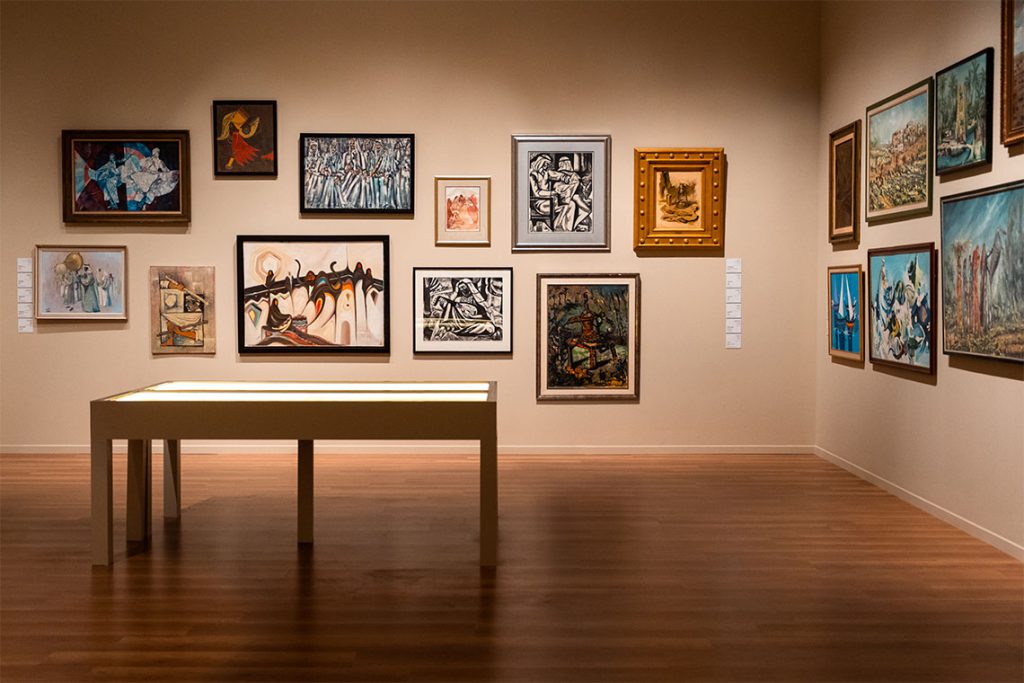
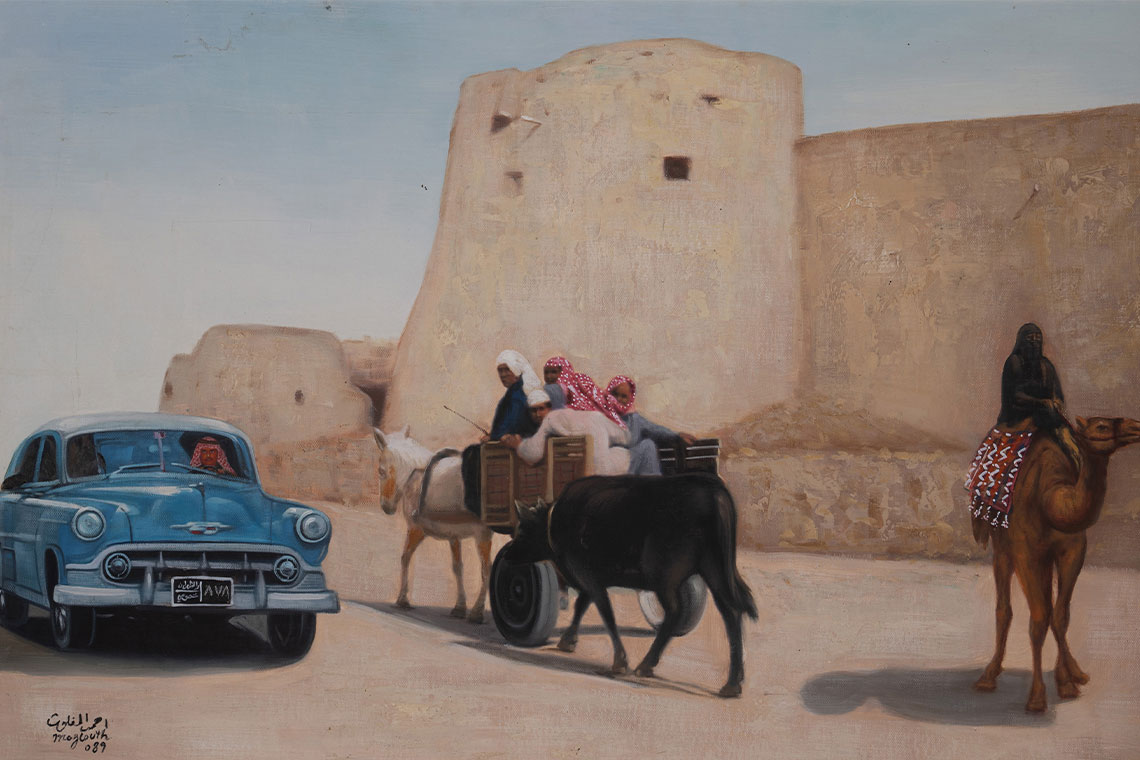
The second section, entitled Currents of Modernity, presents works through four thematic parts: Nature and Landscapes, Social life, Portraiture and Dreams and Symbols. In the first of these, artworks demonstrate how artists approached geography as both inheritance and enquiry. Social Life turns outward, chronicling the shared everyday encounters that anchor collective identity amid accelerating transformation. This tension is vividly articulated in Ahmad Almaghlouth’s Passing by the Sahoud Palace (1989), which captures a moment in transition, as if a snapshot of time briefly frozen. A car, cart and camel share the same road, suggesting that modernisation is layered onto tradition rather than replacing it. Although not positioned at the centre of the artwork, a woman maintains a calm and confident presence, remaining grounded while quietly asserting her place within this evolving landscape. Also noteworthy for its innovation is Kamal Amulaem’s Triptych (1994), a three-piece mixed-media work on canvas where the lower portion is left deliberately exposed, revealing a metal mesh and three-dimensional extensions of horses’ hooves that almost seem to leap off the surface. Thin wires trace along the vibrant streaks of colours, guiding the eye. The horses themselves appear caught in a fleeting instant of intense motion.
Moving through Currents of Modernity, maroon walls envelop the space. In Portraiture, artists depict themselves, their families and even their lovers, employing a variety of techniques and styles. These approaches challenge the assumption that portraiture was absent in more conservative contexts, showing that artists engaged with the genre in creative and culturally significant forms. The following part, Dreams and Symbols, immerses the viewer in the artists’ personal and imaginative realms, through abstraction and surrealism. These works bring to life dreamlike landscapes and symbolic visions, offering glimpses into the inner thoughts and emotions of their creators, as seen in Abdulhamid Albaqshi’s The Loud Silence (1983).
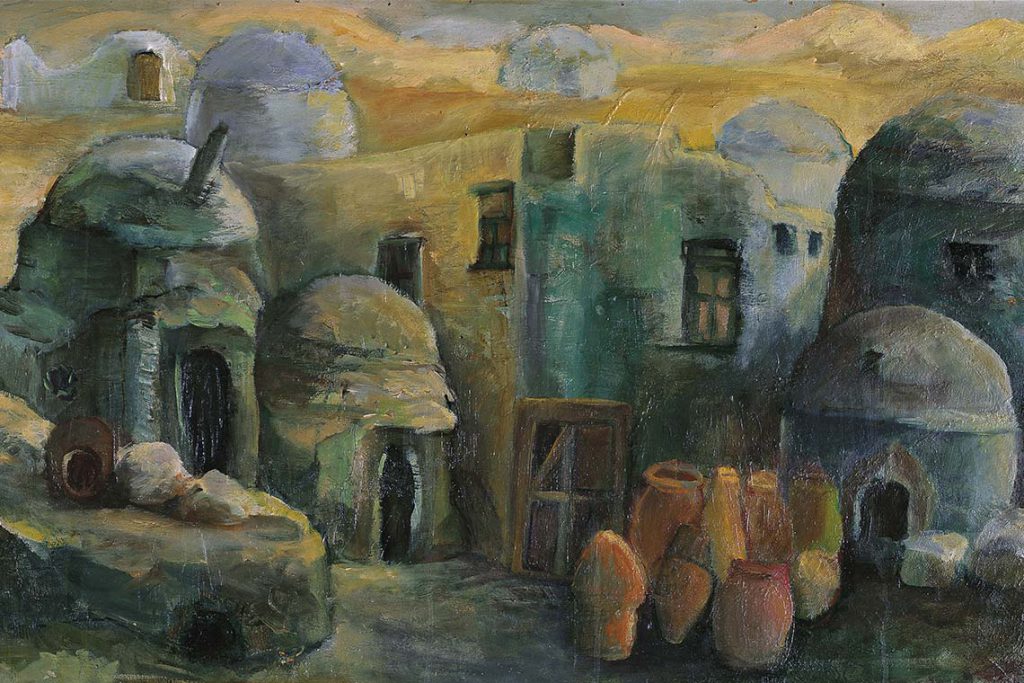
The third and final section of the exhibition is Modernist Pioneers, which celebrates four trailblazing artists whose careers played a defining role in shaping the Saudi art scene and continue to influence the successor generations: Safiya Binzagr, Mohammed AlSaleem, Abdulhalim Radwi and Mounirah Mosly. An exhibition held by Binzagr and Mosly at the Dar Al-Tarbiya girls’ school in Jeddah in 1968 marked the first public presentation of women artists in the Kingdom. Rajaa Moumena, Mosly’s niece and the founder and general manager of the Future Institute of Higher Education & Training in Jeddah, shared how “[Mosly] used to involve us in so many projects in the city”, capturing the generosity, mentorship and enduring spirit that defined her aunt’s character. This section not only honours the individual contributions of these pioneers but also underscores the courage and vision of a generation that laid the foundations for modern Saudi art.
Perhaps the most intimate moments in the exhibition come when artists who contributed to the modern movement stand in quiet contemplation before their works, encountering them again after years apart , while the families of artists who have passed gather before the creations of their loved ones. Some pause in quiet reflection, others take photos that hold personal significance, capturing a memory that reconnects them to the past. In that suspended moment, looking at the works becomes an act of recognition, a delicate merging of history, creativity and shared experience. These fleeting gestures remind us of the origins from which the legacy of Saudi modernism continues to flow.
Bedayat: Beginnings of the Saudi Art Movement runs until 11 April
