

The Canvas team invites you to discover a selection of exhibitions from around the world to check out in February.
THE MISSION IS THE END, THE END IS ALL I WANT! at FACT
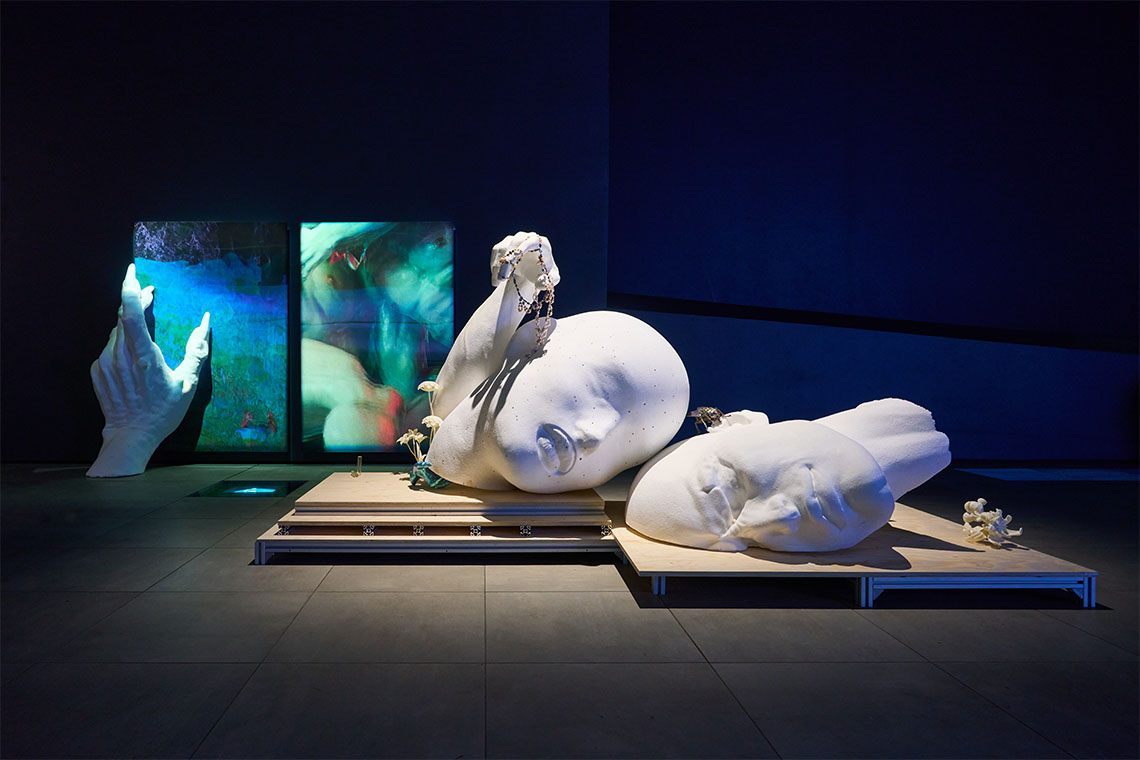
Bassam Issa Al-Sabah’s exhibitionat FACT in Liverpool is an immersive installation comprising sculpture, digital animation and film that explores the existence of repeated cycles and motifs that influence how we encounter the world around us. Here, Al-Sabah draws us into a world of questions, as we follow a group of characters in a film which heavily references computer games and world-building as they navigate the difficult choice of accepting the status quo, taking action to change their circumstances, or striking out on their own. The variables of the world he creates are fully immersive, though carefully measured. Around the space, damaged sculptures sit, as if victims of a collision amongst them, prompting visitors to reflect upon the mechanics of force in an installation environment that gives the impression of caving in on itself as it brings one further into its fold.
THE MISSION IS THE END, THE END IS ALL I WANT! runs until 22 February
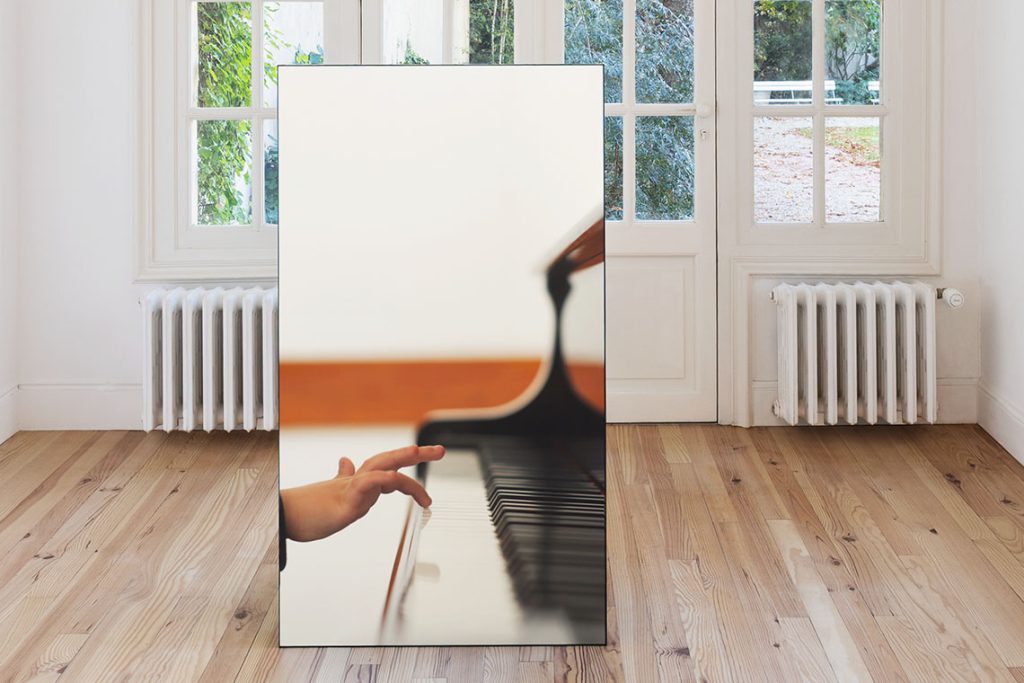
Image courtesy of the artist, Sfeir-Semler Gallery, and carlier I gebauer
Rituals of Perception at Tanoto Art Foundation
The inaugural exhibition of the Tanoto Art Foundation (TAF) unfolds across the New Bahru School Hall in Singapore and gathers over 20 artists presenting recent and commissioned work around the central theme of “presentiment”, meaning a sense of intuition that goes deeper than what the mind can rationally comprehend, as defined by philosopher Byung-Chul Han. Participating artists, including Ali Cherri, Tarik Kiswanson, Shuvinai Ashoona, Tsang Kin-Wah and Wang Ye, among others, use materials such as clay, cement, paper or fibre as vehicles through which to express memories and histories, thus encouraging visitors to rethink their ideas of perception itself. The exhibition demands a renewed focus on an intuitive way of encountering the world through materials that one innately recognises, urging a disconnection from the current urge to move at a fast and performative pace.
Rituals of Perception runs until 1 March
Produced by Chisenhale Gallery. Image courtesy of the artist
A Bug’s Life at Chisenhale
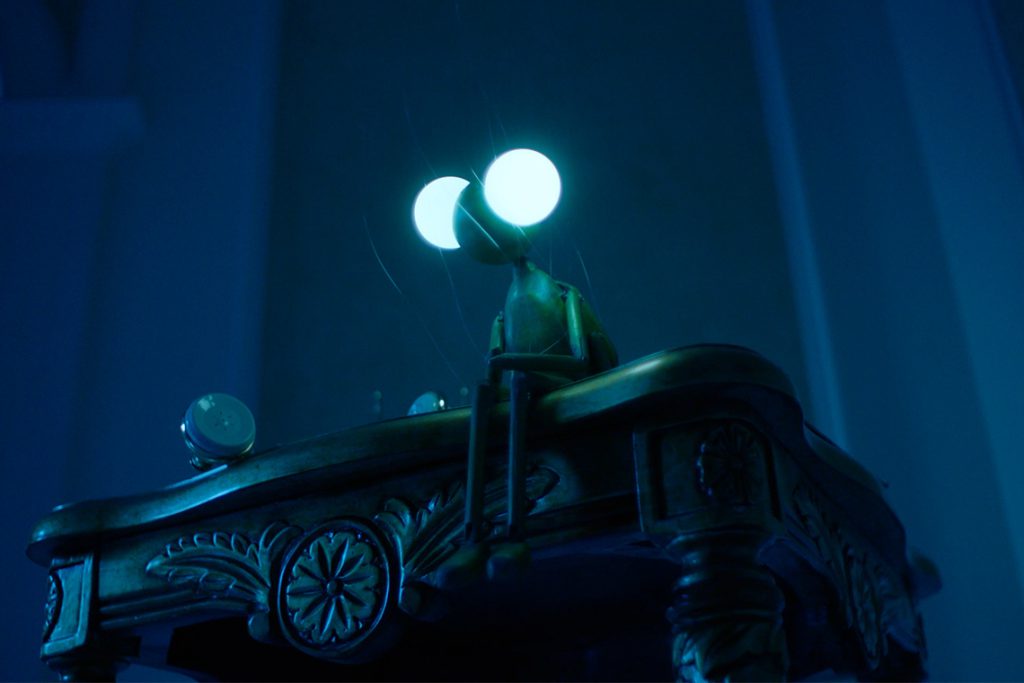
Arash Nassiri’s A Bug’s Life at Chisenhale marks the artist’s first institutional solo exhibition. Showcasing a commissioned film, A Bug’s Life, and a sculptural installation, the exhibition ponders how histories are either vanished or perpetuated. The film follows a wooden puppet shaped like an insect around a mansion in Beverly Hills, dating from the 1980s and built by Iranian immigrants, the last remnant of a style of architecture popularised in the years after the Iranian Revolution in 1979. The puppet discovers hidden signs of life in the home, with each encounter revealing how architectural design can embody aspirational lifestyles while reinforcing the social exclusion of the immigrant experience, demonstrating how both personal and broader histories intertwine in constructed environments.
A Bug’s Life Runs until 22 March
Arduna at Centre Pompidou in AlUla
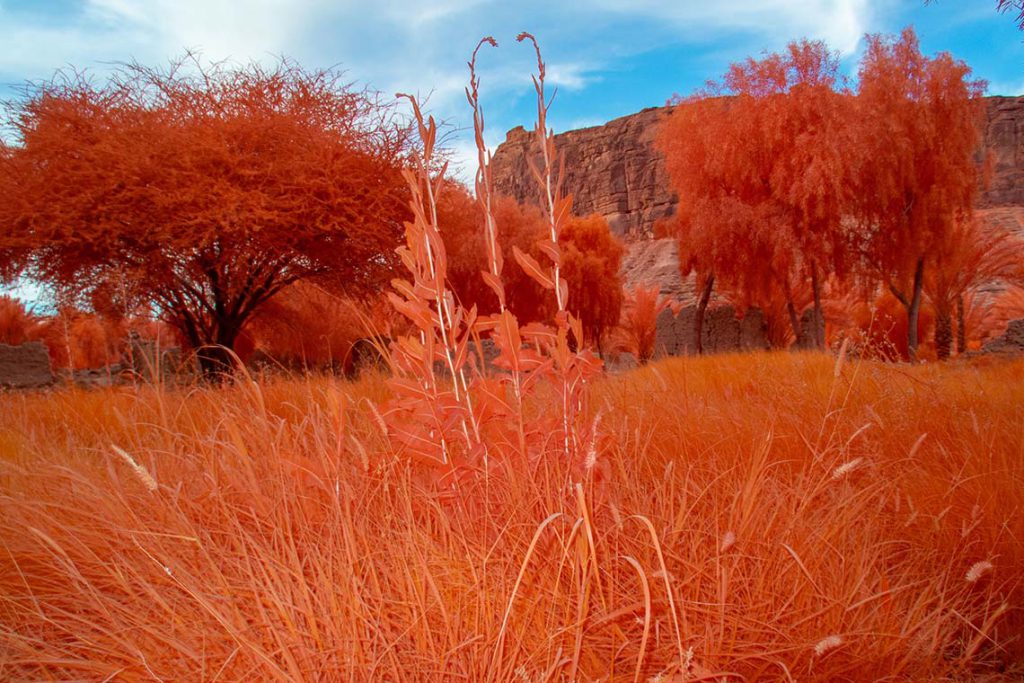
Taking place in AlUla and organised by the Centre Pompidou, Arduna (meaning “our land” in Arabic) gathers over 80 artists from Saudi Arabia, the wider MENA region and further afield to delve into the ways in which the natural world has been represented in modern and contemporary art. As part of the AlUla Arts Festival 2026, the exhibition unfolds over six chapters, with work in a variety of media by artists such as Samia Halaby, Etel Adnan, Imran Qureshi, Ayman Zedani, Manal AlDowayan and international artists including Joan Mitchell, David Hockney and Pablo Picasso. Arduna explores issues facing the natural world while examining the complex relationship of humans to their natural environment and urges us to imagine a future in which the lifeforms on planet Earth can coexist.
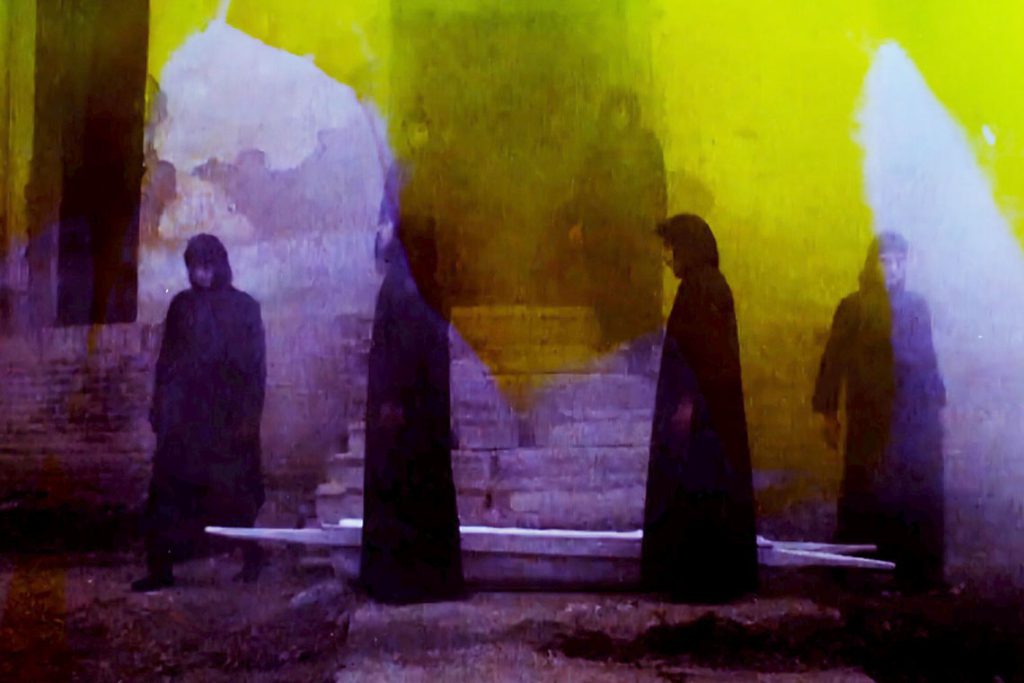
Daria’s Night Flowers at Project Arts Centre
Daria’s Night Flowers is a new film work by Maryam Tafakory, showcased at Project Art Centre in Dublin. In it, the artist combines moments of scripted narrative and found footage drawn from a broad archive of film in what ultimately serves as an essay in fractured parts in which Tafakory continues to investigate the lack of female representation in Iranian films after the 1979 revolution. Particularly focusing on how desire is portrayed in these films as well as on underlying themes of alternative lifestyles, the film serves to further Tafakory’s examination of censorship and the hidden aspects of society which are often expunged from overt narratives.
Daria’s Night Flowers runs until 18 April
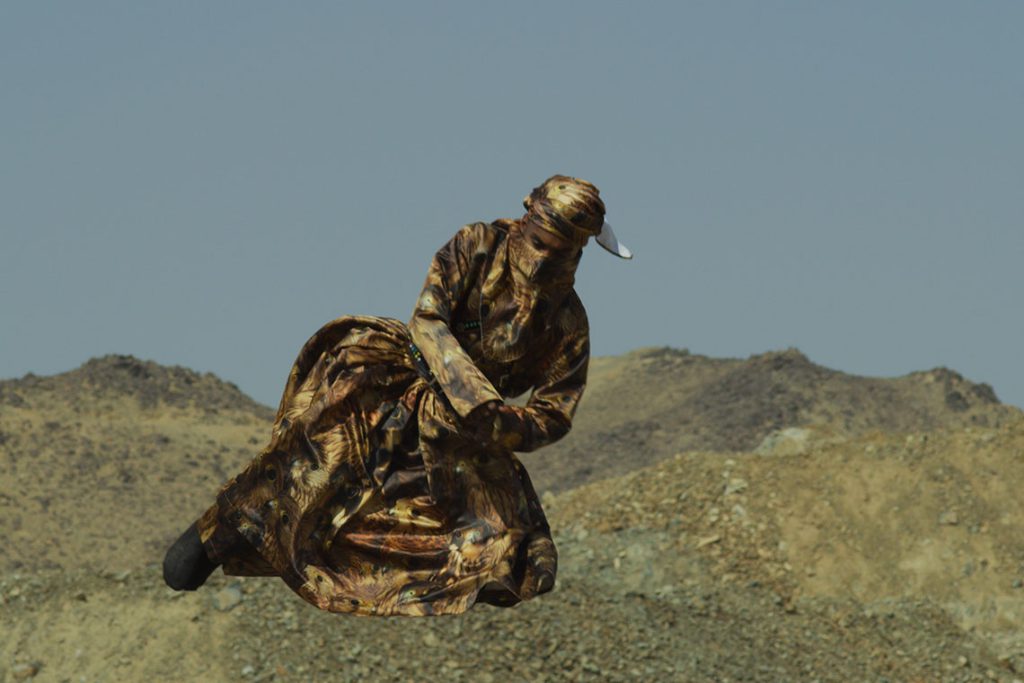
Sunkissed at Sharjah Art Foundation
Ahaad Alamoudi’s latest solo exhibition, Sunkissed, at Sharjah Art Foundation, brings together a selection of recent as well as commissioned work to look into the ways in which collective cultural identity overlaps with individual forms of expression in the wider MEAN region, particularly at a time of rapid social and cultural change. Alamoudi gives viewers a glimpse into how contemporary Khaleeji aesthetics are shaped while introducing humorous touches and demonstrating a broad knowledge of today’s pop culture. She ponders how, in a region increasingly set on the idea of development, self-expression and material adornment are in constant dialogue with a wider collective social expression. Beloved characters such as the talking falcon from What is This? crop up, as well as toy cars, insect light traps and viral memes, all as instruments of rapid change.
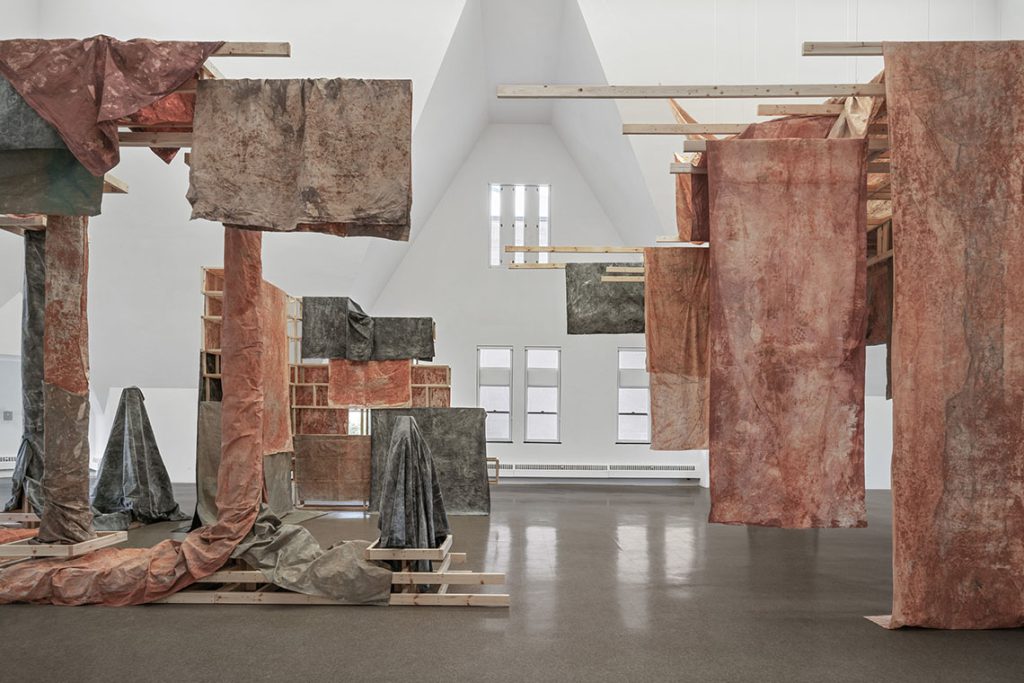
Image courtesy of the artist and Renaissance Society at the University of Chicago
Cemetery of Martyrs at Nottingham Contemporary
Cemetery of Martyrs is Dala Nasser’s first major institutional solo exhibition in the UK. Curated by Katie Simpson and Klara Szafrańska, the show transforms the gallery into a symbolic graveyard made up of a commissioned sculptural and sonic installation, as a site of remembrance and mourning in the face of the current violence worldwide. Key cultural figures from England, Lebanon, Egypt and Jordan, such as writers, poets, filmmakers, artists, historians and journalists from the mid-nineteenth century to the present day, are mourned here, with a focus on those from the Arab Renaissance, known as the Nahda. A series of charcoal rubbings from their graves lie alongside cyanotypes for those whose graves were not found, while the two gallery spaces are enveloped in a canopy made from sheaths of black mourning fabric.
Cemetery of Martyrs runs until 10 May
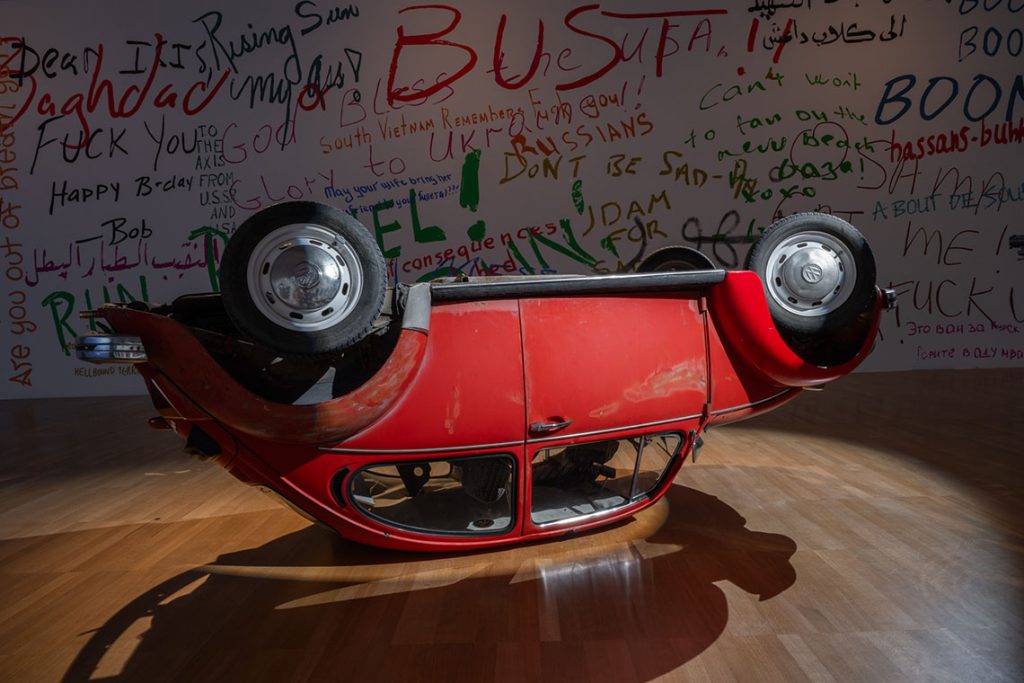
Photography by Urša Rahne, Moderna galerija Ljubljana
Festival of (In)Gratitude at MG+
Walid Raad’s Festival of (In)Gratitude at MG+ (Moderna galerija Ljubljana), curated by Zdenka Badovinac, gathers artworks from three of the Lebanese-American’s ongoing projects that investigate how the turbulence and trauma of violence and political upheaval, particularly as it pertains to the Middle East, can have lasting physical, psychological, cultural and even the architecture of spaces. Through The Atlas Group (1989–2004), Scratching on Things I Could Disavow, and Sweet Talk: Beirut (Commissions) as well as new works created in conversation with the material found in the archives of MG+ relating to Slovenia and post-Yugoslavia, Raad interrogates how history is formed and which narratives become dominant, as he creates his own forms of documentation and tales to narrate alternative pasts.
Festival of (In)Gratitude runs until 17 May
Photography by Gert Jan van Rooij
A land as big as her skin at Arnolfini
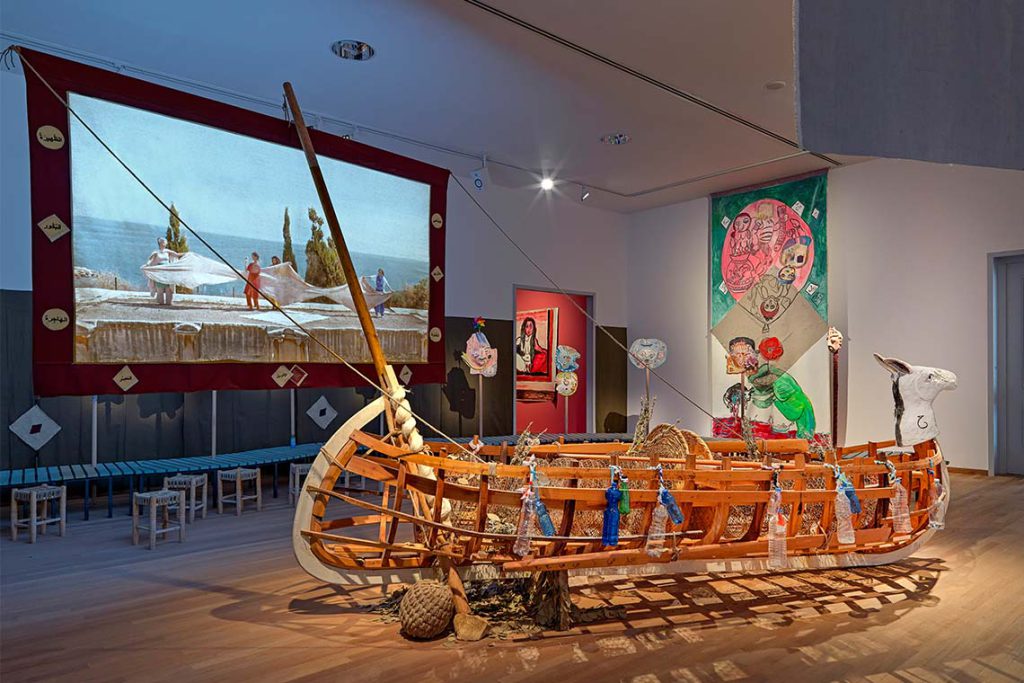
A land as big as her skin is the latest solo exhibition by Mounira Al Solh, which is currently on view at Bonnefanten in the Netherlands. Displayed at Arnolfini will be Al Solh’s multimedia installation from the Lebanese pavilion at the 2024 Venice Biennale, A Dance with her Myth, made up of masks, works on paper, paintings, film work and the life-size skeleton of a rowing boat. Also on view will are two recent works entitled Elissa’s Room and Europea’s Bedroom, as the exhibition invites viewers to discover the mythology of the Middle East through the story of Europa, a Phoenician princess and Greek god Zeus, before bringing them back to the present day as the fates of both Europa and Queen Elissa are looked at from a modern-day perspective.
A land as big as her skin runs until 24 May
The Storyteller and the Obedient Tide at Jameel Arts Centre
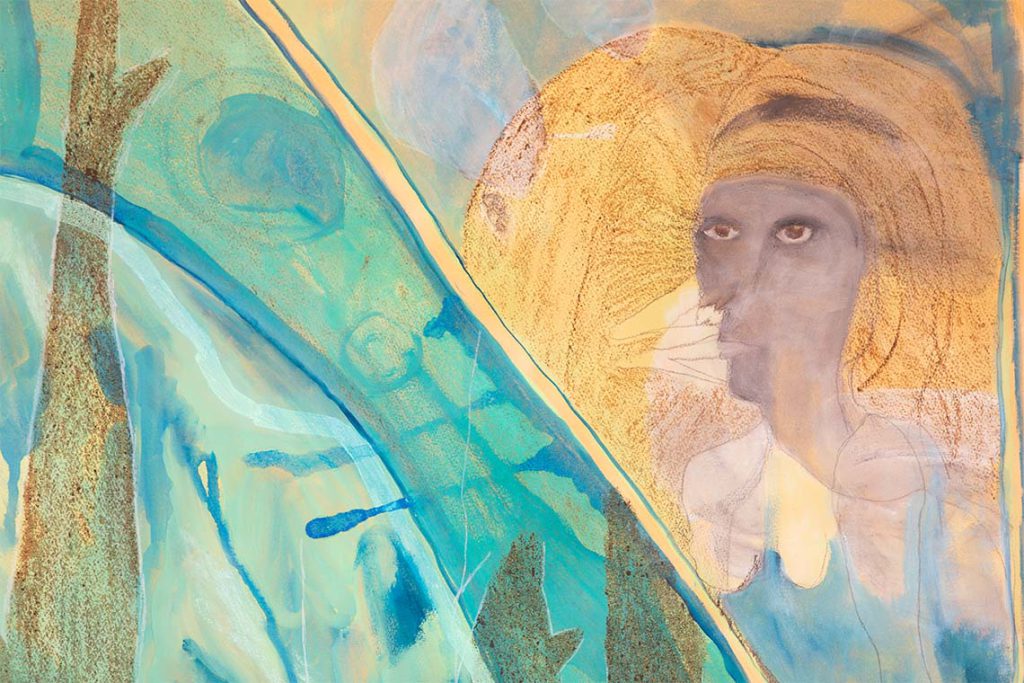
Jumana Emil Abboud’s first solo exhibition in the United Arab Emirates, The Storyteller and the Obedient Tide, maps out the enduring effect of Palestinian folktales, as the artist muses upon the ability of tales to alter both personal and collective memories and histories while also living on in the landscapes from which they were born. Curated by Indranjan Banerjee, the exhibition unfolds along two guiding subjects with the first being the set of five virtues, which Abboud terms labours, made up of Trust, Fortitude, Patience, Contentment and Self-denial as conceived by philosopher Ibn Zafar in the 12th century and the second subject the artists’ examination of the commonalities between Palestinian and Japanese folklore tales featuring fishermen. At a time of continued struggle for Palestinian freedom, the exhibition highlights the enduring power of storytelling, serving as a grounding force.
The Storyteller and the Obedient Tide runs until 28 June
© Mona Hatoum. Image courtesy of Galerie Chantal Crousel, Paris
Over, under and in between at Fondazione Prada
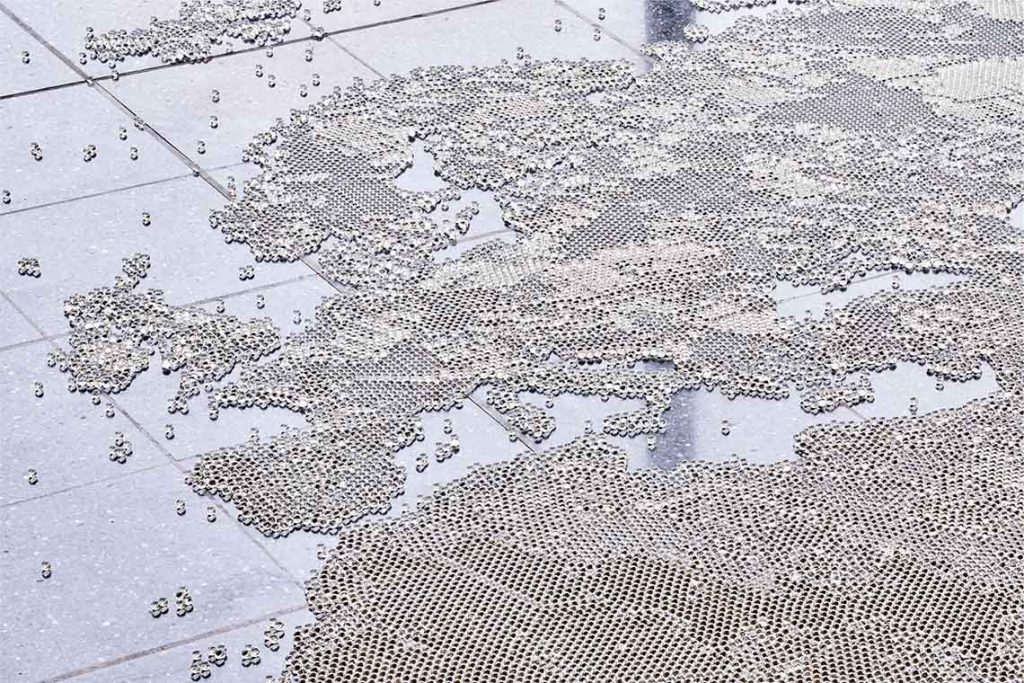
Mona Hatoum’s Over, under and in between takes the form of a site-specific installation in three parts that look into the web, the map and the grid as archetypes of the artist’s art practice. Hatoum’s artworks installed in the Cisterna building are experienced physically as well as being in dialogue with their surroundings, symbolising fragility, danger and precarity all at once. One installation is suspended in the entrance, a web of translucent hand-blown glass spheres hanging from the ceiling, while in the main room, over thirty thousand transparent red balls made of glass cover the concrete floor, arranged in the form of a map of the world with continents as the only borders. The final installation, entitled all of a quiver is a floor-based kinetic metallic sculpture made up of cubes, rising and falling to the sound of rattling and creaks.
