

At Dubai’s Carbon 12, artist Anahita Razmi investigates myths and traces the shifting histories and layered significances of the everyday.
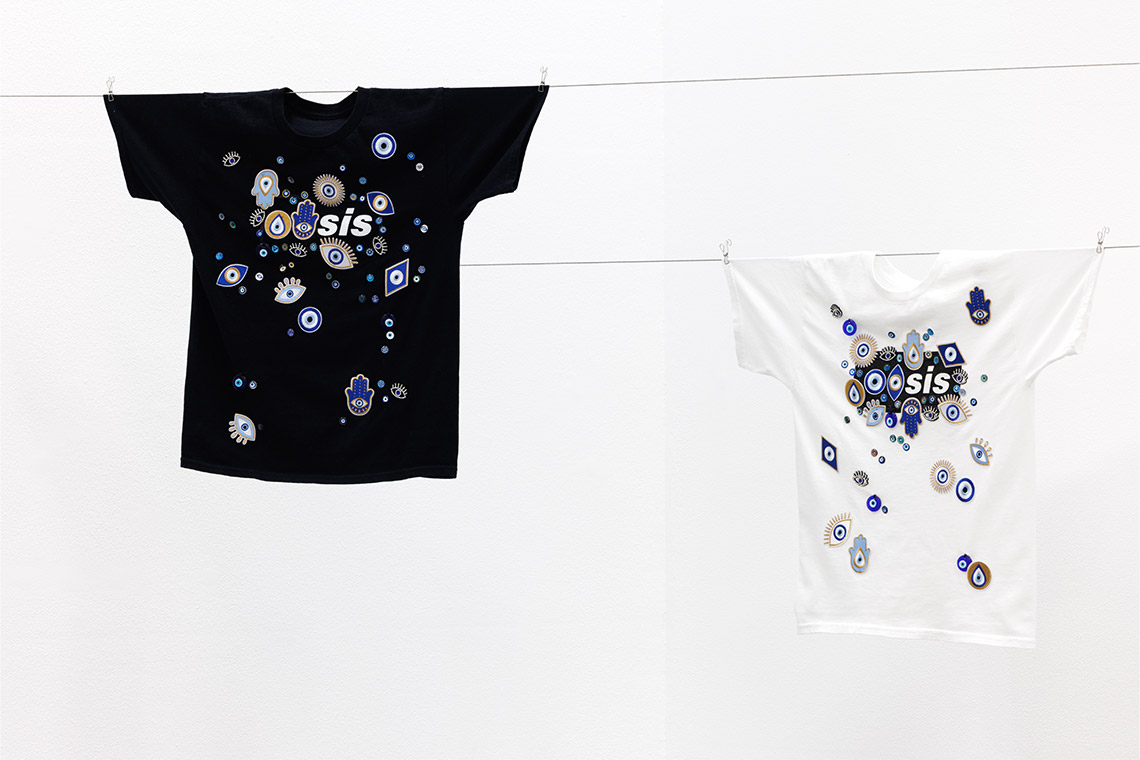
YES, BUT, NO, AND. Four small words, pinned like decisions that refuse to resolve. In her solo exhibition The Task of the Mythologist at Carbon 12, artist Anahita Razmi stages a field of suspended meaning, where objects hesitate between protection and branding. Installed along the left corner of the gallery, a pair of cotton T-shirts hang lightly, as if draped to dry, floating between presence and absence. Their surfaces are densely stitched with evil-eye motifs, transforming everyday garments into something closer to hand-crafted talismans than commercial apparel. The symbol is immediately recognisable – the Nazar Boncuğu, a traditional Turkish amulet placed at thresholds to ward off envy, jealousy and ill intent, normally meant to protect. Here, the motifs are multiplied and shown in various forms across fabric that simultaneously evokes domestic care and the impersonal logic of mass production. In OASIS #1 and OASIS #2 (both 2026), the displacement amplifies Razmi’s ongoing interrogation of significance – protection becomes pattern, rituals become ornament and cultural significance is refracted through both T-shirts, Razmi creates a tension between 1990s rock mythology and Eastern protective symbolism.
The title of the show, The Task of the Mythologist, is drawn from Roland Barthes’s 1957 book Mythologies, in which he examines how ideology disguises itself as common sense through the signs and images of everyday life. Barthes describes the mythologist’s role as exposing the structures hidden within what appears natural. Razmi revisits this premise without treating it as fixed doctrine. Rather than simply unveiling concealed messages, she stages symbols in states of transition, allowing their contradictions to surface.
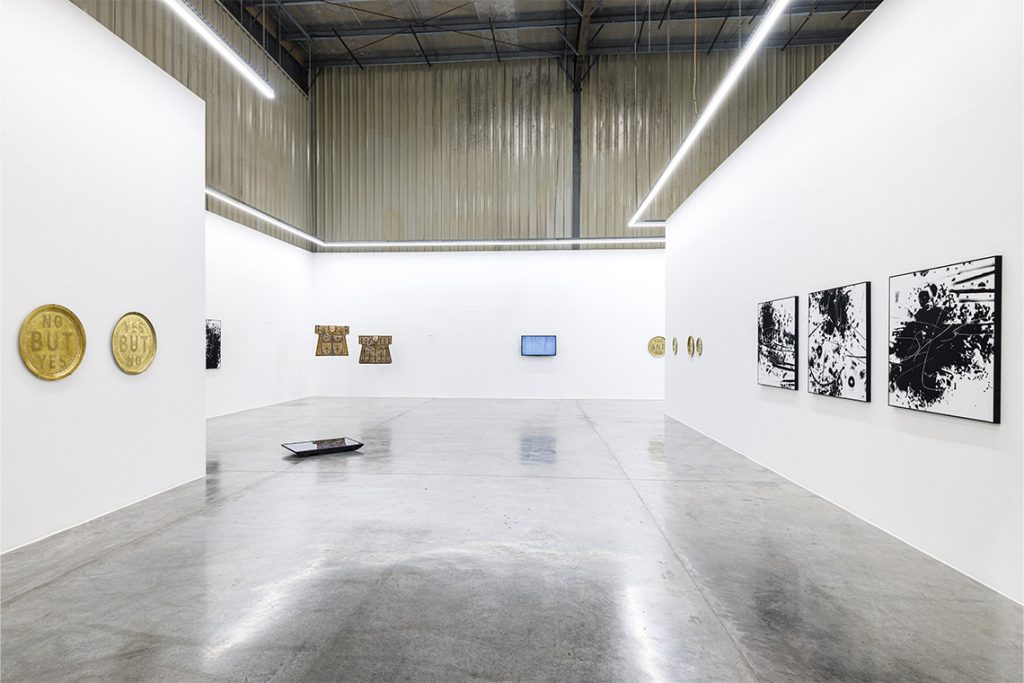
A TV screen placed on the ground presents a video installation entitled Flying Carpet (2015–25). The camera lingers at a low angle, looking toward a building entrance, where a carpet lifts and flutters, stirred presumably by an air vent beneath the floor. Passersby navigate the space, some pausing to study it, while others continue on, absorbed in their daily routines. The scene highlights what is often unnoticed. Razmi transforms the familiar into a subtle stage, where attention lingers and the everyday becomes uncanny. The placement of the installation on the ground subtly guides viewers through the space, shifting their gaze from floor to corner and leading toward suspended T-shirts, heightening the awareness of space and materiality. This attentive trajectory continues with two nearby brass plates, one engraved with “YES BUT NO” and the other “NO BUT YES”, mirroring each other and investigating the tension between craft and originality.
Alongside, two Islamic talismanic shirts are pinned in a similar way to the Oasis T-shirts, hung in the corner like fragments of ritual caught in a moment of stillness. The buttons reading “YES”, “BUT”, “NO” and “AND” cluster together like whispering voices, leaning into one another, murmuring and folding meaning among themselves. While earlier iterations of Razmi’s Talismanic Polarities series (2021–) paired these buttons with pop-cultural or political references, here the historic qualities of the shirts themselves are questioned, in terms of where they came from and the histories they carry. Their interpretations are fluid rather than fixed.
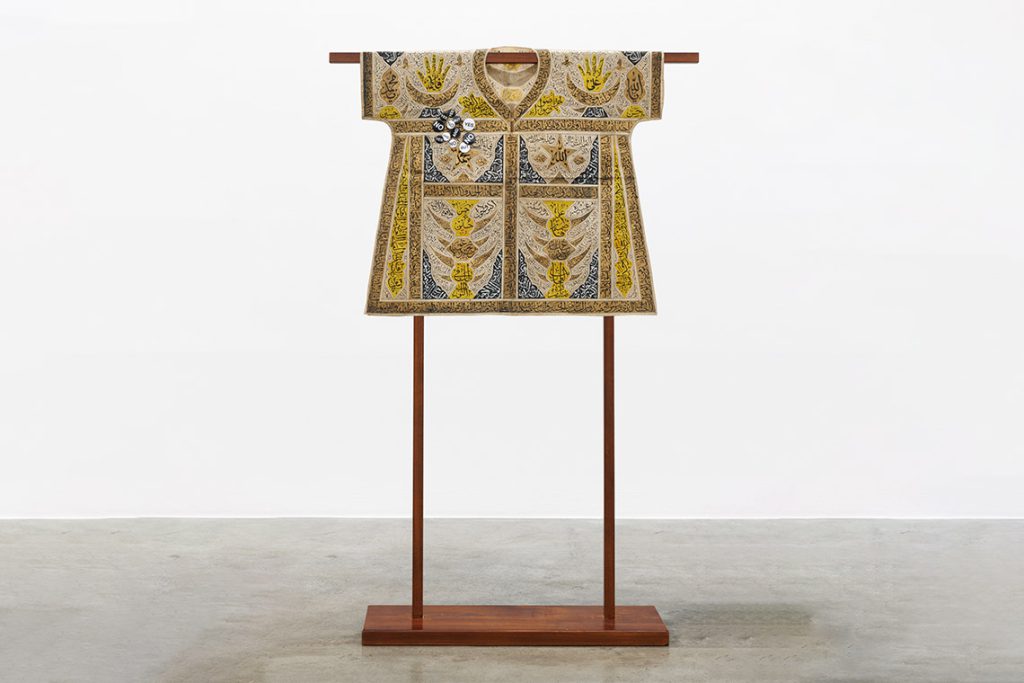
Nearby, a film presents digital renderings of Islamic talismanic shirts that appear distorted and fragmented like an optical illusion, recalling the way in which thoughts or memories process and recombine themselves. Some linguistic elements draw on Qur’anic phrasing, and while these reconfigurations are part of the artistic exploration, the engagements with sacred texts may be sensitive for some viewers. In this dialogue between physical and digital, textural and talismanic, there is an emphasis on incompleteness, uncertainty and openness. It complicates the notion of authenticity and presence. Fragmented and animated, they suggest that meaning is not fixed to materiality but circulates through perception and meditation.
Beyond the individual artworks, the exhibition functions as a choreography of hesitation. The instability feels particularly urgent within a cultural climate that increasingly rewards immediacy and fixed positions. Razmi instead foregrounds conjunctions such as ‘and’ and ‘but’, the small linguistic hinges that complicate certainty. These are not passive fillers but structural devices. They slow the rush toward conclusion and introduce friction into statements that might otherwise harden into authority. If mythology once operated by naturalising power, here myth is shown as something continuously assembled and reassembled. In this context, myth is not a relic of postwar mass culture but an ongoing process.
An intervention by artist Peyman Shafieezadeh showcases Black Square on a White Ground (2025), a collage made from ELLE magazines. The cut and assembled pieces form a three-dimensional square, questioning repetition and overconsumption while highlighting the reproduced elements of media and symbolising how it is digested and reinterpreted. Through accumulation and consumption, the work stages a visual field of saturation. Individual images dissolve into pattern, mirroring the relentless reproduction of media in contemporary culture.
In Task of the Mythologist, Razmi performs a kind of living mythology. Ordinary shirts, motifs and band logos become sites where histories, gendered codes and cultural values collide, overlap and mutate, revealing the subtle work of meditation that underpins how we assign meaning. If these symbols can be so easily reconfigured, how stable were the meanings we trusted in the first place?
This review first appeared in 122: Reshaping Time
The Task of the Mythologist runs until 29 March
