

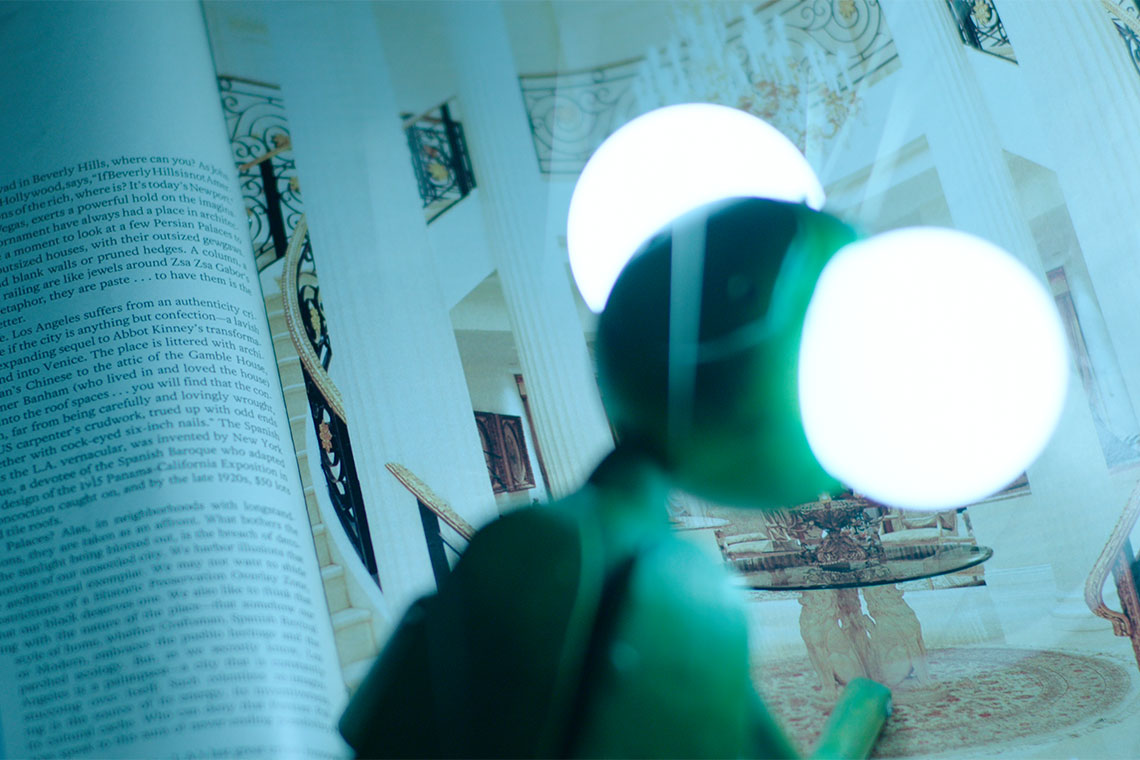
A moving-image and sculptural installation by Arash Nassiri at Chisenhale Gallery highlights the vagaries and uncertainties of working through allegory
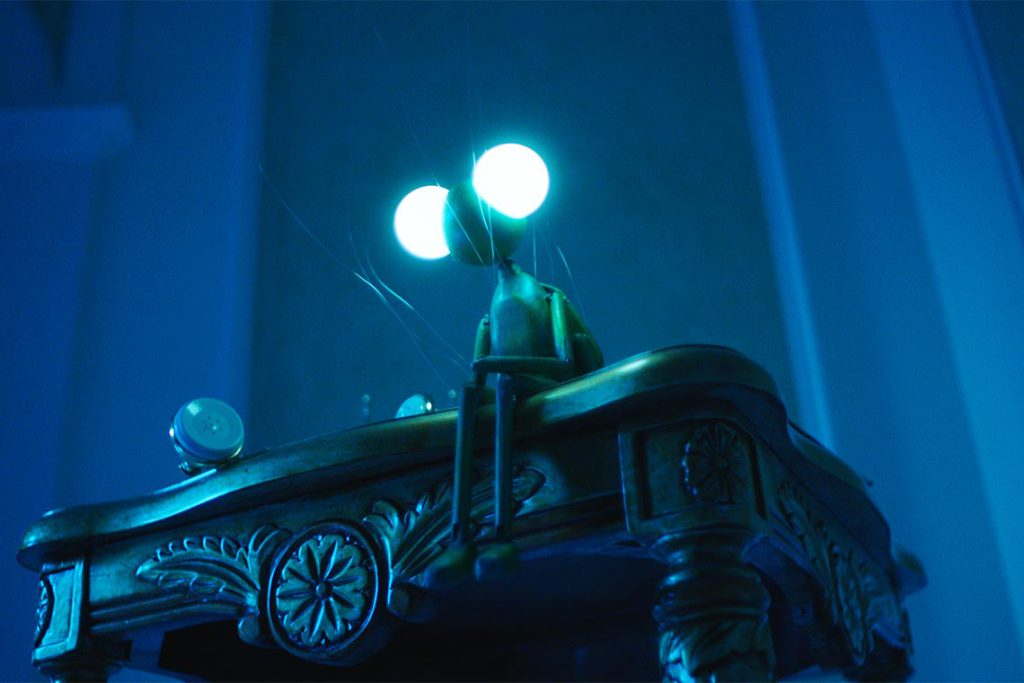
In A Bug’s Life, Arash Nassiri’s first institutional solo exhibition at Chisenhale Gallery in London, a puppet-bug walks across a floor and stops where a circular window casts moonlight. It is one of the few moments in the eponymous 21-minute film when the bug actually rests, staring through the window’s conical sliver of the Moon as if performing puppet-bug moon worship. Throughout, Nassiri plays with scale in subtle ways. The camera sits very low, near the floor in almost every scene, making the bug appear lifelike, even human-sized, yet its smallness is clear whenever it stands next to the hoof-like foot of a chair, a door handle or a countertop. Projected onto the box-like screen, the bug looks larger still. The smooth marble floors reinforce the effect. Everything is shot at night, illuminated primarily by the bug’s own eyes – two bulbs set in a body of worn brown wood.
A giant vase – the only recognisably man-made object – reaches almost to the lower edge of the circular window. With its white wall, adjacent rectangular pane and clear floor, the scene resembles a lunar base, an astronaut alone on the Moon. Here Nassiri’s ideas about scale find their sharpest contrast. The bug is tiny, both physically and in the human imagination, and yet it seems to draw energy from the Moon, something impossibly far away. This miscalibrated communion, the minuscule addressing the cosmic, quietly frames the film’s logic.
In another scene, the bug levitates from the floor onto a bathroom sink with a marble top. Using its stubby hands, it turns on the tap – not without trouble – and lets the water run, then closes the drain so that it builds into a pool. The bug sits on the rim, legs dangling, as you would at the edge of a swimming pool – a gesture of familiar domesticity that is charming, but also where Nassiri’s allegory communicates most strongly. The ease with which this alien puppet makes a pool for itself, sits in it, runs its feet through the water – a stranger breaking into one’s home to do this might seem disrespectful. Or is it simply that the bug is at peace, at home enough to dip its feet in water it has drawn?
Such domestic strangeness echoes a very real architectural history. The film’s allusions to alien life recall the perception of so-called Persian Palaces, an architectural phenomenon in Beverly Hills and elsewhere in Los Angeles, associated mainly with wealthy Iranian émigré families after the 1979 revolution. Architect Hamid Omrani, who appears in Nassiri’s film as consultant and guide, built hundreds of them. These homes fused American Modernist proportions with grandiose French-Rococo-inspired aesthetics, ornamental motifs that had circulated in Tehran since the eighteenth century, now transplanted to the West Coast of the USA and magnified through new wealth. The intention was to project belonging; the obstacle was a city that read this projection as excess. Neighbours complained, media sensationalised, and in 2004 the Beverly Hills Design Review Commission effectively banned the style by enforcing restrictions on ornamentation. Nassiri grasps the irony: the very performance of belonging inspired its rejection.
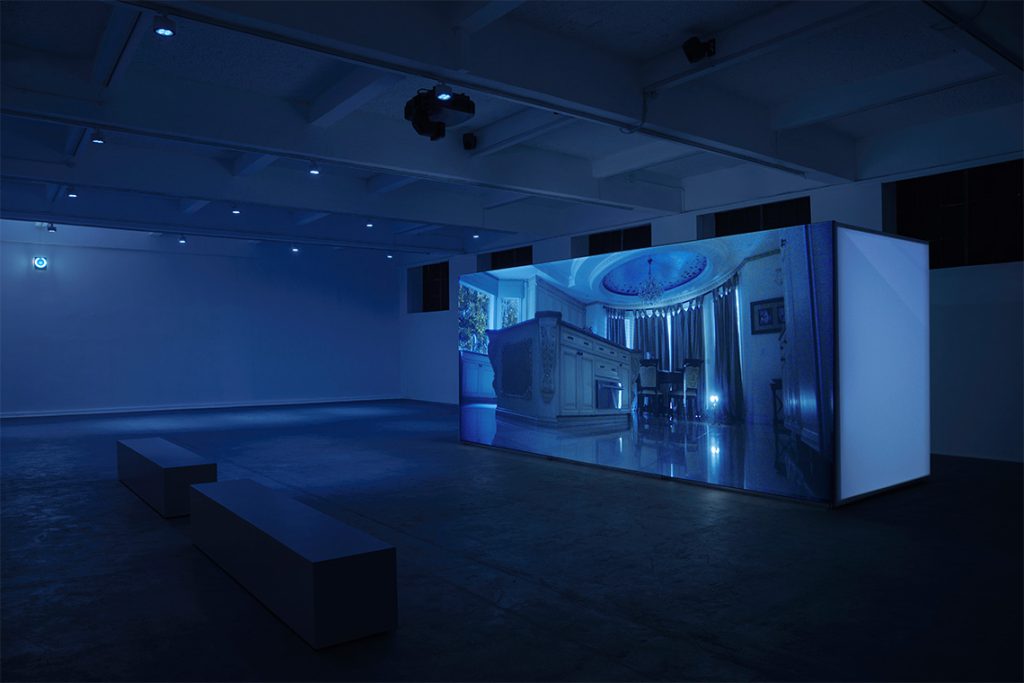
In the film’s last scene, we return to the circular window. It remains dim overall but warmly lit within – a soft glow in the otherwise shadowed mansion. Just before the resolution, the insect puppet appears awestruck by a light bulb. It reaches out to touch it. Immediately, its body parts disjoin and scatter across the floor. The wooden Pinocchio-like puppet suddenly shows raw emotion and the film ends on a note of fragility and finality. The light architecture continues into the gallery space. The room is dimly lit, with illumination coming mainly from the screen and from warm blue spotlights overhead. The mood of the film thus extends into the gallery, feeling like a continuation rather than a separation. While watching the work at Chisenhale, I saw a visitorwalk around the screen, move into a pool of light, and perform fluid dance movements under the spotlight. This lasted only a few moments. Later she explained it was not part of the exhibition: she had simply found the staging of light useful, a ready-made stage for choreography.
This persistent instability of meaning invites a theoretical frame when Nassiri approaches the mansion with what Walter Benjamin called an “allegorical attitude”. His camera adopts an “allegorical intention” and an “allegorical intuition”, treating objects not as décor but as fragments charged with hidden meaning. The film operates through allegory, yet it also courts allegorical overload and what Benjamin described as the inevitable instability of interpretation in The Origin of German Tragic Drama (1928). Why is this failure to stabilise allegory inevitable? Because almost every item seems to mean something, or not, and the viewer is never allowed to decide with certainty.
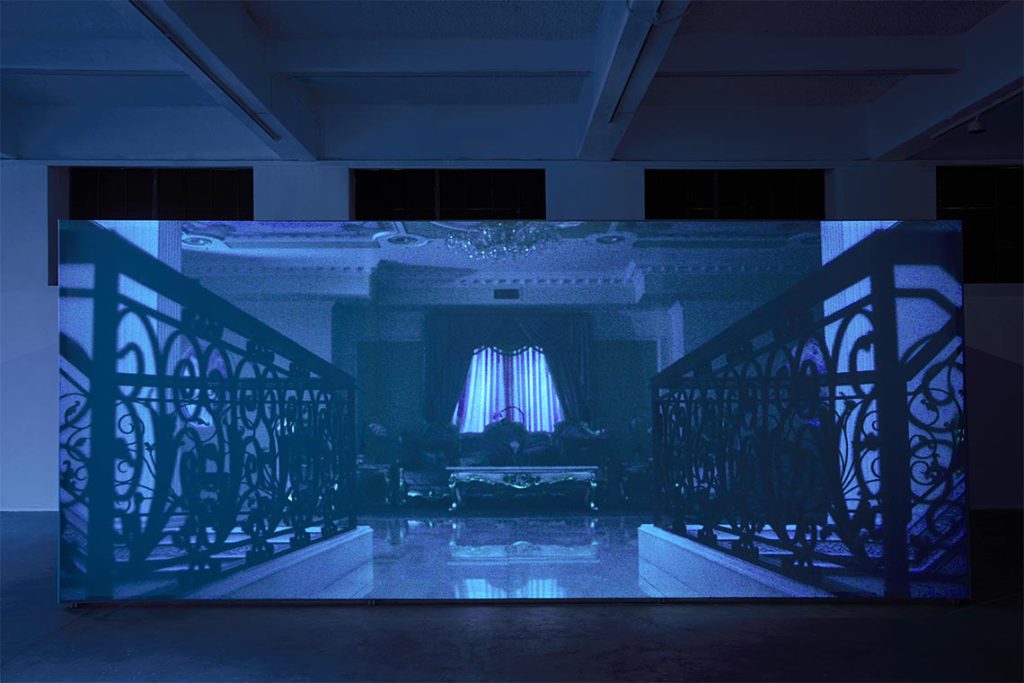
That instability returns in the film’s title and its brief grasshopper motif. There are two instances when a grasshopper appears. This relates to the title A Bug’s Life, pointing back to the 1998 Pixar movie of the same name and further back to ancient Aesop’s fable of the ant and the grasshopper. Nassiri’s allegory of the Persian palaces signals that ancient fable, yet nothing quite aligns. In the original story the grasshopper is lazy and the ant virtuous; in Pixar the division of good and evil is muddier. In Nassiri’s film the grasshopper appears only twice, briefly and without explanation. It seems to be there merely to announce the territory of allegory, yet it never fully performs that role. It does not settle anything. What this allegorical map does is create a false map. You are left deciding how far to reach, how much meaning to ascribe to every shot, every item, every thought.
Where does meaning go when every shot is, or might be, an allegory? It drifts from the image to the viewer, becoming provisional, hesitant and finally personal. Meaning in A Bug’s Life becomes a temporary condition: the bug can be read as immigrant, trespasser, artist, child or ghost, and none of these identities settle for long. Allegory, here, does not clarify experience but multiplies it. Interpretation becomes experiential, subjective and necessarily unstable.
