

The Taipei Fine Arts Museum’s latest exhibition proves that truly hearing requires effort beyond simply experiencing sound.
When my friend Renyu and I translated Astrida Neimanis’s Bodies of Water into Chinese, we could not find an adequate equivalent for the word ‘attunement’. What was missing was a word carrying the continuous labour of staying aware of whatever it is we attempt to attune to. So, I wondered whether I might find an answer at the Taipei Fine Arts Museum’s exhibition Attunement: Contemporary Politics between Mindscape and Soundscape.
The Chinese title for attunement turns out to be a single character read in two tones. One means melody; the other, to adjust. Quoting Heidegger and the Zhuangzi, guest curator Hsu Fang-Tze establishes a philosophical vision for a harmonic nature, inviting thirteen artists to examine contested narratives through sound. The first works that the audience sees are two classical Chinese landscape paintings by Yuan Jai, who worked for more than three decades as a conservator at the National Palace Museum. Her Shifting Hills (2000) depicts a landscape altered by the disastrous ‘921 earthquake’ that struck Taiwan in 1999. It can be read as tectonic sound, a sound experienced through the body, not necessarily through the ear.
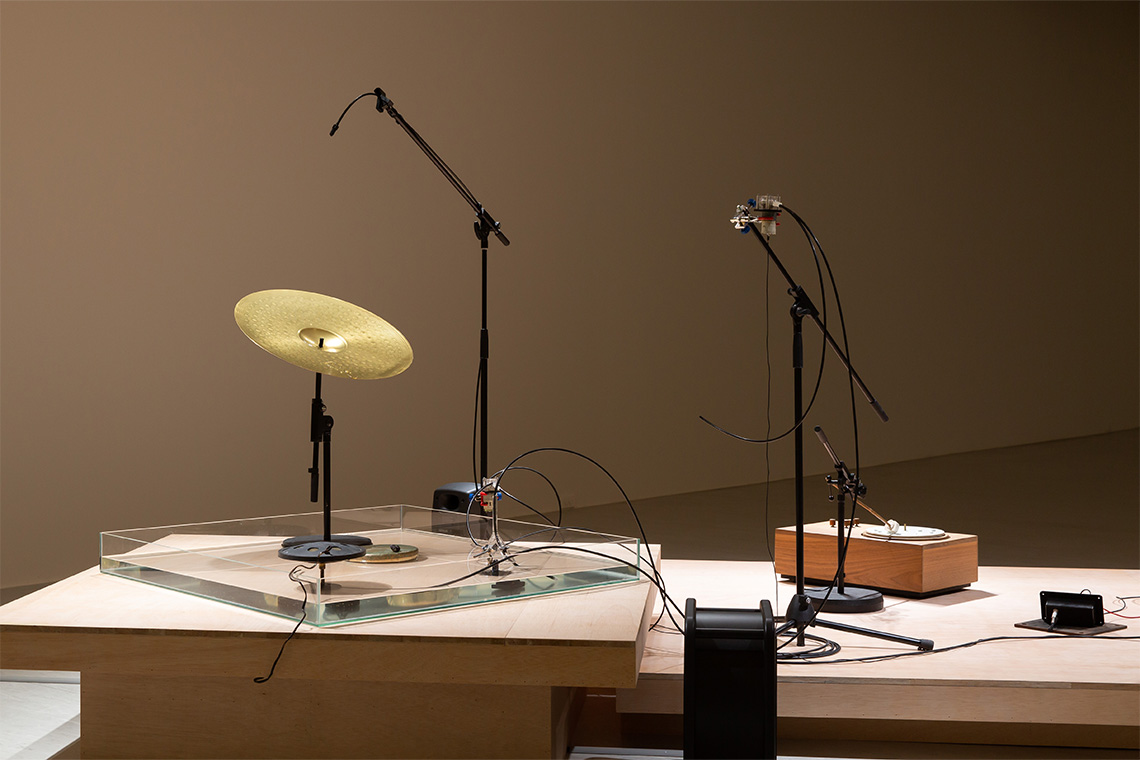
Next to the paintings, Tarek Atoui’s Pulses in 11 (2020) makes granular, subtle sounds easily submerged by ambient noise. He draws on the eleven-beat cycle in the Arab music tradition of the Tarab, building a self-circulating system driven by water drips, a sequence contingent on the water’s own rhythm rather than the artist’s control. It also demands the audience’s full attention and patience. I spent time with this piece, waiting for the moment of a drip falling. But most passersby did not wait for the entire 11 beats. They only noticed the loudest part of this installation, a hammering sound from a porcelain vinyl that Atoui made with his residency’s local artisans.
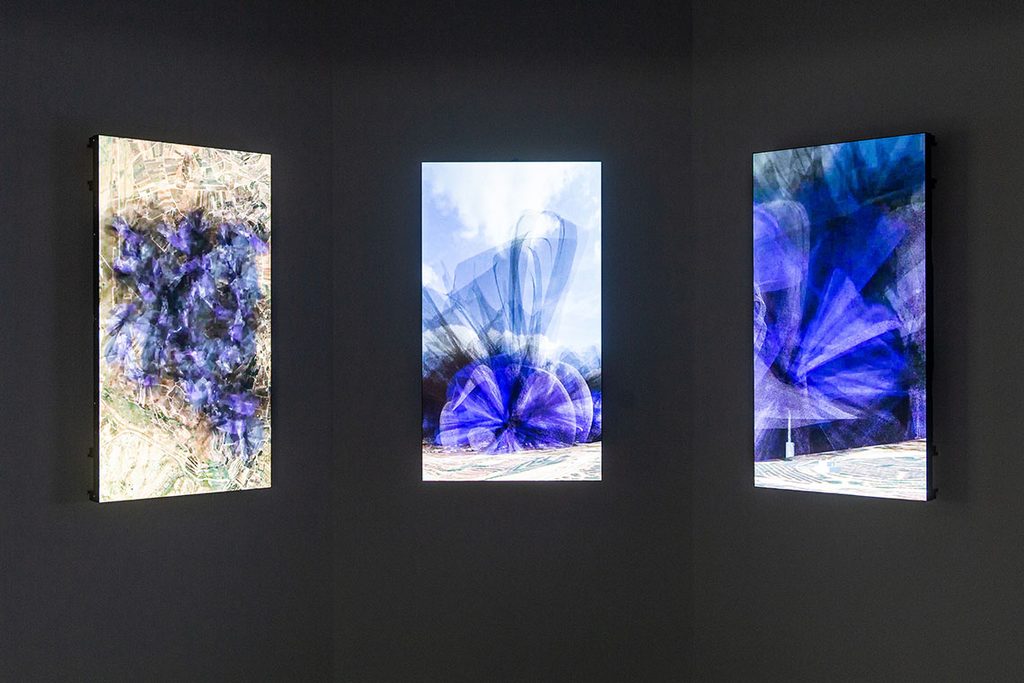
Nguyen Trinh Thi’s immersive video installation 47 Days, Sound-less (2024) stages a similar insistence on attention. The video installation opens without any image, with only birds chirping and insects buzzing. These ambient sounds are extracted from American and Vietnamese war films. Black-and-white documentary footage of Jrai and Ifugao communities and nature scenes from Apocalypse Now then sit on diagonally opposed screens. The audience can hardly watch both at once. What capitalism and colonial power ask us to attend to becomes background, while the neglected – forest sounds, Indigenous presence – becomes the subject.
Hajra Waheed’s video installation A Letter From My Sister, November 16, 2015 (2023) addresses violence from an intimate perspective. As the title suggests, the narrative is an exchange between siblings. However, it is also a deep reflection on the systemic violence that brutally harms those made into ‘the other’. The video shows ever-changing clouds and creates a peaceful atmosphere, echoing Hsu’s ambition of exploring “how atmospheric forces shape the contemporary world”.
Waheed makes the sky a witness and leaves the site of violence invisible. Lawrence Abu Hamdan does the opposite, visualising the landscapes where colonial violence occurred across three works. In Zifzafa: A Livestream Audio Essay (2025), he uses digital simulation to re-create the occupied Syrian Golan Heights, where Israel built wind turbines to carry out what he calls sonic annexation. The low-frequency noise drove out the Syrian Arab population. Still, some stay, staying with the kookh, a type of small shelter, where they keep their memories and dreams. Those emotions can be felt in Wind Ensemble (2024), where the Jawlani saxophonist Amr Madah plays on a balcony. The affective melody contrasts sharply with the cold visualisation of turbine noise in Tilting at Windmills (2024).
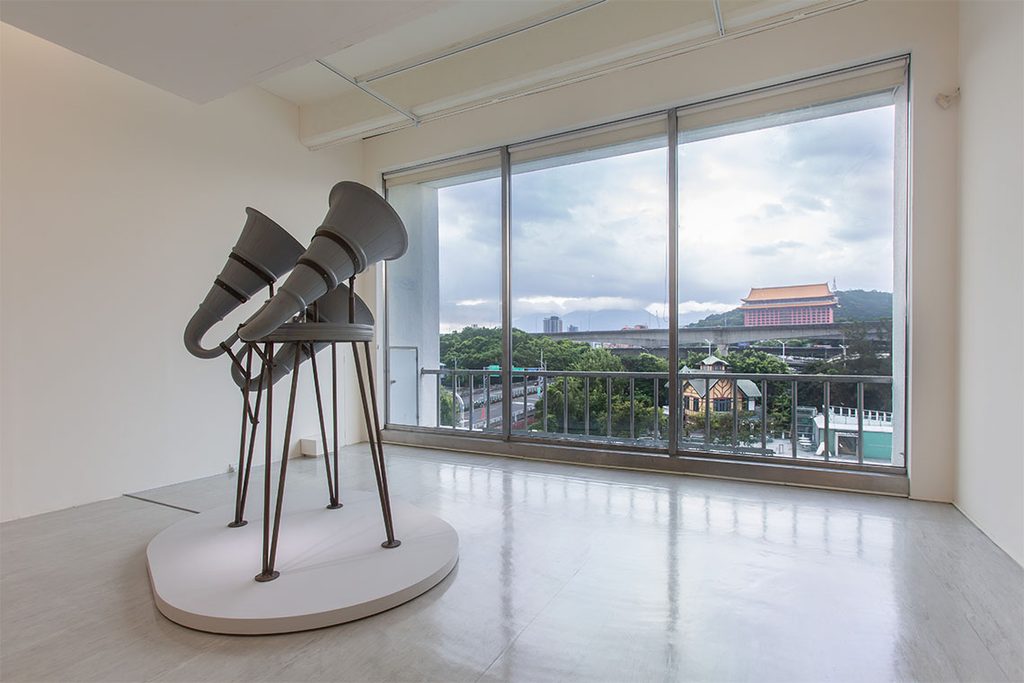
I could not help noticing a subtle curatorial decision in the installation. Two works with peculiar amplifiers occupy mirrored galleries looking out onto the Grand Hotel, whose golden roof and red pillars evoke imperial Chinese aesthetics strangely at odds with Taiwan’s current determination to unlink itself from Chinese influence. In Chen Ting-Jung’s You Are the Only One I Care About (whisper) (2018), a set of large amplifiers broadcasts Teresa Teng’s mellow ballad, once deployed as an affective weapon. Reena Saini Kallat’s Chorus I (2015–19) turns a pre-radar listening device into a player of birdsong unbound by borders. Against the same backdrop, in a reminder of how ideology is inserted into daily life through architecture, voices from a female singer and from the more-than-human inevitably slip beyond its control.
The soundscape of this exhibition is relatively quiet. Attunement, after all, is the adjusting rather than the tune. The most political trait of sound as a medium is that we cannot choose not to hear, if we find ourselves within the radius of its acoustic waves. Yet these works reveal that we hear, but not closely enough. To listen otherwise takes time and insistence. I waited beside Atoui’s work for a single drip, and still could not say whether I had heard the whole cycle. Perhaps this is the same uncertainty I once confronted: how we name the labour of sustained attention. I think of Abu Hamdan’s work, where the most cherished sound for the Jawlani residents proved to be nothing more than the hum of a water pump’s motor. It never stops. Neither do the turbines.
Attunement: Contemporary Politics between Mindscape and Soundscape runs until 27 September
