

Compared to some other Gulf countries, the art scene in Oman is less immediately vibrant and diverse. Yet it offers a range of perspectives, including hidden synergies and unexpected resonances with art from elsewhere.
I spent about eight months in Muscat over the course of a year, and during my stay I was eager to connect with local Omani artists and discover their inspirations and practices. Oman is artistically very different from Lebanon, where much of my own background in cultural communication was formed, and so my time there was both intriguing and eye-opening. During my visits to various exhibitions, I discovered a world of young artists whose works revealed a fascinating depth and originality. Some of their art carried a striking and almost unconscious connection to well-known international artists and cinema directors, despite their not being exposed to the references that their work resembled. This realisation is what inspired me to write this piece. I also wanted to shed light on the artistic milieu of these Omani artists, not only by comparing them to their Western and regional peers but also by exploring and appreciating their work on its own merits.
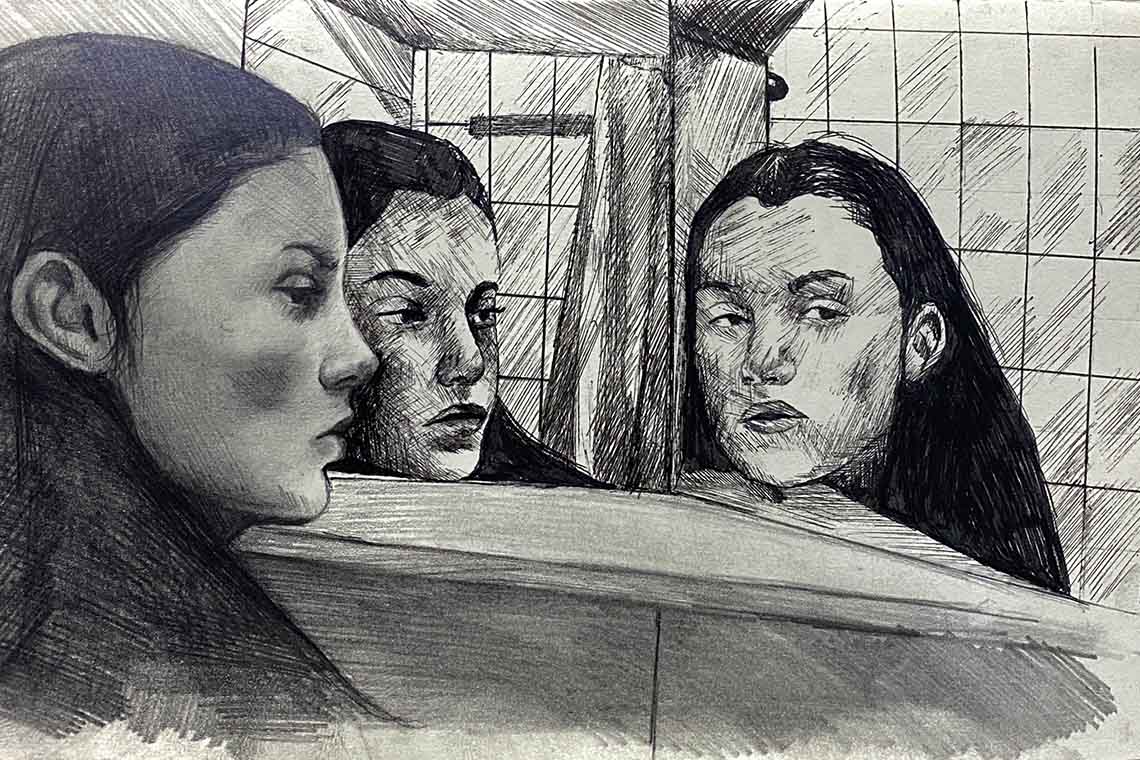
During my visit to the exhibition Art in Pages 2 by Makan Studios, where artists showcased their drawings in sketchbooks, I discovered the intriguing work of Issa Saif Alnayari, who had drawn a series of black-and-white portraits that immediately reminded me of a scene from an Ingmar Bergman film. When I reached out to him on Instagram, I learned he had not heard of Bergman. Yet the composition, ambiance, reflections and proportions of his drawing felt to me like a storyboard straight out of one of Bergman’s films. When I asked Issa about his work, he replied: “The context of my work explores the multiple facets of a single person and how our perception of them changes depending on the perspective from which we view them”. His work resonates deeply with Bergman’s 1966 film Persona, particularly in its exploration of identity and perception.
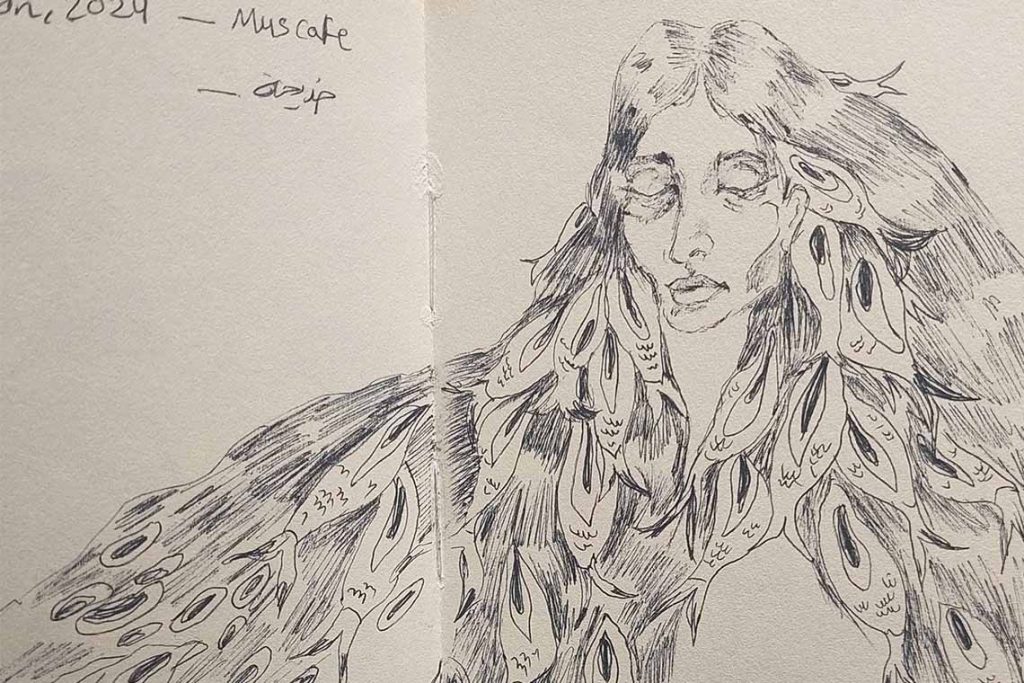
Also showing in Art in Pages 2 was one of my favourite Omani artists, Ruqaiya Mazar, who draws enigmatic, strange figures that are often inspired by her heritage. Deeply rooted in personal reflection and her country’s layered histories, her art reminds me of the surreal, fantastical and deeply symbolic imagery of Hieronymus Bosch’s epic masterpieces. “Every page of my sketchbook was a record of moments – things I saw, emotions I felt and even stories I imagined,” she explained to me. “But one particular drawing was different, it carried the soul of a place… the spirit of Jibreen Castle. I sat within its walls, in the inner rooms and on the rooftops, observing, sensing and listening to the echoes of those who lived there before me. The story that touched me the most was that of Imam Bil’arab bin Sultan Al-Yarubi, of his immense love and jealousy for his wife, his attempts to keep her hidden from the eyes of others, and how love can be both a force and a constraint at the same time.”
While Mazar’s work remains deeply Omani in essence, it unknowingly taps into a universal artistic language: one that Bosch, centuries ago, also used to explore human nature, emotion and transcendence. I was particularly struck by her depiction of floating fish, which parallel the creatures in Bosch’s own world. “The fish I drew were thoughts, words, things once trapped in the mind, but in this moment, they were freed, swimming in space – without restrictions, without surveillance… just floating,” she explained.
Another artist who caught my attention was Hafsa Al Tamimi, who was showing at Stal Gallery. Her dreamy, fauvist, colourful and fantastical drawings with floating figurants reminded me of the paintings of Marc Chagall. When I showed her some images of his paintings, she agreed on the resemblance but confirmed that she had not encountered his work before. Chagall’s figures often defy gravity in weightless intimacy, much like Al Tamimi’s representations of women suspended in space. Both artists imbue their work with a sense of nostalgia and an almost spiritual connection between their subjects. I asked Hafsa about her work, Ray of Joy (2025). “The light in this work signifies hope, shining as a beacon of optimism,” she explained. “The inspiration comes from the shared stories of mothers and women everywhere, interwoven narratives that transcend any single individual and reflect the universal experiences of motherhood and womanhood.”
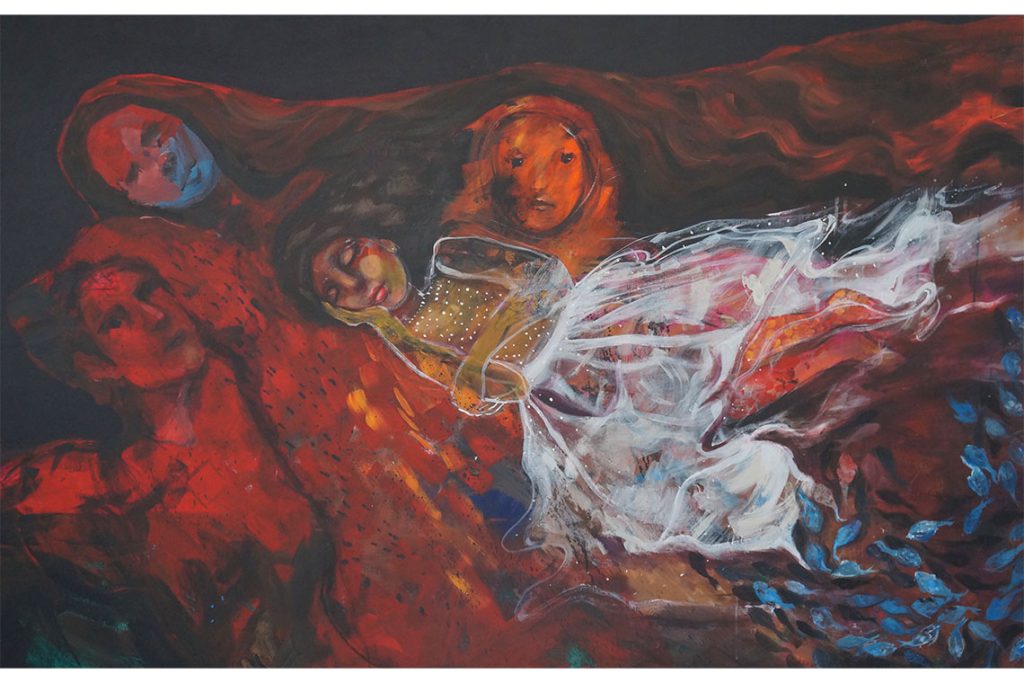
My personal favourite of her pieces, The Abaya of My Mother (2025), depicts women floating together, its intense red tones and ethereal white elements instantly reminding me of Gustav Klimt’s 1907 masterpiece, Water Serpents II. “The colour red symbolises the deep love and strength a mother provides, as her children continue to draw resilience and life from her,” explained Al Tamimi. Like Chagall and Klimt, she portrays women as delicate, powerful and deeply interconnected, capturing both their strength and vulnerability.
These silent resonances were a source of great joy to me as I visited the few galleries and exhibitions available in Muscat. It felt as though I had discovered hidden parallels that the artists themselves were unaware of. The experience reminded me of a story from Carl Jung’s autobiography, Memories, Dreams, Reflections (1961). As a child, Jung secretly made a small wooden doll that he kept in a box in the attic. He would visit it and occasionally add tiny scrolls of paper with mysterious writing. Years later, he was astonished to learn that African tribes, Indigenous peoples of North America, Polynesian cultures and European folk traditions all had similar practices, creating small sacred figures and idols imbued with symbolic meaning. This discovery deepened his reflections and further shaped his theory of the collective unconscious: the idea that humanity shares deep, archetypal symbols and psychological patterns across cultures.
This idea of a shared symbolic language made me reflect on the Omani artworks I encountered. Their pieces, though deeply rooted in their own unique cultural heritage, seemed to tap into the same universal well of imagery and emotion that Jung developed in his theory. They may simply be drawing on a shared collective unconscious – a reservoir of archetypes and symbols that transcends geography. This phenomenon suggests that creativity naturally moves beyond East and West, crossing borders and cultures through common unconscious currents. In Oman, where the arts scene is quieter and often less exposed to global influences, this connection feels even more profound. This silent, unconscious echo is what makes the Omani art I witnessed so captivating – a hidden thread tying it to the broader tapestry of human creativity.
