

At Pioneer Works in New York, the archive collective Khajistan orchestrates an office of wartime memorabilia where the past feels eerily familiar.
If history is a labyrinth of rooms, the dim corners are where its foundation lies. A thinker might feel lost between the grand affairs and earth-shattering clashes which occupy hefty real estate in the past’s interconnected chambers, but be sure to never overlook the nooks where everyday lives are documented and the crannies brimming with folklore and orality. Macrohistories of those who have endured bombastic circumstances determined by a handful of power-clutching men reveal the true impressions of their actions. Letters, songs, recipes, photographs, videos, posters, journals – they all unearth the human aspect of sometimes incomprehensibly inhumane experiences.
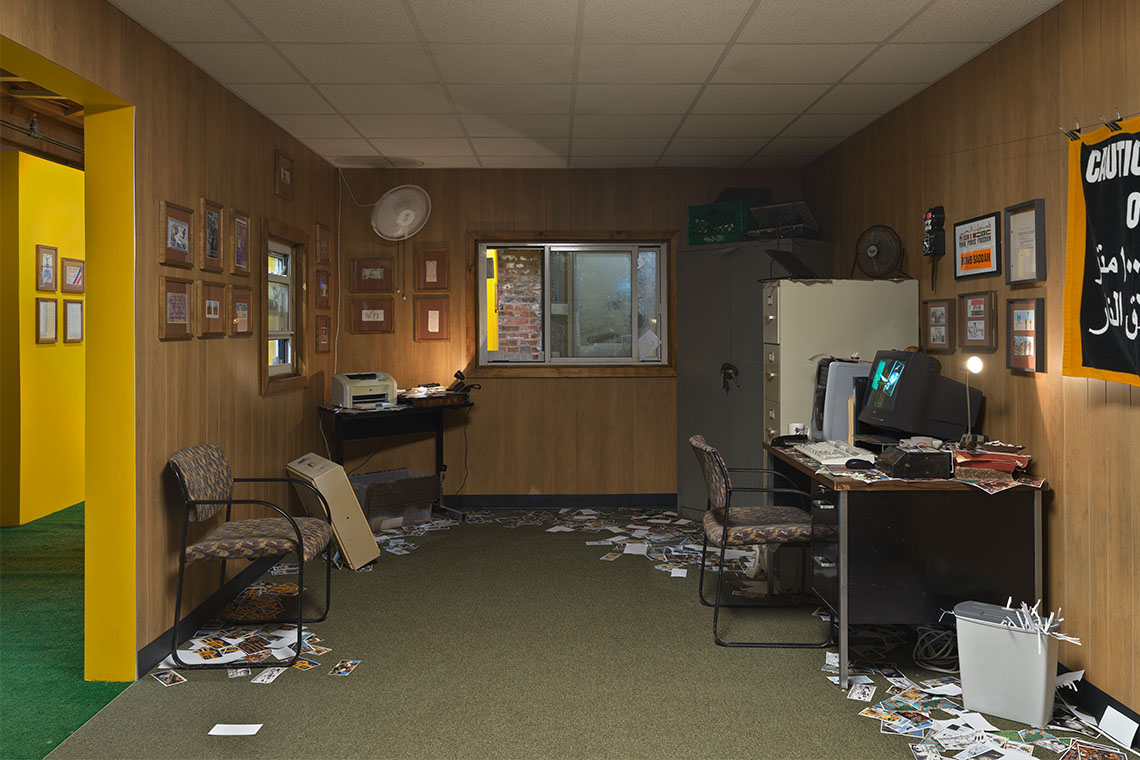
Khajistan’s exhibition, Office of War Information (O.W.I.), at Brooklyn’s Pioneer Works embodies this maze of history with a neatly orchestrated chaos. Immured from the breeze blowing over the water right outside the Brooklyn art centre, the building’s third floor is now a government-backed Middle America claustrophobia-central. Flyers everywhere and antiquated computer screens running low-pixel green texts, the dropped ceiling wood-panelled office is a product of mole people nightmare.
The New York-based archive and publishing platform based this fan-aired overhead lighting-lit hideaway on the Office of War Information’s Omaha outpost, where the Washington DC-based government agency operated a distribution office and archive housing facility. While the corporate crust of long office hours is traceable in the installation’s intricate design details, OWI’s history goes back to even older times, to the 1940s and the Second World War, when the USA established this agency to bridge information between overseas battle zones and the nation at home. Far from being subjected to today’s over-saturation of knowledge, which often hangs between real and dubious, back then the public was in dire need of updates on what was happening on the other side of the globe.
Khajistan assumes the bygone initiative and its Midwestern proxy to exhibit printed matter dropped onto Afghanistan, Iraq and Libya by the US military and CIA in the late 1990s and early 2000s. Communicative on what to do urgently, these pamphlets were intended to guide the locals about where to hide or surrender, or teased them about the food or medical aid that was on its way. Besides these informant printouts, which are now housed largely in the Kislak Center at the University of Pennsylvania and published into a volume titled America War Propaganda Leaflets (1990–2022), the collective also displays a portion of the large collection of propaganda material created by the US during its war with Japan. The path to the office ushers visitors through a bright yellow wall hung with racist illustrations of Japanese soldiers and written notes that alert the locals about impending bombings. Floored with a fake grass-like green carpeting, this hallway of war propaganda teases the office installation through windows that rather more repel than invite us into the chaotic workday overflow. Inside, we are invited to scan through decades-old computers to search through the many different posters and even print out some of our choosing to contribute to the growing mess.
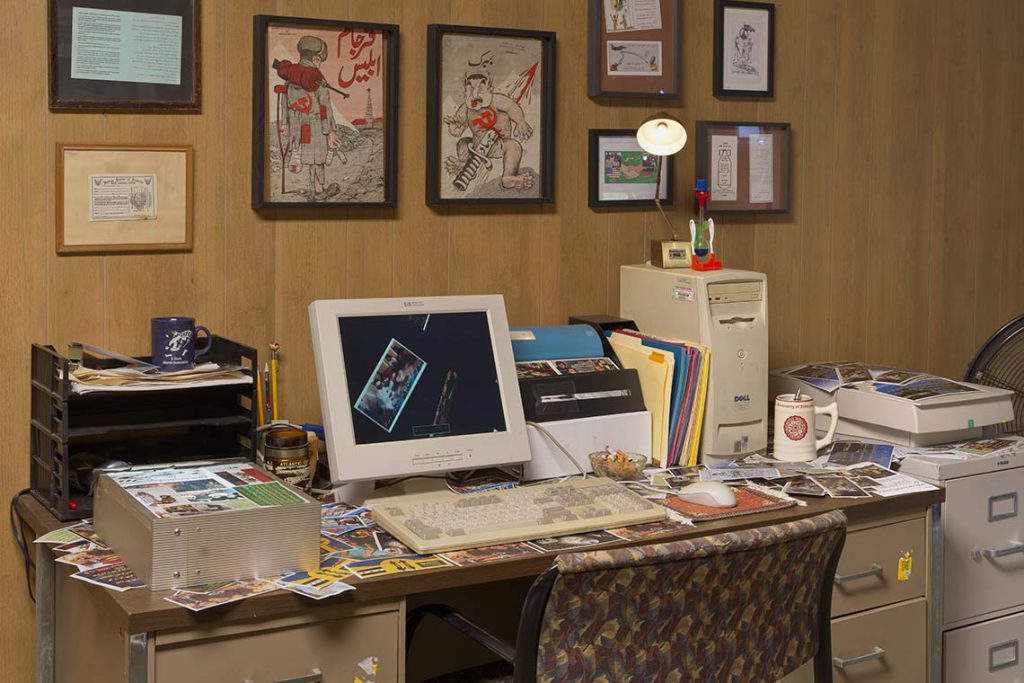
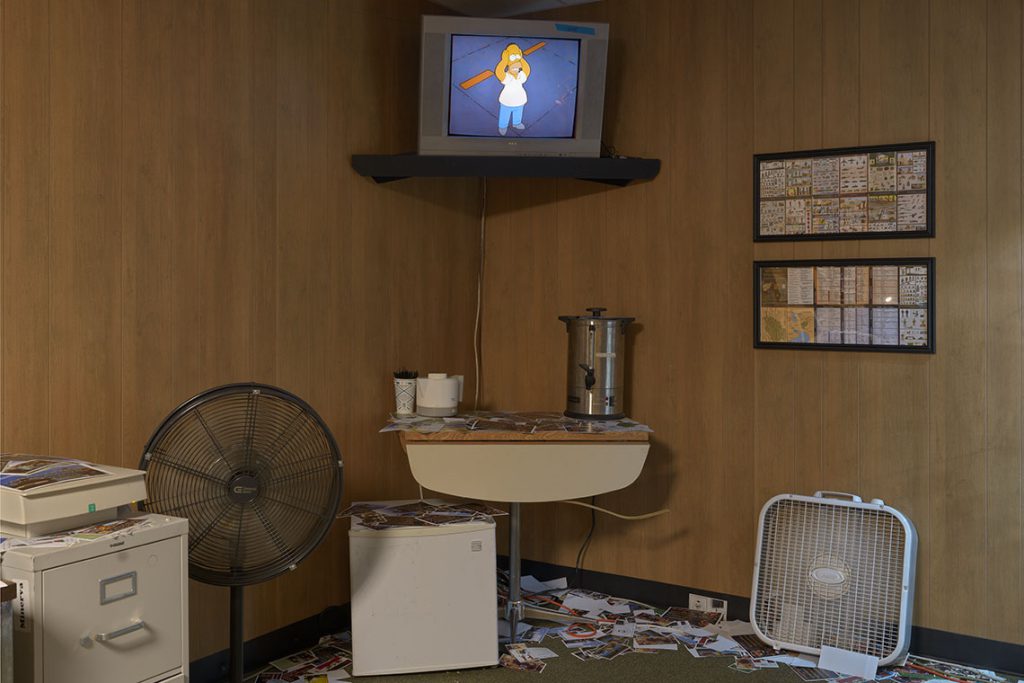
Equipped with suspended tubed TV running The Simpsons and a sad coffee corner littered with paper cups, the layout is far from convincing in terms of inviting us to stay longer – this intentional feeling of intrigue and repulsion is central to Khajistan’s practice of archiving what mainstream history has perpetually pushed aside. From women’s magazines in Urdu or pre-revolution Iran’s cinema, the collective’s collection offers not the shortest cut but the most scenic route to how we have gotten here. Colourful posters, never-released films and Afghani music decentralise the intertwined strategies produced by media and government policies. Through a lens of humour, the archive revitalises past joys and creativities shrouded by perpetual attempts to turn off the lights on different cultures’ ways of being. The gesture of reactivating the past is particularly critical given the fact that the part of the world which Khajistan calls “Middle World” has a large diaspora across the globe. This way, the lineage of knowledge which has often been uttered yet not written has the potential to be passed on to those scattered in different geographies through an almost forgotten song or over half-century-old film magazines.
Paranoia and ignorance are on display in this show where the gruesomeness of war is felt on the neck of each visitor. Humour, however, is never compromised in Khajistan’s takeover, which handles history as an active kinetic entity which spits out its extracts to the very moment. Drenched in these extracts, stepping out of the office feels like a stark reminder that true claustrophobia is in history’s endless whirlwind of self-repeat and in our own refusal to learn.
