At Al Riwaq Art Space, Bahraini artist Mayasa Al Sowaidi approaches the journal as a space for recording, revisiting and reworking personal experiences.
At what point does a word become an image? In Bahraini artist Dr Mayasa Al Sowaidi’s solo show, A Journal of Becoming, the distinction is difficult to maintain. Arabic and English move between handwritten notes, stencilled phrases and abstract shapes. A curved fragment might resemble a flower, a comma or something cellular. Stitching becomes drawing, while a cut edge takes on the character of punctuation.
Curated by Gaida Almogren at Al Riwaq Art Space in Manama, the exhibition unfolds across interconnected rooms and outdoor spaces. Four symbols introduce its visual language: an irregular circle, a geometric form resembling a capital I, an asymmetrical quadrilateral and a rounded, flower-like shape. Displayed above an open journal, they suggest an unfamiliar alphabet. As these forms reappear, visitors gradually learn to recognise them.
Trained in mathematics and management, the self-taught artist has long experimented with geometry, collage and collected fragments. Her earlier exhibition The Golden Ratio, in 2023, explored mathematical proportion and visual composition. Here, that underlying structure is continually interrupted. Paintings are cut apart, reconstructed, stitched and suspended, retaining traces of earlier decisions. The journal becomes a place where thoughts remain open to revision.
In All That Came Before, hexagonal canvases establish a geometric order complicated by writing. Handwritten Arabic and English coexist with printed lettering, painted gestures and irregular fabric forms. Some resemble quotation marks; others suggest flowers, bodily forms or cellular membranes. The distinction between image and language becomes increasingly uncertain.
This ambiguity has a history within Arab modernism. Iraqi artist Madiha Umar explored Arabic letterforms as independent abstract compositions in the 1940s, anticipating later developments associated with the Hurufiyya movement. Al Sowaidi’s approach is distinct, but similarly allows language to operate beyond conventional communication.
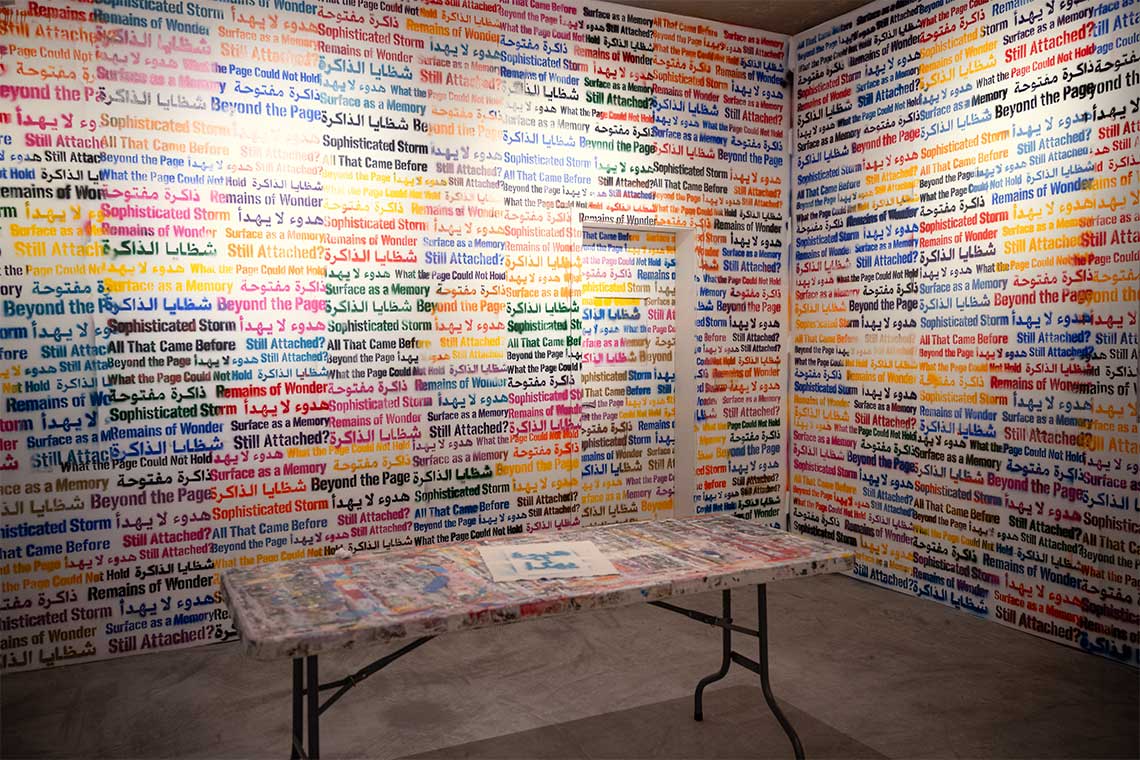
Bahrain’s bilingual environment adds another dimension. On the exhibition walls, Arabic occupies the right and English the left, their opposing reading directions approaching a shared centre. Neither feels secondary. Within the artworks, handwriting retains the irregular rhythm of an individual gesture, while stencilled lettering introduces repetition and control. The connected curves of Arabic encounter the separated forms of Latin letters. Meaning travels between languages and materials without always requiring translation.
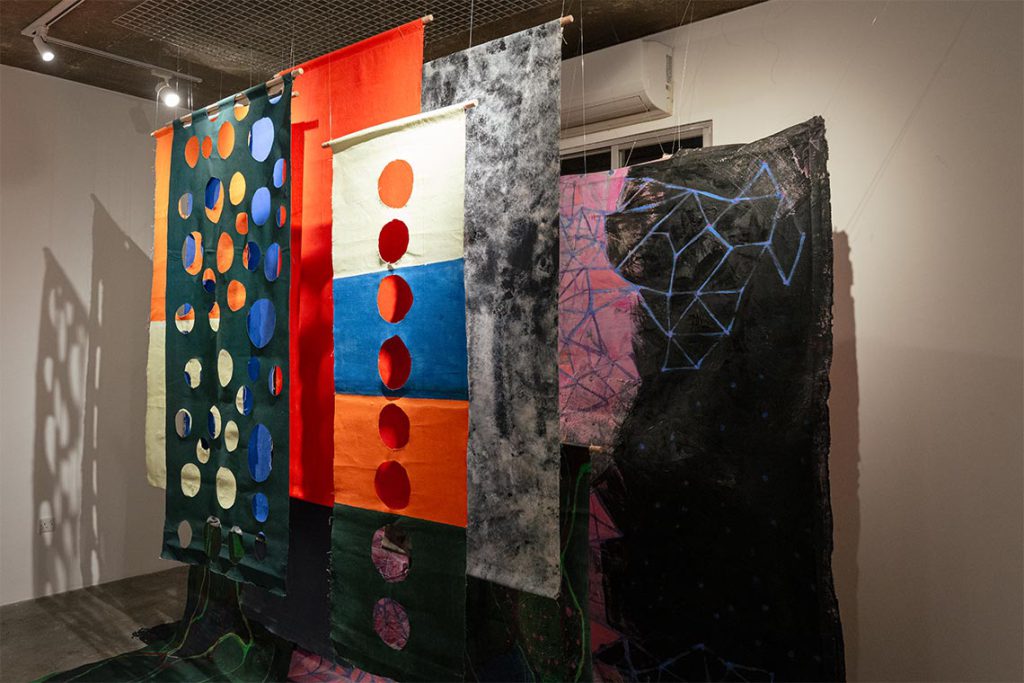
In the suspended Beyond the Page (2026), these relationships become physical. Its irregular silhouette, stitched construction, eyelets and exposed fastenings recall American sculptor Lee Bontecou, whose canvas-and-steel reliefs similarly made seams and openings integral to their compositions. Walking around Al Sowaidi’s work reveals another surface of handwritten thoughts, ruled lines and visible stitching. Both sides contribute to the composition. A line can record a thought, join two pieces of fabric or mark where something has been cut away.
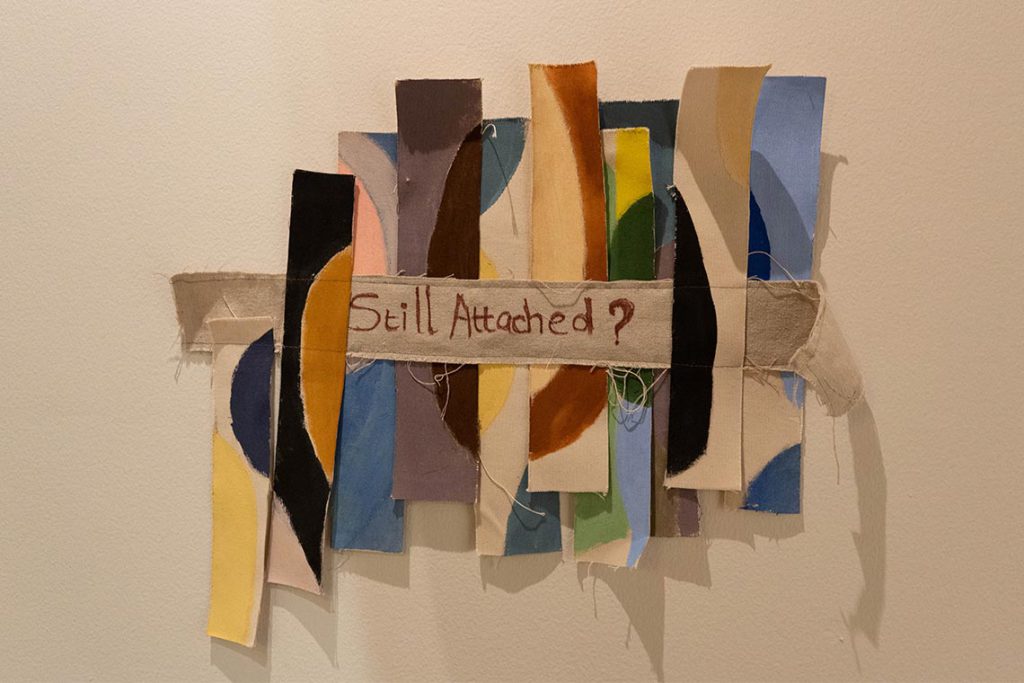
Elsewhere, the journal expands into architecture. In Still Attached (2026), suspended painted textiles create passages through which visitors move, their shapes briefly aligning before separating again. Layers of Us (2026)introduces overlapping surfaces and circular openings that rearrange the composition as perspectives shift. In Sophisticated Storm, angular forms occupy a corner and spill onto the floor, incorporating mirrored fragments. At certain angles, an opening frames a window or another painted surface. Move a few steps and the composition disappears. Shadows, floor patterns and architectural details become newly apparent. The works encourage attention to spaces that might otherwise remain unnoticed.
Yet the exhibition is less assured in its earlier rooms, where the abundance of paintings, textiles and smaller works occasionally fragments an otherwise coherent visual language. The later installations benefit from greater concentration, allowing individual ideas to occupy entire spaces. The translucent floral works of Secret Garden, though delicate, remain more contained within their room, without the same engagement with the surrounding architecture.
A nearby film offers an intriguing counterpoint. Showing Al Sowaidi writing, painting, cutting and rearranging materials, it reveals the labour behind the exhibition’s forms. Its looping structure reinforces the idea of an unfinished journal. In the room of repeated Arabic and English phrases, a paint-covered studio table holds a small fabric fragment bearing the words ‘Restless Calm’. Against the surrounding accumulation, the isolated phrase gains particular presence.
The film also observes that not everything that grows needs to be seen, a sentiment that acquires an unintended curatorial resonance. A more selective presentation might have allowed some of the earlier works greater space to breathe. At times, the poetic wall statements similarly explain emotions that the materials communicate more effectively.
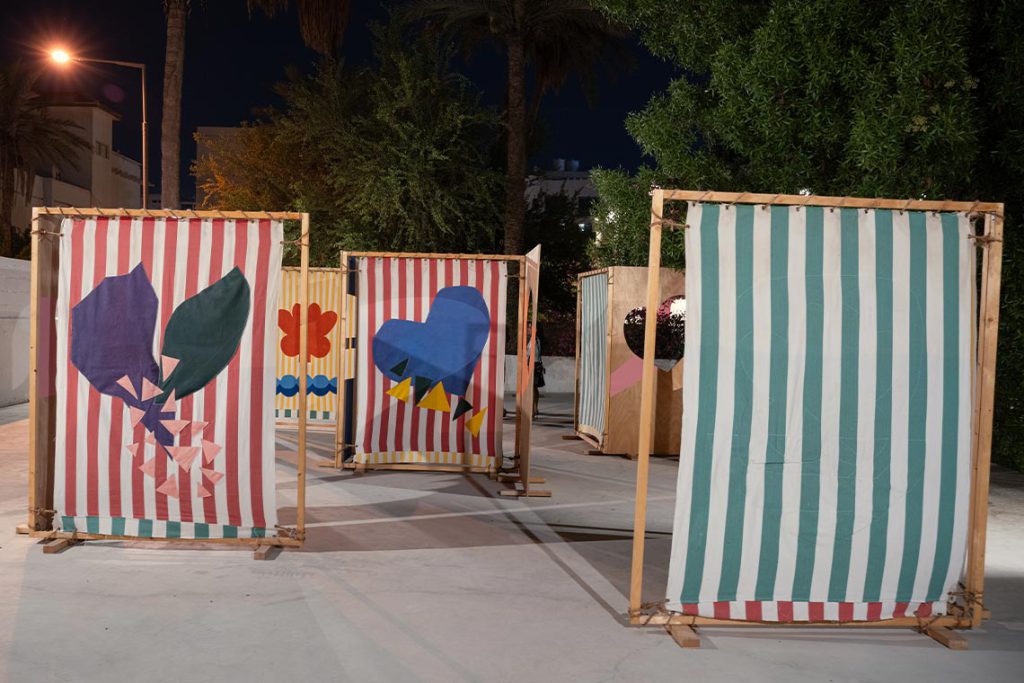
Outside, Remains of Wonder (2026) returns the recurring shapes to the courtyard. Freestanding panels frame foliage, windows and fragments of the surrounding architecture. Openings in the artworks begin to resemble those in the buildings, while spaces between branches echo the contours encountered inside. What initially appeared to be an unfamiliar alphabet has become a way of seeing. Al Sowaidi’s journal extends beyond its pages, changing how the surrounding world is read.
A Journal of Becoming runs until 31 December
