

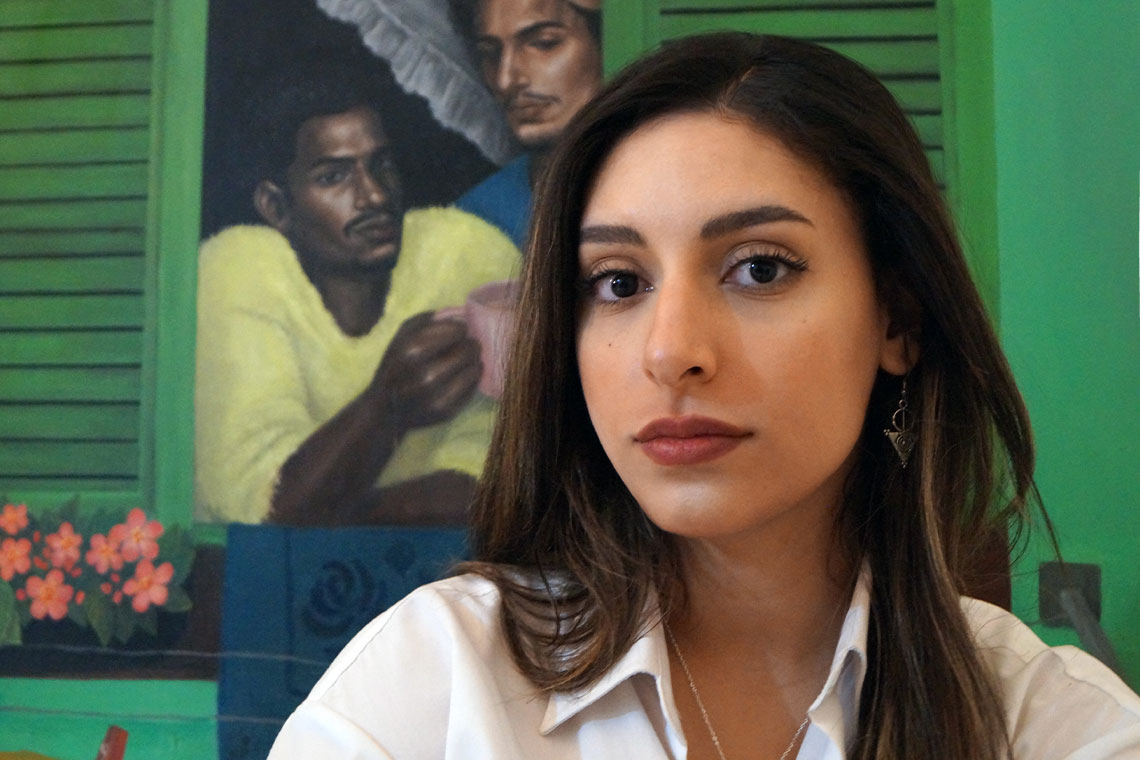
The artist portrays emotional isolation and intimacy in domestic spaces, using symbolic objects to explore vulnerability in men while reflecting cultural influences.
Canvas: The home is often imagined as safe and nostalgic, but also as a site of longing or loss. How do you explore this duality in your practice?
Nour Elbasuni: In the process of creating an artwork, I tend to delve into spaces that I’m depicting mentally. I can almost feel the subject matter emoting, interacting with its environment and emitting the feeling of warmth that I want to communicate. A painting will go through the process of creation and many changes, until it has been developed enough to have a life of its own, be on display or go on to find its way in the world of exhibitions or collections, where it is appreciated for what it is and where it is valued dearly.
Our living spaces, much like artworks, are our own daily creations, built and formed by our perceptions. Through time, they get to carry the energy of life and are influenced by our inner states. As we live within them, a certain kind of familiarity and closeness develops, to a point at which they begin to feel as if they have a life of their own, one that is watered and nurtured by what we project onto them. In these spaces, safety and nostalgia – as well as loss and longing – are feelings that we all experience to varying degrees. Combining and experiencing the range of these feelings, and being mindful of them or embracing them, unifies the duality and informs growth. It is one of the ideas that I care to communicate in my works.
Your upbringing in Qatar, alongside your Egyptian heritage, exposed you to diverse cultural expressions. How has this multicultural environment shaped the way in which you depict spaces?
The image in my mind of my Egyptian heritage is a mixture of a trip to Egypt during my childhood with nostalgic accounts from older family members, who told stories about what it used to be like growing up there. My childhood in Qatar was true to the environment I was brought up in and surrounded by. Part of me loves the culture of Qatar and the GCC, and part loves and admires the greatness of the culture in Egypt, its fascinating history and how intelligent the design of everyday life was. Certain architectural elements, like wooden plantation-style shutters, the ventilation inside homes built with brick and mud, and how close family members lived to each other or lived in the same big house together – which I hadn’t seen much, growing up in a nuclear family in Qatar – are all fascinating to me.
The rootedness of both Egyptian and Qatari culture has influenced how I depict spaces. Closeness and community is important in all Arabic-speaking cultures, and spaces serve as a vital part of our daily lives across the region. So, depicting spaces that bring about a feeling of togetherness, mindfulness and warmth is an element that I emphasise throughout my paintings.
Community is a visual that I also highlight in my work, because of my firm belief that it is essential for well-being and for the emotional healing of any human being.
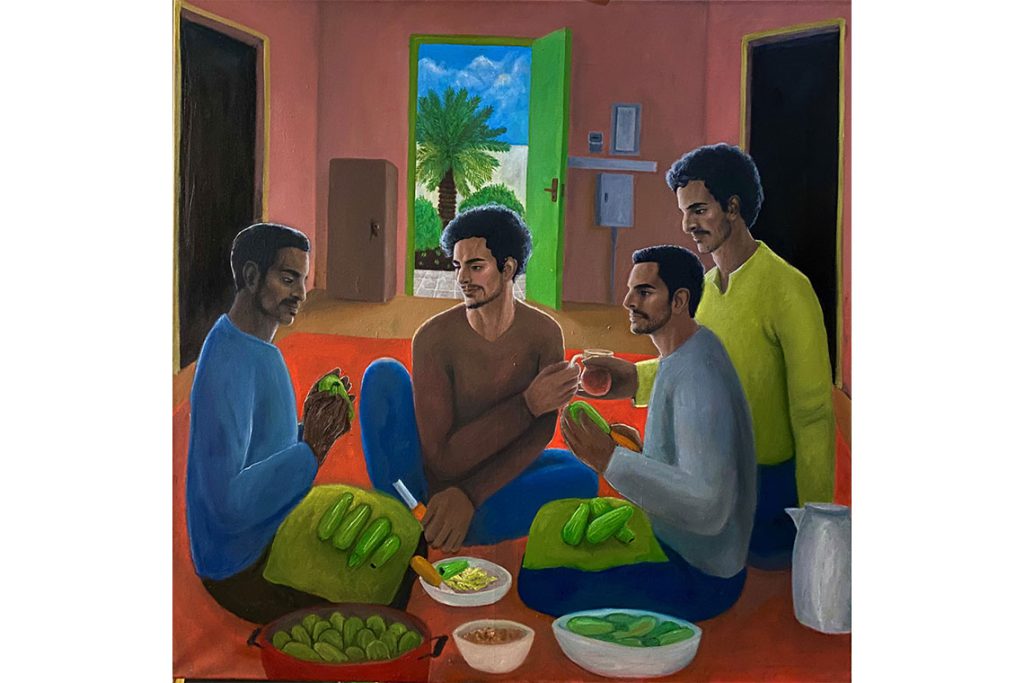
Kousa (2021) depicts a calm, attentive scene of men performing domestic tasks together. How do you see ordinary routines – such as preparing food – function as sites of comfort or emotional intimacy?
The reason I depict groups of men together in intimate domestic settings is because I believe that healing for men is often stunted by their immediate community. If a man’s peers shame emotional growth, creativity, vulnerability or anything coded as ‘feminine’, he is forced to conform. When men are emotionally content, the entire community becomes safer and more peaceful – women, children, everyone. The domestic scenes I paint are like a proposal – a visual nudge of what emotional safety among men could look like.
Everyday objects often appear in domestic scenes. How do you decide which objects carry meaning?
Since ancient history objects, plants and signs have been a powerful way to represent meaning through symbolism. Certain flowers I paint would be historically or spiritually a symbol of empathy, rebirth and sincerity. For example, the act of taking tea together has more to do with connection and mindfulness than simply drinking. By depicting mundane objects and spaces in my paintings, I add an element of magic to them that helps us see our everyday in a more thoughtful way. Most of the visuals I paint have some mental link to nostalgic memories of home, plants, furniture and textiles. I grew up around the time of a technological boom, with the internet unifying a generation’s experience of the world over time until most of us started to feel a very similar type of nostalgia. My generation experienced globalisation in a very particular way – we watched the same shows, ate the same candy, shared similar cultural references. You can see that today through meme culture. The interiors I paint reflect this shared nostalgia.
Your work often conveys intimate, private moments on a public canvas. What unfolds for you conceptually, when a scene rooted in privacy becomes something that viewers can witness?
Bringing private moments into public view unveils a softer humanity that exists in everyone, although it is often resisted. By framing these mindful, intimate moments on a canvas, I aim to normalise the human nature of everyday activities and times of leisure where there isn’t a public front being performed. This shift allows the viewer access to a disarming space, one which they may recognise, long for or wish to be a part of.
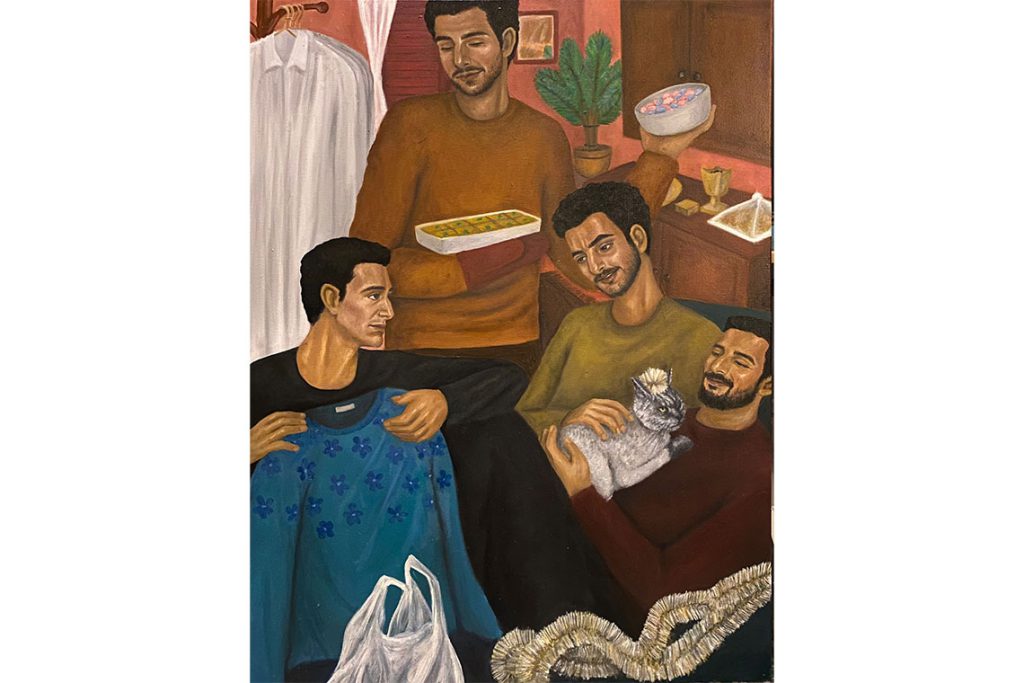
Your titles often evoke a particular moment or atmosphere, as in Friday Afternoon (2021). How do you approach titling your works, and what role do their names play in shaping how viewers read the scene?
Friday is culturally significant – it is a slow, peaceful day. People finish prayer, come home, relax and prepare for lunch. The atmosphere is very distinct. My titles often capture these specific moments in the week that carry emotional weight.
How does your interest in visual culture and psychology inform your choices of composition, colour and symbolism when depicting domestic spaces?
My practice is grounded in psychological research and self-reflection. I spend months reading, writing and exploring concepts, especially Carl Jung ideas about integrating suppressed parts of the self. The symbolic meanings I embed in the domestic scenes, spaces and objects in my painting all walk a fine line between carrying personal significance to me and evoking a shared memory for many in my generation – a simulacrum of collective nostalgia and longing for the softness of home as it used to be. These symbols are used to communicate the atmosphere of the painting to the viewer, drawing them closer to the world that I create.
This interview first appeared in Canvas 121: If Walls Could Talk
