

At the 25th Biennale of Sydney, it is the quieter works, the less prominent locations and the new voices that demonstrate most potently the power of remembering afresh.
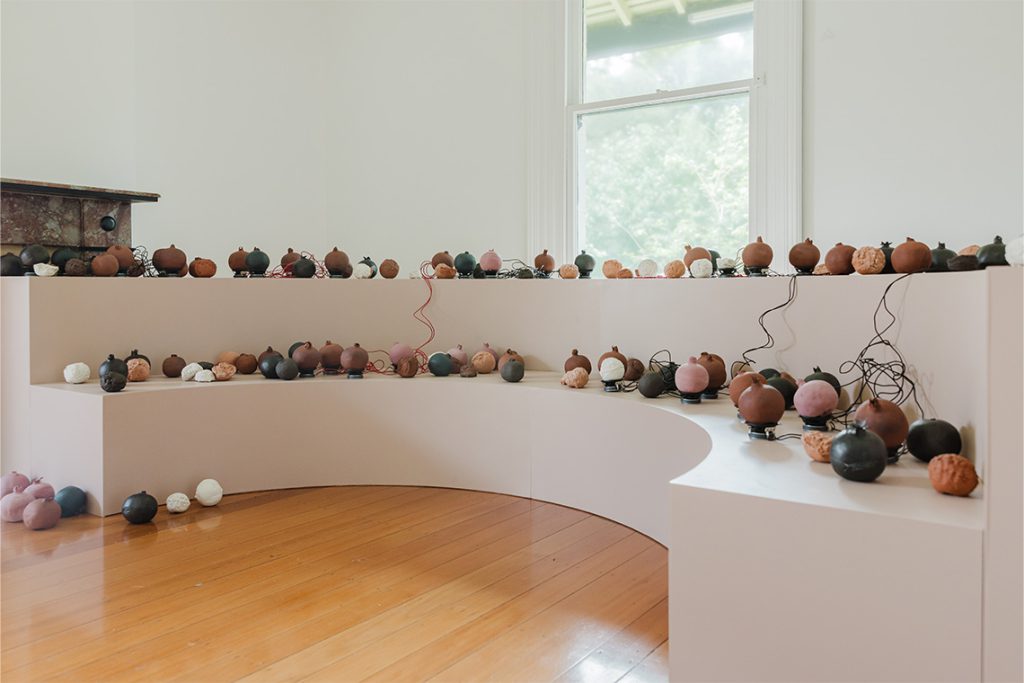
“I remember the sounds of seeds falling into the bowl, like rain on windows”. A child and woman’s voices, ever-so-slightly out of sync, emanate from around 100 ceramic pomegranates in various states of wholeness, sitting on a long, stepped plinth. I am in a small room off a corridor at Penrith Regional Gallery (PRG), entered via black curtains with the installation Pomegranates/Rumman (2021/2026) by artist Nora Adwan. “They scatter on the table, split the fruit apart, tear the tough skin”, the voices continue from the unglazed fruit, nestled amongst a tangle of electrical cords. These wires are connected to humidity sensors outside the gallery. If they detect wetness, then sounds recorded in the heat of Jordan – where Adwan’s family lives – play. If the sensors detect heat, noises from cold Norway, where the artist now resides, are activated instead. If the weather sits in between wet and hot, both tracks blend together. As the chirping of birds, children’s laughter and the distinctive rip of fruit skin being split fill the room, it is interesting to wonder which world they come from.
The overall effect of Adwan’s layering of sounds and sculpture is to feel as if you have walked into someone’s memory – of their yearning to be somewhere else, while also wanting or needing to be where they are. The installation, titled in both English and Arabic, captures the often heartbreaking, sometimes joyful, split of belonging to more than one place, more than one people and more than one culture, all at once. As the caption explains, the work deals with “the fragmentation of exile” and “the discombobulation of displacement”.
Deeply personal but also relatable, thanks to the entry points of food and weather, this work clearly fits the brief of this biennale, which asked over 80 artists from 37 countries to present pieces under the title Rememory. “Many of the works in this edition draw on personal, familial and collective histories to reflect on how memory is carried across generations, and how histories that have been fragmented or suppressed can be revisited and reassembled through art,” explained Hoor Al Qasimi, this edition’s artistic director, in a press release.
Under Al Qasimi’s vision, the biennale presents memories as things that are constantly and necessarily evolving as new voices come to the fore. As the event’s first Arab director in its 53-year history, Al Qasimi is perhaps the most significant of these voices and the result of her involvement is an incredibly ambitious biennale. A staggering 85 per cent of the work on display is newly commissioned for the event, which is spread across six geographically dispersed venues. Al Qasimi prioritised commissioning artists from, or with connections to, communities and places that historically have been marginalised. Combined with the provocation of ‘rememory’, this has led to works that run through the biennale consistently focusing on politically charged and often heartbreaking topics. For instance, large-scale photography, paintings and video works by Hoda Afshar, Vernon Ah Kee and Behrouz Boochani document the mass incarceration of First Nations youth in Australia; while 40 brooms and shovels with shafts hand-carved into raised fists by Ángel Poyón address food sovereignty and colonial poverty among Guatemala’s Indigenous Mayan populations.
Both of these topics and many more, including slavery, forced displacement, war, detention and colonialism, are incredibly urgent and each artwork on display is powerful and nuanced. The importance of foregrounding these kinds of untold or unacknowledged histories in public – to ‘rememory’ them – is undeniable. However, the accumulative weight of these complex topics, shown side-by-side across vast exhibition spaces, risks tipping from powerful into paralysing – a viewer moving through stories of crisis, cruelty and loss can face a diminishing capacity to meet each work with the attention it deserves. This feels especially true of the White Bay Power Station, where the huge scale of the venue – tied in with an unclear curatorial narrative linking one work to another – provides very few moments of respite or hope. Maybe this is an intentional reflection of the escalating number of crises and ongoing conflicts today, and perhaps to ask for hope from artists, curators and biennales is naive. However, the two venues in Western Sydney take a gentler and more audience-focused approach to the curatorial balance and, as a consequence, encourage us not to shy away from confronting the topics addressed.
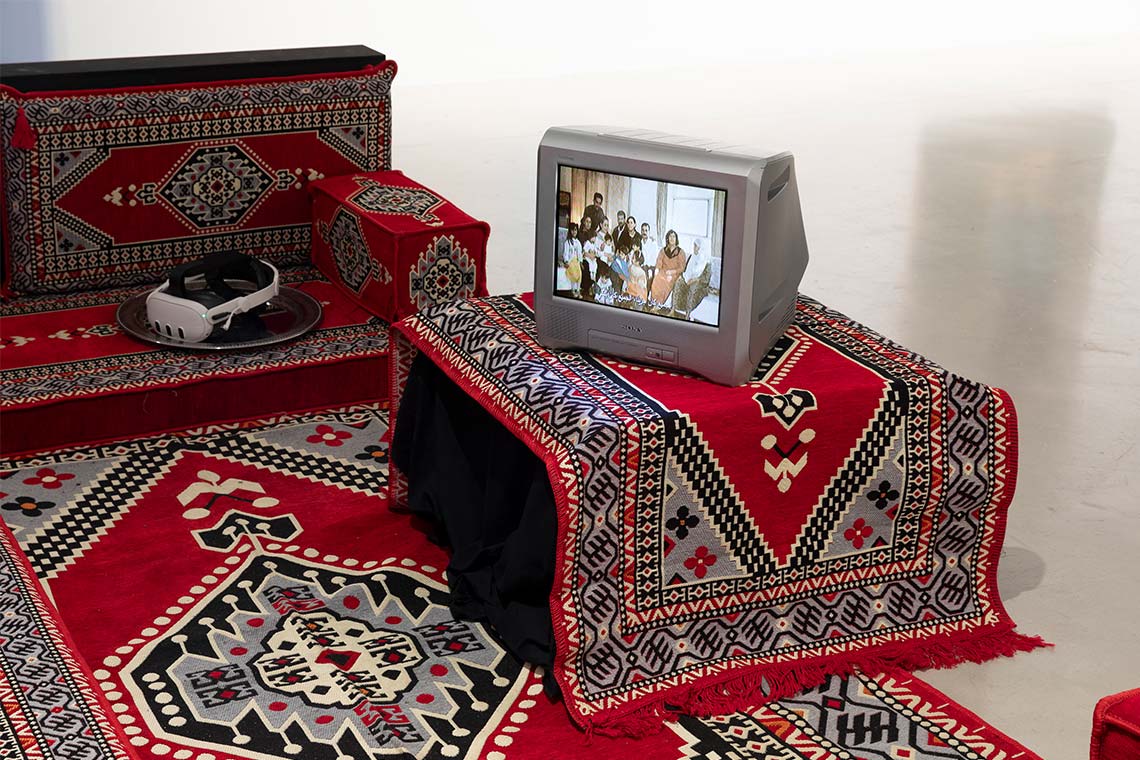
Take the video and VR work, House of Memory (2025) by Basil Al- Rawi at Campbelltown Arts Centre. Here, visitors are invited to take off their shoes, sit on low, rug-covered sofas in a traditional Iraqi shanasheel and immerse themselves in an old TV set or VR headset, which present personal stories and photographs that have been crowd-sourced from Iraqi people across the world. The installation builds from the Kuwait-born, Irish-based artist’s larger project, The Iraq Photo Archive (2019–ongoing). Al-Rawi’s archival work began from a conversation with his father about his parents’ photos of their last meals with friends and family in the days leading up to their leaving Iraq. Al-Rawi describes them as moments of “sad celebration”. He has spent years compiling similar submissions via his website, providing “a chance for Iraqis to tell their own story”, he explains, rather than the stories presented in Western archives of Iraq, which often uphold colonial or Orientalist stereotypes. He stressed that “it is important to record them, as these are voices that are not yet represented.”
At PRG, a venue which is included in the biennale for the first time, Sudanese artist Khalid Albaih similarly explores peoples’ final moments in their home country. For The Last Time (2026), the artist asked members of Sudanese communities in Sydney to contribute the final photo they took before they left Sudan and to write a memory on the back. Hanging simply from the ceiling via fishing wire and bulldog clips, the images and texts give glimpses of intimate moments of care between people and places as part of a wider story of forced migration and survival. The Last Time is accompanied by Haboba (2026) is a soft sculpture of a woman lying on her side on a bench, whom visitors are invited to sit alongside. ‘Haboba’ means grandmother or matriarch in Sudanese culture. Omer Kattia, an Australian-based performer who helped Khalid connect with Sydney’s Sudanese diaspora from afar, tells me that a haboba is like “a very gentle care bear mafia boss” whose “weapon is love”. He explains that the sculpture evokes the lost opportunities to sit together as a family as a result of war.
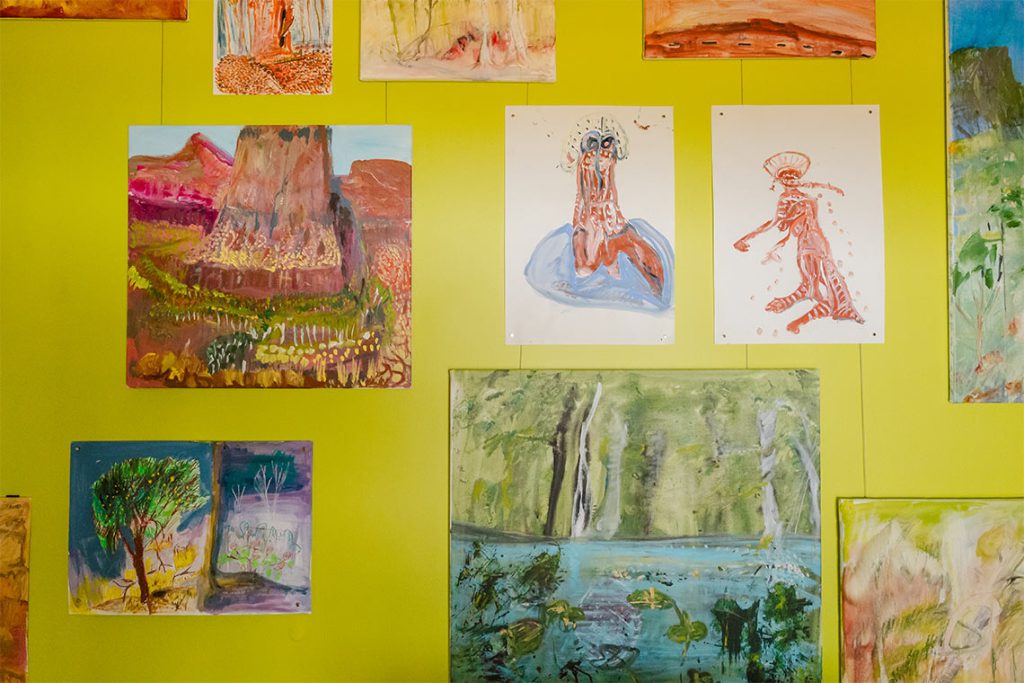
Tony Chapman, PRG’s Interim CEO, noted that many of the 120,000 annual visitors who come to the venue have never been to an exhibition or art institution before. That awareness shows in how the biennale’s works are sequenced and contextualised in the space. A highlight is Yindjibarndi Nyinyart at Wendy’s Garden (2025–26), in which First Nations Elder Wendy Hubert joyfully and brightly covers an entire room, ceilings included, anda courtyard with ancestral knowledge of the natural world. At the Art Gallery of New South Wales, a humble work tucked into a quiet corner stands out for its similar thoughtfulness of audience interactions. No Condition is Permanent (2014/2026), made by Taysir Batniji, a Palestinian-born artist, is a sculpture made from bars of soap stacked, brick-like, into a relatively small, neat, rectangular pile. It seems initially unremarkable until one notices that the words dawam el hal men al mohal [no condition is permanent] are stamped into the faces of the bars. The caption explains that “this common phrase is used in Arab counties to console people during times of hardship”. Given that the words are on soap made in the centuries-old Palestinian tradition using olive oil – which is recognised by UNESCO as part of the world’s intangible cultural heritage – this feels an urgent message whose gentle delivery renders it even more powerful.
The bars are periodically gifted by gallery staff to visitors, so that the sculpture shrinks and is replenished at different times. After the biennale ends, it is nice to imagine that people across Sydney, or perhaps further afield, will be washing their hands with the soap, watching its words disappear in satisfying alignment with its message: No condition is permanent. As they turn off the taps and dry their hands, will they remember, or even re-remember, the larger messages posed by Al Qasimi – that no memory is fixed; that forgetting is not permanent; and that we can, and should, use the powerful act of rememory to reshape our world?
This review first appeared in Canvas 123: Venice Special Issue
