

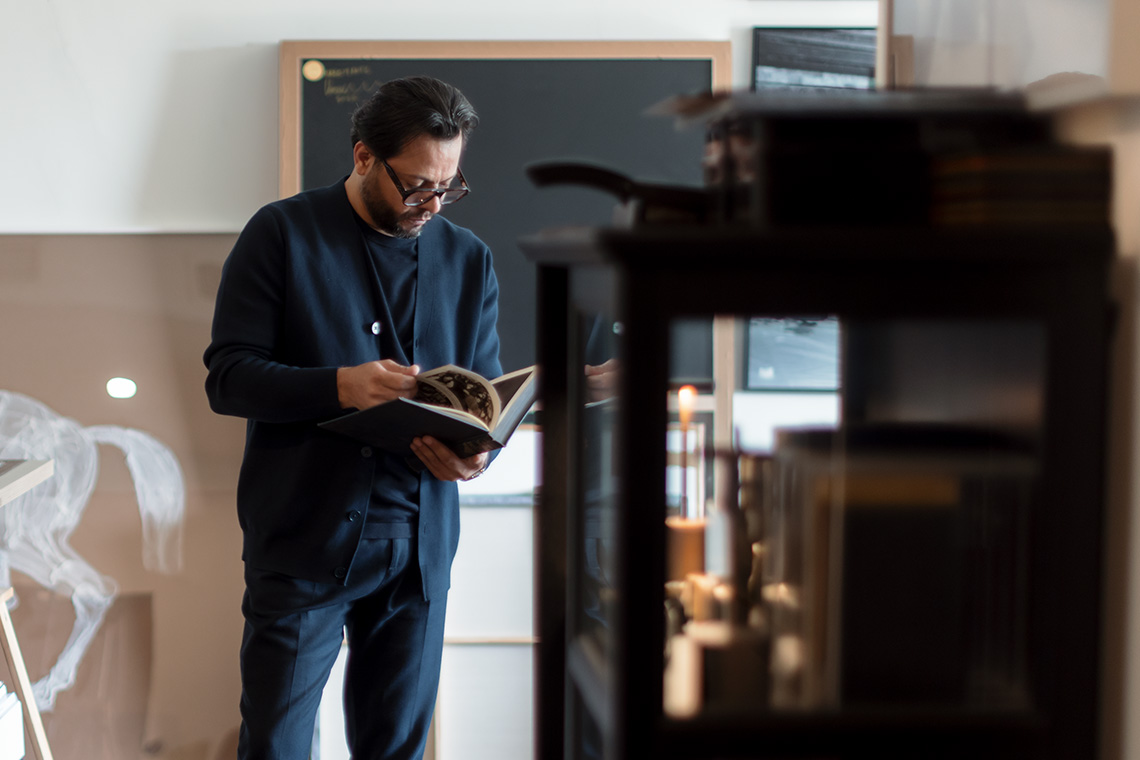
The Palestinian artist shares how his use of archival materials has evolved over time as he pieces together fragments from the past and the present.
There is something singularly self-composed about Hazem Harb. As we speak over Zoom, he sits in his studio in Dubai, nursing a toothache and waiting for the painkillers prescribed by his dentist to kick in. He smokes a cigarette to take the edge off. In the background, everything appears neatly organised, not a single item out of place – almost clinical, as Harb tells me. “I wish I could move the computer to show you the atmosphere in my studio”, he muses. Through the screen, I can glimpse only a little of this carefully controlled environment, revealed in the inordinately tidy sofa that sits behind him. It is difficult to imagine a time where his practice might have been far less meticulous.
Once drawn primarily to painting, first in Palestine – in Gaza, where he grew up – and then in Italy, where he moved to study art, Harb’s practice today seems a far cry from where he began. The large-scale, gestural figurative paintings of the past have been superseded (replaced, even) by smaller, more meticulous works, born from a desire to reconnect with his heritage and personal history after his 12 years in Italy. Of his time painting, he divulges that he felt “lost sometimes, with emotions, with feelings, with relations. Painting is very romanticised”. He does not say it, but I get the impression he perhaps means self-indulgent, although he does admit that painting was for him a comfort zone. The image of the passionate painter is difficult to conjure when encountering Harb now, as he is as carefully put together as the studio behind him.
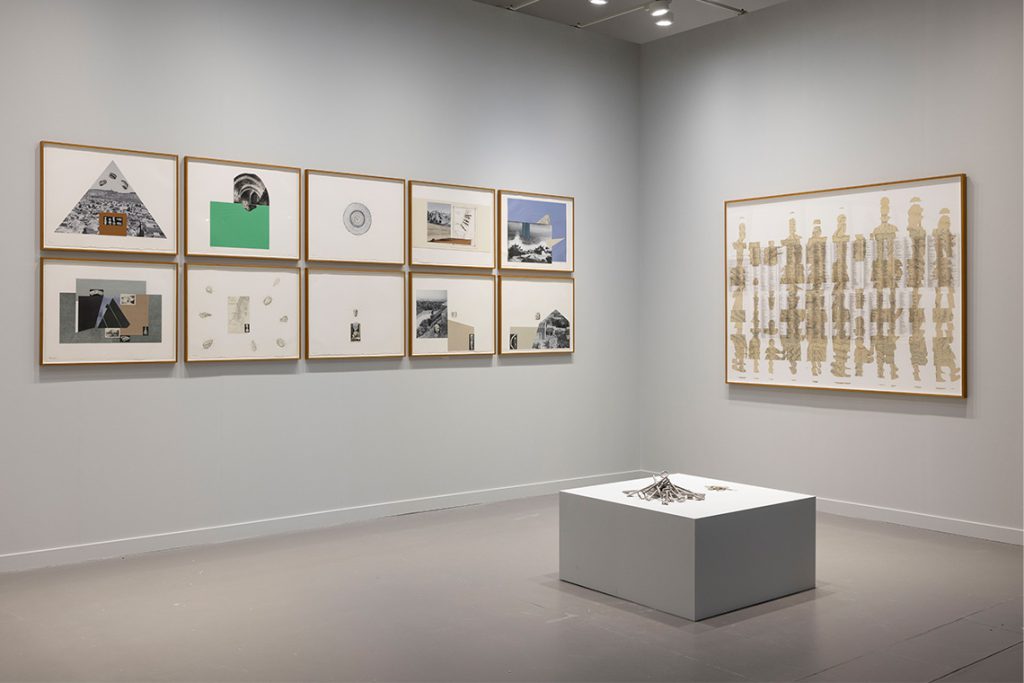
“It was an obsession because art is an obsession. Art is either you are an artist, or you die. There is no in between,” Harb says of this period of his life. He carried this passion into the next phase of his artistic career, where his quest to better understand his history led him to a new form of art: “Collage became my new identity, and I found myself drawn into an ocean of archives.” Through these archives, Harb began to find himself a little more, to regain control and to sharpen his practice. Rather than focus solely on the aesthetic merit of his artworks, he sought something more balanced between concept and material, without which he believes that art cannot tell a story.
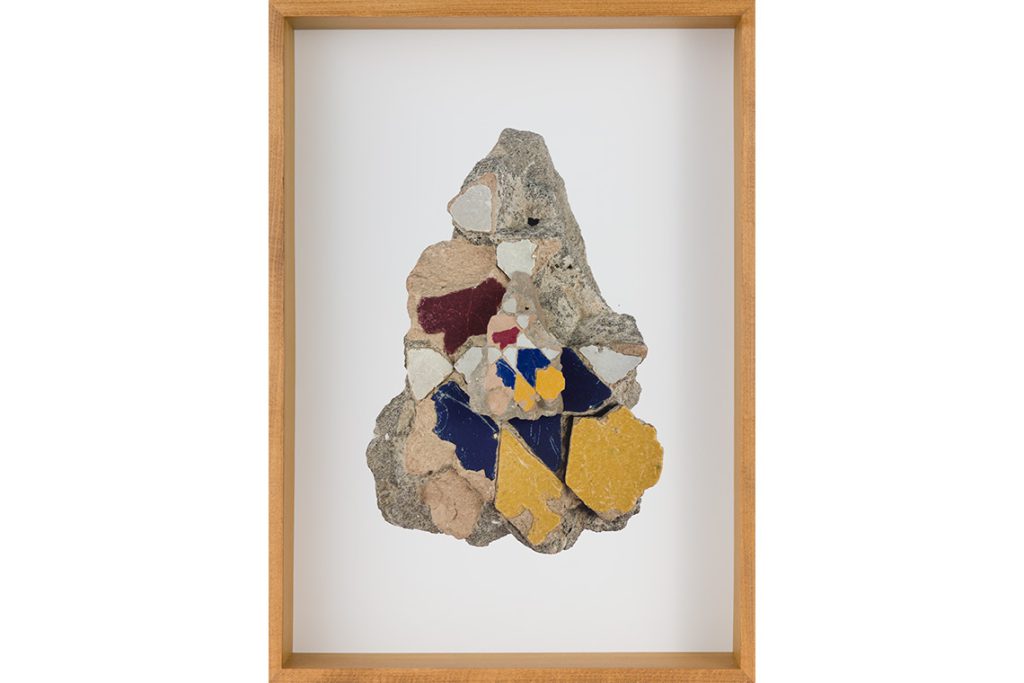
Aesthetics have not completely departed his practice, often showing up as unintentional gateways to a deeper understanding of the work’s themes. For instance, at the recent inaugural Art Basel Qatar, where Harb had a solo booth presentation with Tabari Artspace, one particular work featuring a fragment of blue stone from Gaza garnered a surprising number of admirers for its aesthetic qualities. The stone comes from Gaza’s old (and now demolished) airport and made up part of one of the Future Archaeology (2025) works on display in the booth, which focused on showcasing a “concentrated survey of my sustained enquiry into cartography, extraction, colonisation and the institutional framing of heritage”. By bringing this material from Gaza, Harb explains that he is literally importing destruction into the frame, playing on the “irony of something aesthetically beautiful actually being something really brutal”, while equally trying not to romanticise the subject matter.
Romanticising the past has been an ever-present concern for Harb, who does not want to represent Palestine only as a beautiful land but also as a place rich in thousands of years of history and cultural heritage. However, a sense of wistfulness pervades his work, both in the inherent subject matter revolving around “identity, exile, memory and spatial politics” and in what he considers a predisposition in his personality to be attracted to “nostalgic situations”. As a child, he would pore over his mother’s photographs from the 1960s and 70s, longing for a past he never knew but could still potentially access. This all changed when he moved to Rome, where nostalgia took on a new meaning. There, he was faced with “this feeling of exile, or ghorba in Arabic, which is a more painful feeling”.
Of course, the subject of exile and reminiscence has taken on a new meaning in the past few years. Asking about the genocide in Gaza and how it has affected his practice, the question feels at once obvious and trite, however necessary. I find myself saying as we discuss the current situation there that maybe we have veered off topic, before realising that, in fact, Gaza is the topic. In the midst of the carefully curated studio environment that Harb had controlled with methodical research and work, he found himself in need of something he had not felt in years. There was suddenly an urgency to the moment, born out of the necessity to archive a place in the present rather than looking back in time. A return to a more instinctive and automatic response to the emotions he was experiencing led to the charcoal series Dystopia is Not a Noun (2023). He shares that this return to a looser way of creating art was even more instinctual than painting had been, almost sounding surprised when he explains to me that “I found myself in the middle of my geometric works and collages, in the middle of the genocide, doing – really for the first time in my life – something from my gut, not from my mind.”
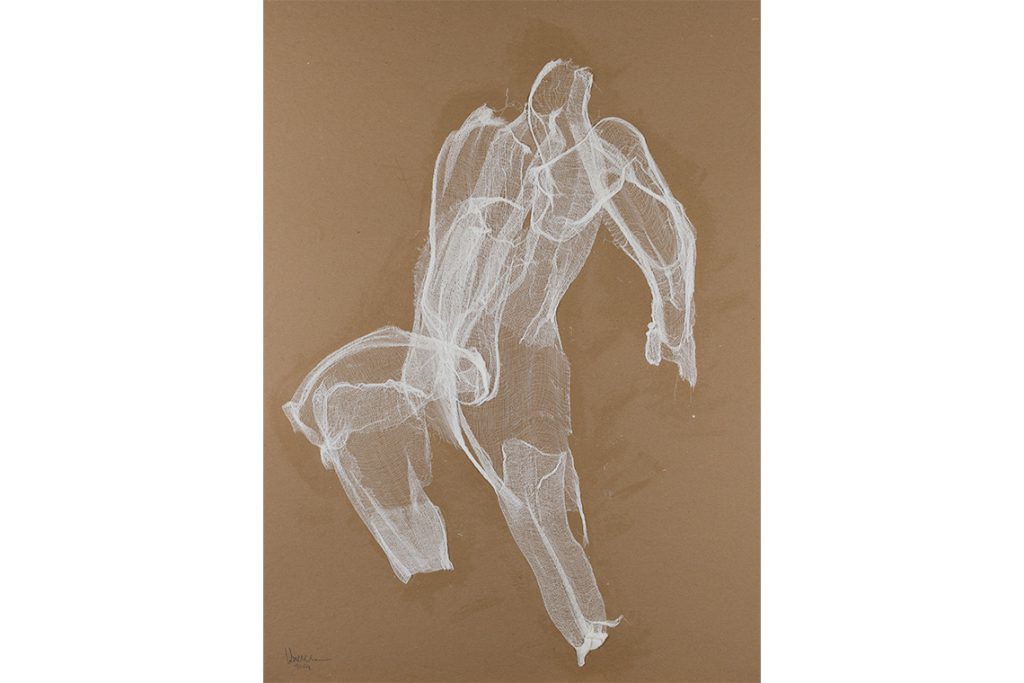
During this period he also produced his Gauze series (2024), a collection of nearly 40 primarily small-scale works on cardboard, save for a larger self-portrait and separate depiction of a horse. These pieces, anchored in the materiality of the gauze which originates in (and is named after) Gaza, were a way for the artist to grapple with the destruction of the body occurring on a massive scale. As with most of his works, he finds that simple concepts are the most effective: “I don’t like to complicate my works, I like to showcase them in a very simple yet strong way.”
The Palestinian artist firmly believes that “the artist’s duty is to showcase some small things, to make significant or valuable those fragments on an international platform, to protect these human values and to tell stories that would otherwise be silenced. Sometimes I feel like art is a fight or a form of resistance.” Harb is all too familiar with the tactics of silencing used in the West to censor the subject of Palestine. At the moment, he is writing a letter to the British Museum in London, where his piece Beyond memory (2012) is part of the institution’s collection. In a move in keeping with its recent decision to remove the word Palestine from a number of its exhibitions after bowing to pressure from a notorious group called UK Lawyers for Israel, the museum refers to Harb only as a “native of Gaza”, without situating it clearly in Palestine. This is just one of the many fights against erasure that Harb and other Palestinian artists must face in the constant battle against the obfuscation of their lived realities and histories.
While Harb prefers to showcase his work in institutional settings (in addition to the British Museum, he also has pieces in the collections of the Centre Pompidou and LACMA) and believes it to be an important tool, particularly in the Western context, in terms of “positioning Palestinian spatial narratives within global collections”, he has been feeling an increasing desire and pride in exhibiting in the Arab world. Just like the British and Western photographers who took the photographs of Palestinians that Harb relies upon, he feels that “the West still looks to Arab and Middle Eastern art from an Orientalist perspective, more than actually understanding who we are.” But just as he reframes and reuses these archival photographs to subvert the depiction of Palestinians at the hands of their colonisers, reclaiming a narrative that was once imposed, regional opportunities to challenge and rethink this false grasp on the local art market are emerging.
Art Basel Qatar was a turning point for Harb. He experienced the event as a form of decolonisation, explaining the novel sensation of being “completely free in an art fair, free to express myself, to showcase my work in a very relaxed way. I said everything I wanted without any kind of censorship.” At the moment, Harb is continuing to advance in the same direction in his practice, seeking to “investigate architecture, spatial governance and the reconstruction of endangered histories” while gathering fresh archival material and going back to old sources, rebuilding his own narratives. The journey to discover himself and his practice is still very much ongoing. “I have never arrived at what I want, I’m always researching, always doing,” he tells me. “I’m not sure, but I’m trying my best.” As for whether or not he will ever go back to painting? “If one of the concepts needs to be painted, then I will do it,” he declares.
