

Weaving its audiences through engulfing states of beauty and intricacy, only to leave them with a foreboding sense of containment, Mona Hatoum’s exhibition at the Cisterna of Milan’s Fondazione Prada – Over, under and in between – stages a series of physical encounters that each occupies a distinct spatial relationship to the human body. The site itself, a 1909 industrial distillery structure built to house storage tanks, becomes a silent protagonist in this triptych. Its monumental volume anchors a specific choreography, with the exhibition’s title directly reinforcing the journey the audience must take — a series of precise positions, above, below and between, around which they must move to decode the environment.
In this solo show, the artist deploys three structural archetypes that have recurred across her decades-long practice: the web, the map and the grid. While these geometries traditionally belong to an historical vocabulary of order, rationality and spatial governance, Hatoum initially presents them to us in their apparent neutrality, only to subject them to the unstable conditions of material fragility and kinetic vulnerability. By undermining their structural permanence, she is able to expose the latent friction embedded within abstract frameworks, revealing how easily systems of organisation collapse into spaces of exclusion and control, doing so in a manner that is, at first glance, not entirely legible.
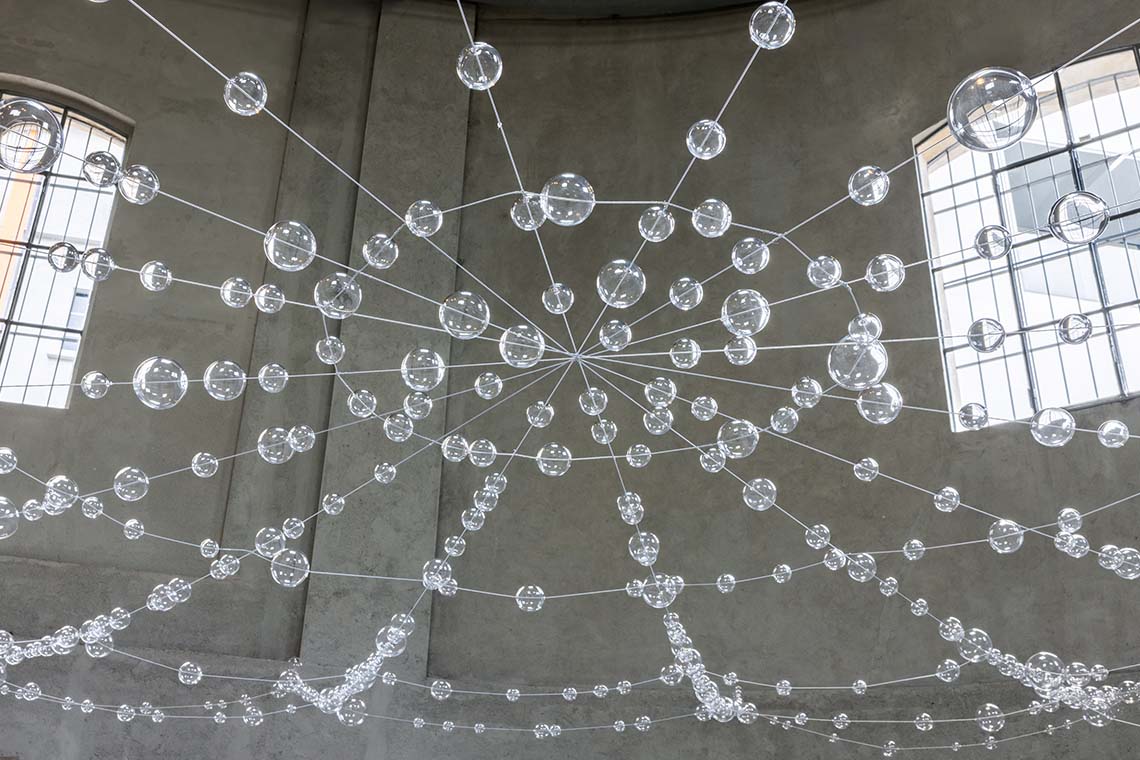
The encounter begins overhead in the first chamber, where we enter beneath Web (2026), an immense, shimmering network of hand-blown clear glass spheres threaded through suspended steel wires. Initially the response is one of awe and the crystalline installation offers a landscape of celestial wonder, catching the daylight and casting delicate shifting shadows across the concrete surfaces like a vault of dew drops or an intricate constellation. Yet this initial allure dissolves to give way to a more complicated psychological terrain as we come to realise that the geometry of the spider’s web cannot be detached from its dual nature as both a meticulously crafted architecture of shelter and a deceptive mechanism of capture. To stand beneath it is to feel caught within a diagram where connection and entrapment are mapped onto the same coordinate system, and Hatoum weaves relational intimacy and structural fear into a single, suspended plane, creating an environment where the immense labour of construction coexists with a quiet, lingering sense of immobilisation.
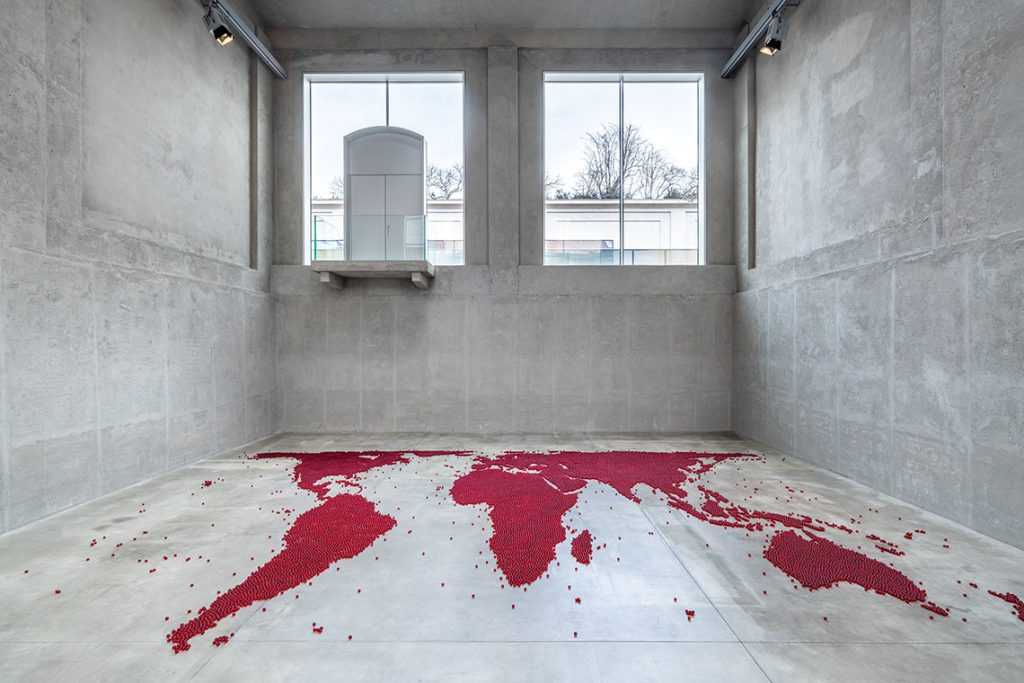
This friction between systemic organisation and material instability deepens as the central room shifts the gaze from the sky to the earth. Spread across the floor is Map (red) (2026), a vast cartographic expanse composed of more than 30,000 unanchored red glass spheres that delineate the contours of the global landmasses while entirely omitting political borders. By opting for the Gall-Peters projection rather than the historically ubiquitous Mercator model, Hatoum confronts the political imagination that geographic representation sustains, exposing cartography as an active, politically fraught framework of domination rather than a neutral reflection of reality. The Mercator projection, naturalised through centuries of European imperial practice, disproportionately enlarges the landmasses of the Global North while shrinking the Global South, but Hatoum’s choice restores a conceptual rigour to relative territorial scales. The brilliance of the red glass initially attracts the eye, although the true gravity of the piece lies in its physical precarity; the spheres remain entirely unfixed and perpetually susceptible to the threat of external displacement – along the margins of the continents, stray marbles spill beyond their prescribed perimeters, contradicting the supposedly absolute authority of geopolitical boundaries.
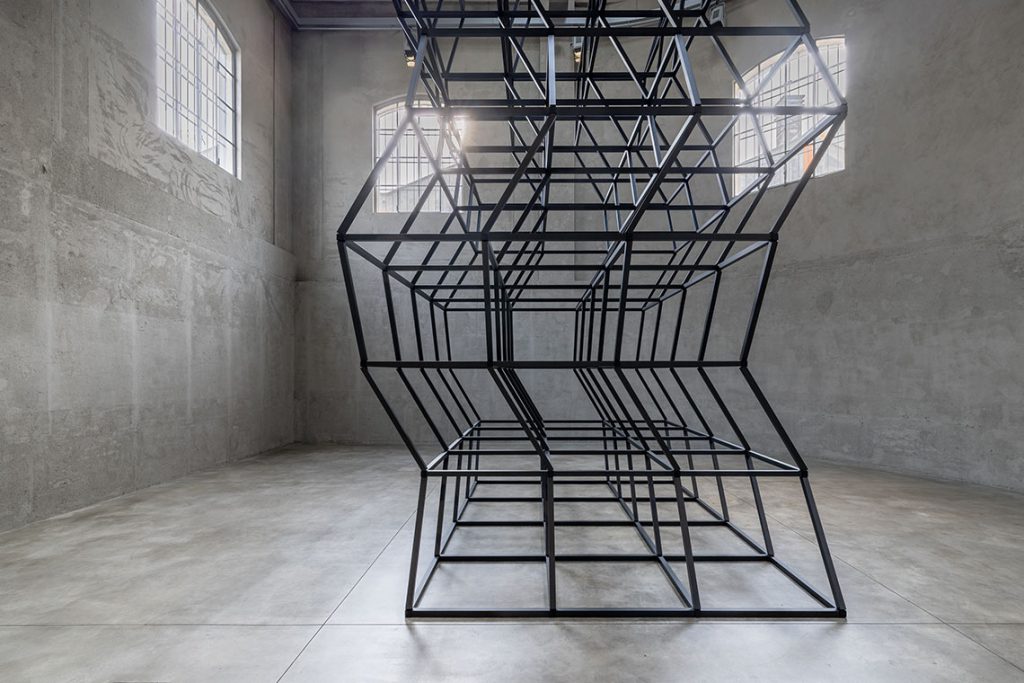
The spatial sequence reaches its most ominous and definitive architectural statement in the final chamber, where the monumental height of the Cisterna is dominated by the foreboding presence of all of a quiver(2022). Standing beneath the barred windows of the industrial space, we are confronted by a towering grid composed of nine levels of open, stacked metal cubes rising over eight metres into the air. Animated by a motorised pulley mechanism, the rigid framework does not remain an inert monument of minimalist order in the position that we first encounter it; instead, it begins a slow, agonising performance of distortion, swaying and bending as if under immense torsion. The mechanical soundtrack of the piece, filled with the raw, rhythmic creaking and clanking of metal, acts as an unnerving physical friction, permeating the room with an uncanny somatic tension.
In its moments of upright stillness, the towering grid asserts itself primarily as an enclosure, a rigid cage that mirrors the structural constraints of the surrounding architecture. However, as the mechanical apparatus pulls the tower into a jagged, downward oscillation, the structure morphs into a form that is strikingly anthropomorphic; perhaps it resembles a hollowed-out building skeleton, or even a vulnerable body slumping toward a trapped, inevitable collapse. In this kinetic cycle, the moments of structural failure take on an unexpected emancipatory valence, suggesting that collapse offers a provisional release from the absolute confinement of the upright grid.
While it is tempting to view this cycle of devastation and recovery through the immediate lens of the geopolitical rupture and territorial violence that we are witnessing today, Hatoum’s creative pursuit steers clear of literal illustration. She has long acknowledged that such realities are reflected in her work, but has also stated that she resists delivering a fixed statement or an explicit political message, preferring instead to pose multiplicities of thought, letting meaning emerge from the inherent properties of the materials and the spaces they occupy. By configuring visually attractive elements to convey conditions of danger, and posing multiplicities of thought, she deliberately pulls the viewer in opposite directions and forces an encounter with the structural contradictions of life itself. In the end, the map, the web and the grid lose their claim to absolute authority; it seems that they become open, fragile systems that sit unresolved and leave the viewer to work through terrains where reality remains a shifting and entirely unanswered question.
