

The opening of the Centre for Contemporary Arts Tashkent marks the latest stop in Uzbekistan’s ongoing contemporary cultural journey.
Tashkent is a city of many incarnations. Once revered as a great medieval centre of learning and a prosperous hub on the fabled Silk Road, it was subsequently absorbed into the sprawling empire of the Russian Tsars, later expanding exponentially to become the fourth biggest city in the Soviet Union. Following a disastrous earthquake in 1966, which razed much of the historic fabric of the city to the ground, it was extensively rebuilt in Soviet Modernist style, later emerging from the collapse of the USSR in the early 1990s as the capital of the new sovereign state of Uzbekistan.
In a place where architecture holds centre stage, it is fitting that Tashkent’s latest cultural offering pays homage to the layered urban fabric of the city. In a nod to the value of preserving industrial heritage, the newly opened Centre for Contemporary Arts Tashkent (CCA Tashkent) is housed in a restored tram depot and diesel station dating from 1912, the first of its type in Central Asia and which has been thoughtfully restored and repurposed by the French architectural firm, Studio KO. The project is led by the Uzbekistan Art and Culture Development Foundation, whose chairperson, Gayane Umerova, has long pioneered the adaptive reuse of historic buildings.
The new cultural landmark has been launched with the exhibition Hikmah, under the direction of the CCA Tashkent’s chief curator, Dr Sara Raza. It features new commissions and recent works by ten Uzbek and international artists, and seeks to explore the concept of hikmah (wisdom) in terms of its value and resonance across Uzbekistan’s wider landscape of multi-layered histories and recent rapid development. Works by Ali Cherri, Nadia Kaabi-Linke, Kimsooja, Tarik Kiswanson, Muhannad Shono, Nari Ward, Shokhrukh Rakhimov, Vladimir Pan, Bakhtiyar Saipov and Daribay Saipov are presented at the imaginatively recast former depot. The scale and configuration of the building calls for decidedly inventive staging and curation. “It’s certainly a non-conventional exhibition space,” says Raza, “but that is both the beauty and the opportunity.”
Participating artists have been invited to respond to the transformation of the structure in which their works are showcased. “It is a chance to think about the ideologies of architecture, but through the artist’s hand,” continues Raza. These words are encapsulated neatly by the installation presented in the Centre’s main exhibition hall, Flying Carpets (2011) by Nadia Kaabi-Linke. On loan from New York’s Solomon R Guggenheim Museum, the suspended steel sculpture was inspired by a visit made by the artist to the Venice Biennale in 2009. Noticing how illegal migrant street vendors – often from Africa or the Arab world – would display their counterfeit wares on simple rugs or sheets, ready to gather everything up and flee when approached by the police or other officials, Kaabi-Linke was moved to create a work that played with the ironic concept of a flying carpet offering boundless travel while also underlining the restrictions and lack of freedom endured by the vendors themselves.
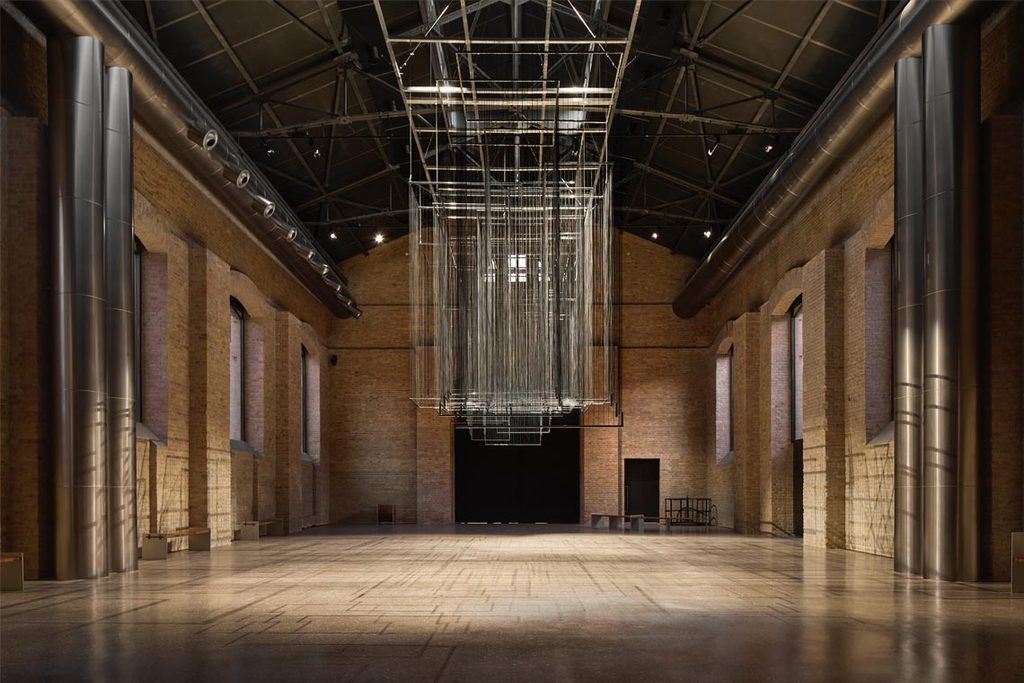
The architectural quality of Flying Carpets – its proportions came directly from the vendors’ rugs – makes for a compelling presence in the gritty main space, but Tarik Kiswanson’s commissioned piece, Nest, speaks just as persuasively to its setting. Oriented around an interest in metamorphosis and renewal, it reflects both the character of its immediate context while also alluding to the wider artistic and cultural transformation underway outside the Centre’s century-old yellow brick walls.
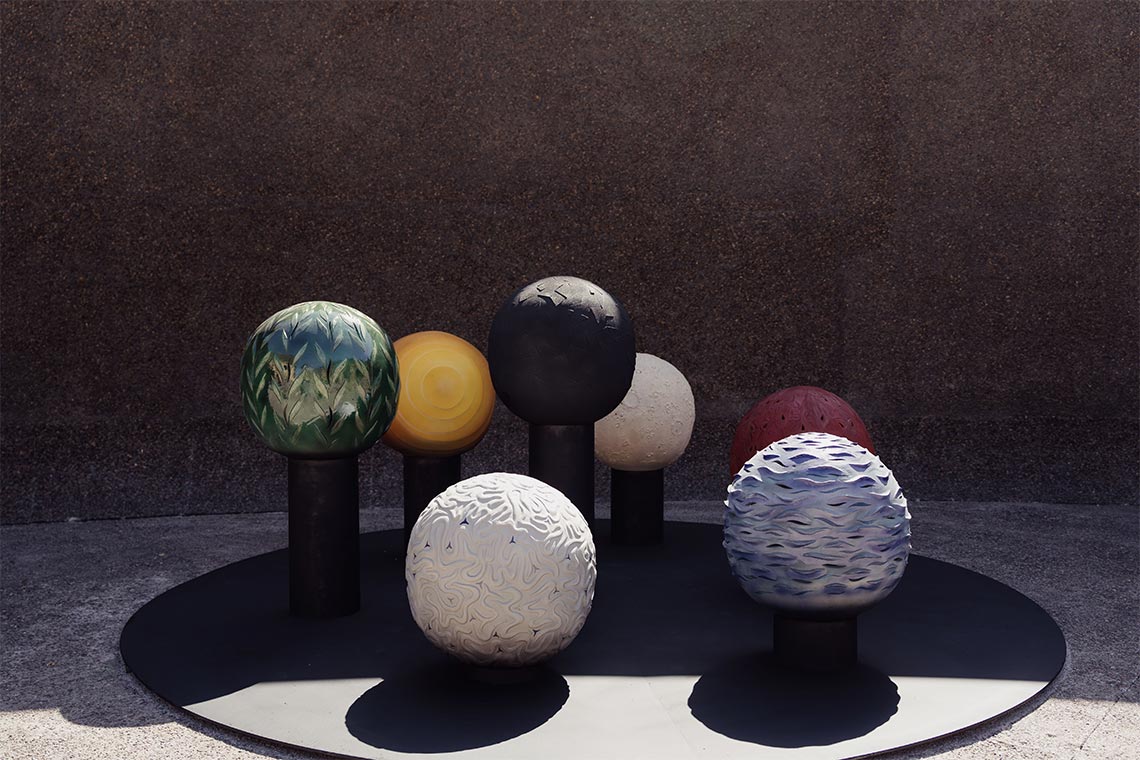
With the CCA residency programme continuing in Tashkent, and soon to be extended to Samarkand, one of the most monumental participations in Hikmah is by a former resident. Developed during his residency, Muhannad Shono’s tubular – you can step inside – Tower for a Single Breath is made from black compressed composite tiles and draws on the Sufi traditions of Bukhara and Samarkand. The artistic and decorative traditions of Uzbekistan are further showcased within Hikmah by Shokhrukh Rakhimov’s The Colour of Silence, In Search of Truth, which spans contemporary expression and age-old craftsmanship in the shape of seven large-scale ceramic orbs, as well as through a selection of historical pieces and artefacts from the collection of the State Museum of Arts of Karakalpakstan.
The brokering of a conversation between the contemporary and the traditional is central to the ethos of CCA Tashkent and featured prominently in the approach to the restoration of the original building. “We wanted the contemporary interventions to be immediately legible against the historic fabric,” said Olivier Marty of Studio KO. “Our interventions were deliberately careful, adding only what is necessary and ensuring that every new element we introduce does not simply belong to any passing trend.” As CCA Tashkent moves forward as a venue for exhibitions, research, education and cultural production, the carefully calibrated approach to its creation and inaugural exhibition should serve as an exemplar elsewhere in Uzbekistan and across the wider region. “At its heart, the Centre is a space for dialogue,” concludes Raza. “Between artists and audiences, local histories and global ideas, [a place] where the past becomes a catalyst for future possibilities.”
Hikmah runs until 31 January 2027
