

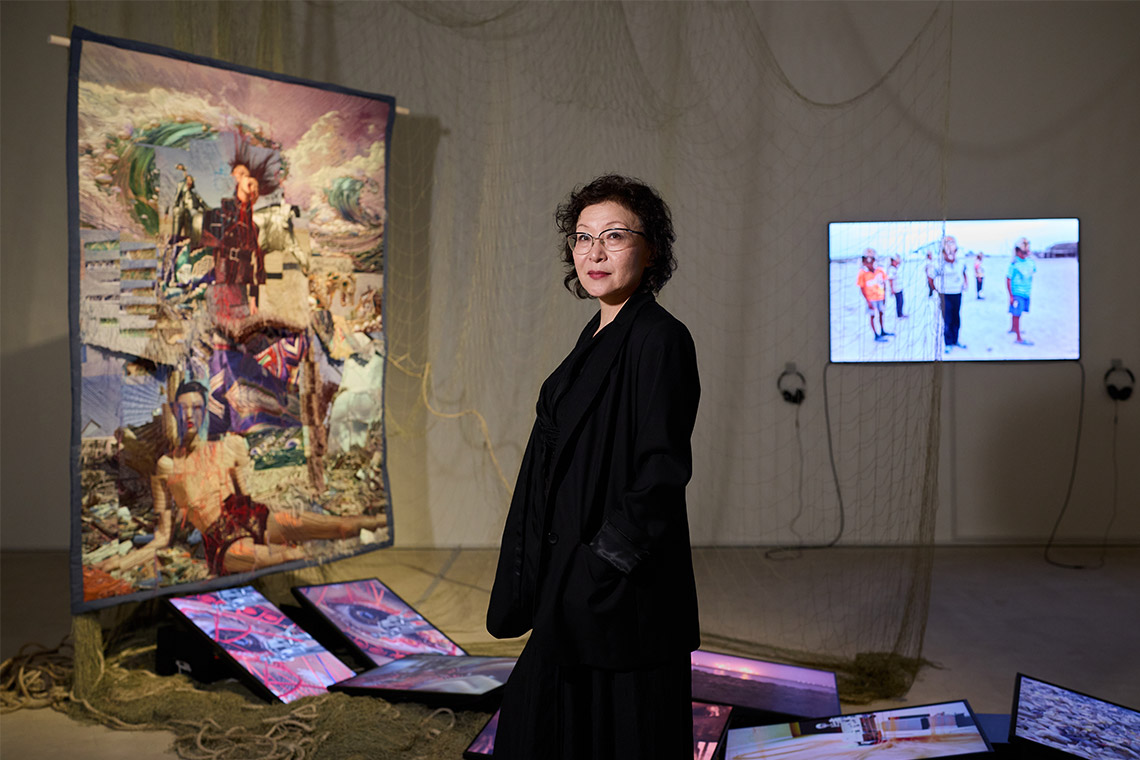
Through a uniquely nomadic and transnational lens, the artist challenges colonial logics of time, history and power.
As artists reimagine the Silk Road, uncovering and renegotiating layered narratives of trade, culture, empire and identity across its vast expanses, Almagul Menlibayeva emerges as a key voice, participating in the reclamation of the trade route as more than an historical commercial highway. In her work, spanning site-specific video installations, photography, cyber textile and AI-generated media, the Silk Road becomes a metaphor for cultural transmission, spiritual kinship and aesthetic hybridity.
Born in Kazakhstan and now splitting her time between there and Germany, Menlibayeva embodies the transnational condition in both her life and art. Her practice reflects a rich interplay of influences – notably, her training at a Soviet art academy with a specialisation in folk art and tapestry, and her exposure to the Russian avant-garde school of Futurism. “This apparent contradiction – between the Soviet avant-garde and folk traditions – has transformed over time into their tense coexistence,” she tells Canvas. “It is this tension that allows me to move freely between different media… I have become a kind of media nomad, looking for a multiple language – not for the sake of form, but to hold marginalised meanings, displaced from official narratives.”
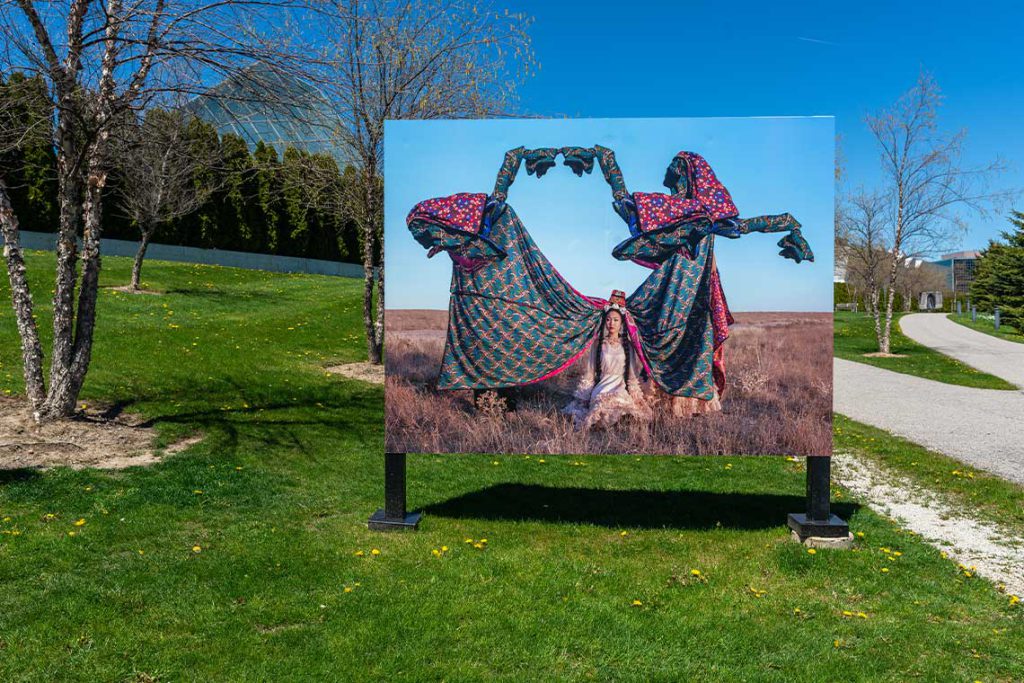
Menlibayeva’s artistic voice is shaped by a deep reckoning with the colonial and post-colonial narratives that have defined Kazakhstan’s recent history. Her work interrogates the lingering impact of the Soviet era – its erasures, aesthetics and environmental recklessness – while seeking what she sees as a decolonial and nomadic aesthetic. “With their flexibility, adaptability and ritual, nomadic aesthetics are a form of resistance to the architecture of control,” she says. “This is not a form of living, but a form of thinking, where freedom of movement and interaction with the environment is more important than monumentality.”
Among her most visceral works, embodying the complexity of decolonial storytelling by engaging with traumatic events from Kazakhstan’s time under Soviet rule, is The Tongue and Hunger: Stalin’s Silk Road (2023), a mixed-media installation exploring the Kazakh famine of 1932–33. Caused by Stalinist policies, the famine killed nearly half of the Kazakh nomadic population – a tragedy still relatively little known outside Central Asia. The piece unfolds in three parts: scholarly research, a personal family narrative and a collaborative piece showing the transformation of ancestral land into the Karlag prison camp, part of the Soviet Gulag system.
Menlibayeva’s decolonial project is animated by what she calls “personal archaic atavism”, a mythic consciousness summoned from historical trauma. “My archaic atavism is not just internalised, but externalised, awakened by the post-Soviet experience of the indigenous Kazakh people,” she has said previously. Through this atavistic figure – part spectre, part symbol – she channels lost cosmologies and forgotten rituals into digital forms, allowing ancestral voices to re-emerge in contemporary idioms.In recent years, Menlibayeva has integrated artificial intelligence into her practice – not to glorify futurism, but to recover erased histories in both historical and rather more contemporary contexts. “Perhaps my interest in artificial intelligence is rooted in the traumatic history of Kazakh nomads,” she notes, recalling how the Bolsheviks introduced a system of strict control in the form of collectivisation and sedentarisation, which transformed ancestral lands into state property and curtailed nomadic existence, pressing communities into permanent settlements aligned with Soviet ideals of productivity. “This technological logic created not just a new form of governance but also a ‘guillotine of efficiency’ that wiped out almost half of the nomadic population,” Menlibayeva explains.
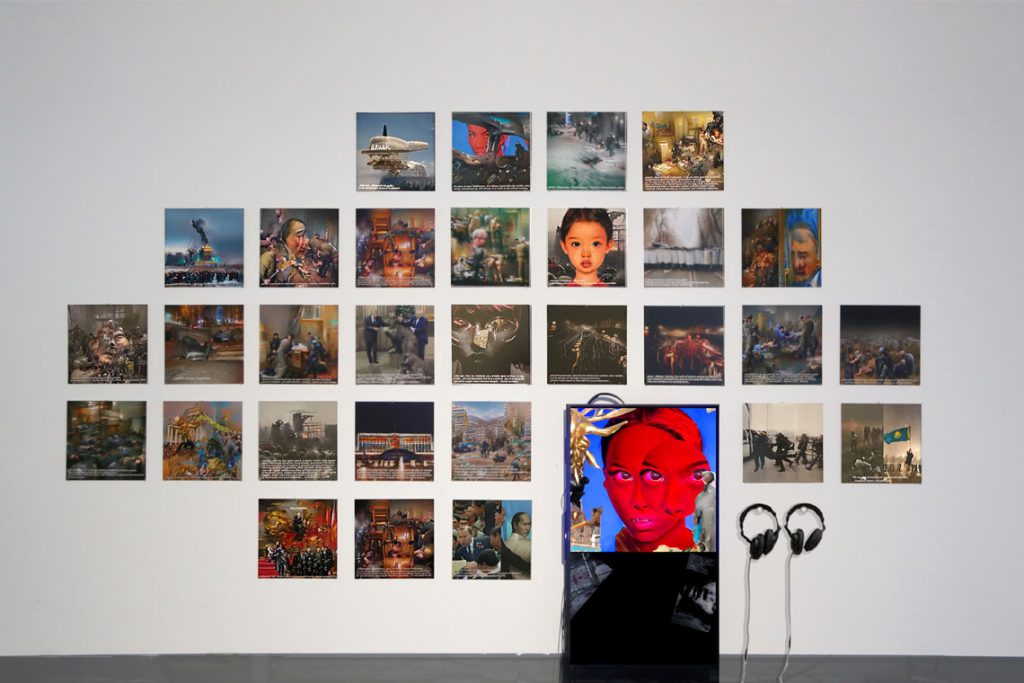
Her 2022 work AI Realism: Qantar exemplifies her approach, applied to a contemporary event whose memory has also been suppressed and obscured. Using speech-to-text-to-image tools, Menlibayeva’s 24-minute video work constructs a synthetic memoryscape of the January 2022 protests in Kazakhstan – events censored by the state and buried in algorithmic silence. Unlike AI projects that look to the future with cold, sterile logic, Menlibayeva’s use of AI is deeply emotional, speculative and archival. It challenges the narratives of power and asks if technology can help recover voices erased by history. Can machines become spiritual tools for collective remembrance? By humanising AI, Menlibayeva subverts its typical post-human associations. “The humanisation of AI is not the task of programmers,” she insists, “it is the task of artists.”
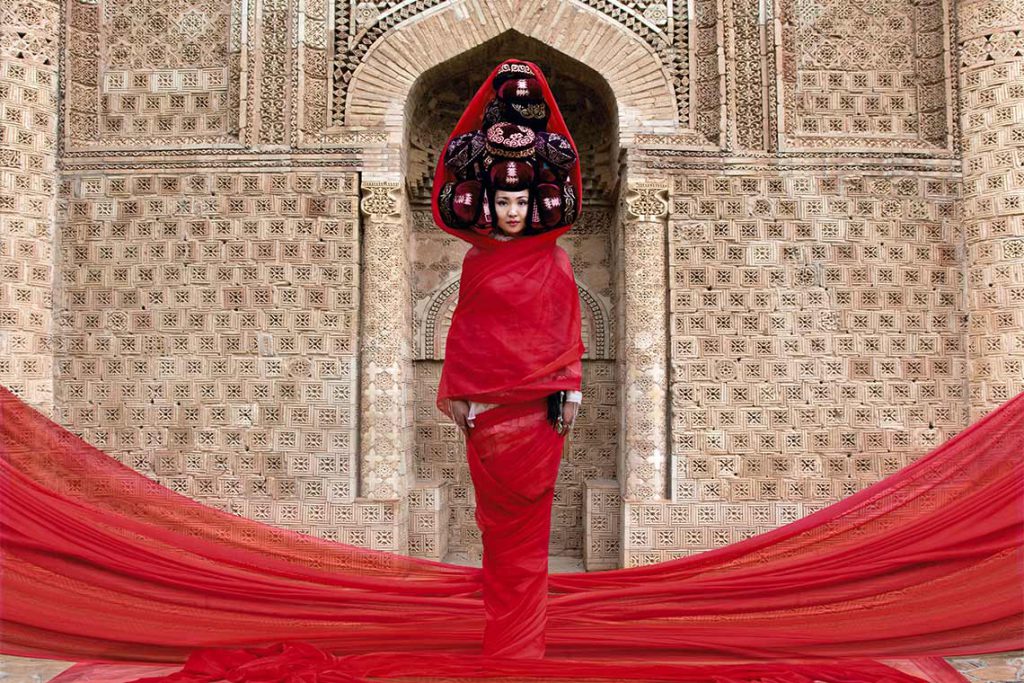
Throughout Menlibayeva’s work, women emerge not as victims of history but as agents of memory, resistance and myth-making. “Each woman in my works is a living being in search of equality and strength, in constant struggle with the structures imposed by society,” she explains. In the series My Silk Road to You, women appear as mythic guardians and political witnesses. In The Red Butterfly (2012), a blood-red cocooned woman stands against the mausoleum of Aisha Bibi, a historic female rebel. In another piece, The Global Entry 1 (2011), black-shrouded women appear as both pillars and shadows of a decaying modernist ruin, linked by winding textiles that blur the line between body, architecture and memory. “Through my art, I seek to explore deep philosophical questions about the nature of power and subordination,” Menlibayeva affirms, “showing how gender identities are formed, deformed and transformed in the context of global changes.” These images not only dramatise the legacy of patriarchal and colonial control but also position women as time-travellers: custodians of ancient knowledge, participants in cultural rebirth, and protagonists of identity.
Time, for Menlibayeva, is not a linear progression dictated by what she calls “the colonial logic of progress” – a structure built in the interests of power, declaring some cultures “advanced” and others “backward”. Her work actively resists this hierarchy by reclaiming what she describes as “multiple layers of time”, whether mythological, corporeal, historical and intuitive, and in which the past is not severed from the present. The future remains firmly rooted in ancestral memory. This reprogramming of time – rendering it “alive again, pulsating, uncontrollable, filled with potentials” – becomes a radical act of sovereignty over perception. Across her practice, time is both a subject and a tool, a way to not only engage with loss and remembrance but also to summon the possibility of “another, non-colonial future” shaped by silenced archives, marginalised voices and submerged knowledge that her art brings to light.
As an artist from Kazakhstan working internationally, Menlibayeva is keenly aware of the challenges of visibility and interpretation in the global art world. Her work is rooted in her country but unfolds in a transnational space, shaped by adaptation, dislocation and return. “Being an artist from Kazakhstan in a transnational context is always a movement, an adaptation to the new,” she reflects. “I always carry with me a multi-layered presence.” This sensibility runs through her work – where nomadic memory collides with digital tools and ancestral knowledge is reactivated in contemporary forms. Menlibayeva embraces the ambiguity of interpretation, welcoming the “uncontrolled emergence of another space where something new arises.” In this space, she invites viewers into a dialogue that is ongoing, unresolved and urgently alive.
