

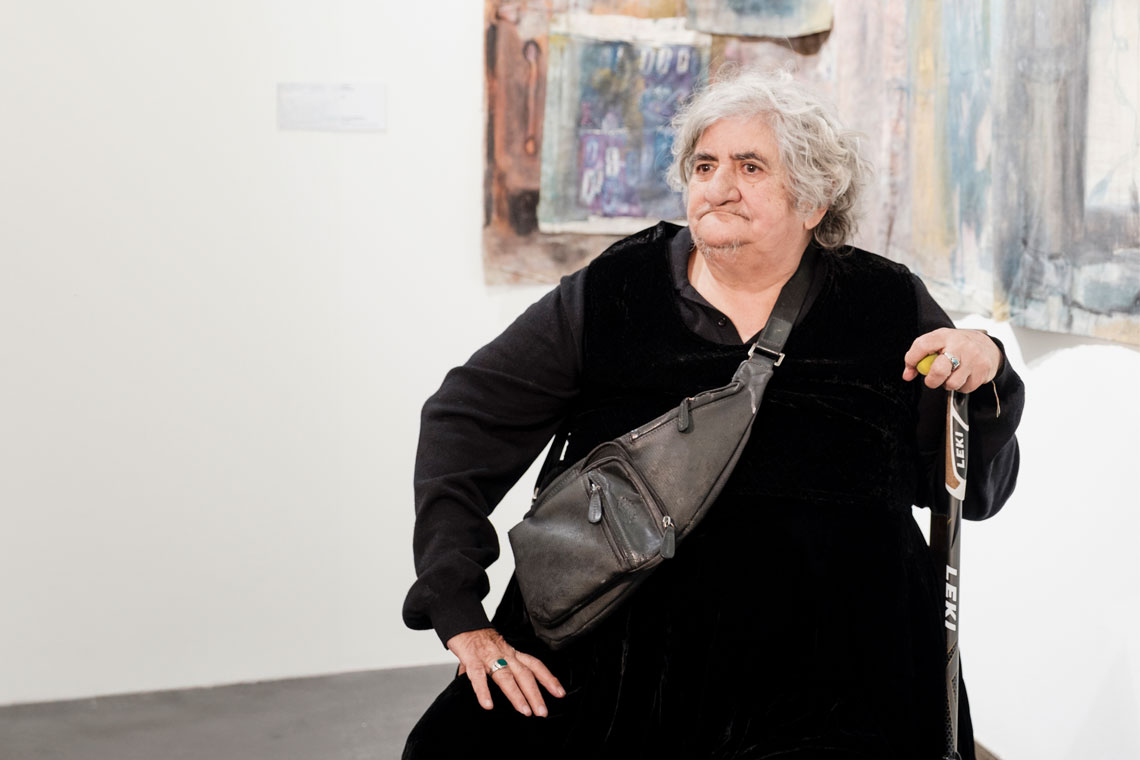
The artist leads a creative life on the road as she unpicks and expresses past histories and myths in her own language.
“You won’t find a new country, won’t find another shore /This city will follow you,” says Constantine Cavafy in his 1894 poem, The City. The Greek-Egyptian poet’s aching lines resonate with the impossibility of undoing the past as well as freeing the memories from a place. The Alexandrian then declares in his verse the futility of striving to abandon home: “You’ll always end up in this city / Don’t hope for things elsewhere: there’s no ship for you, there’s no road.” While his words may echo as downcast in tone, they are in fact reminiscent of the entanglement of histories and drift, of the linearity-defying essence of places we rewind up with, as well as those ingrained into remembrance.
Anna Boghiguian nourishes her art with a similar trust in evocation and storytelling. The Egyptian-Canadian artist’s installations of sculptural drawings, draped textiles and paintings grasp cities, moments and people. With a cartographer’s precision, as well as the mysterious hand of an alchemist, she traverses realms of disputable reality and plausible imagination. “Life in itself is an adventure, a story,” she tells Canvas from Turin, where she is reinstalling her 2015 Istanbul Biennial mixed-media installation, The Salt Traders, at Castello di Rivoli. “Salt, like cotton, is a material that changed world history and the behaviour of people.” The artist is fascinated by earthy materials and their entanglement with cross-continental histories. With a command similar to that of a conductor over an orchestra, Boghiguian occupies spaces with an operatic grandiosity. Her sweeping juxtapositions feature, in addition to cottonand salt, papier mâché, fabrics, maps, books and even beehives, activated with three-dimensional cutout drawings of historical or imagined characters.
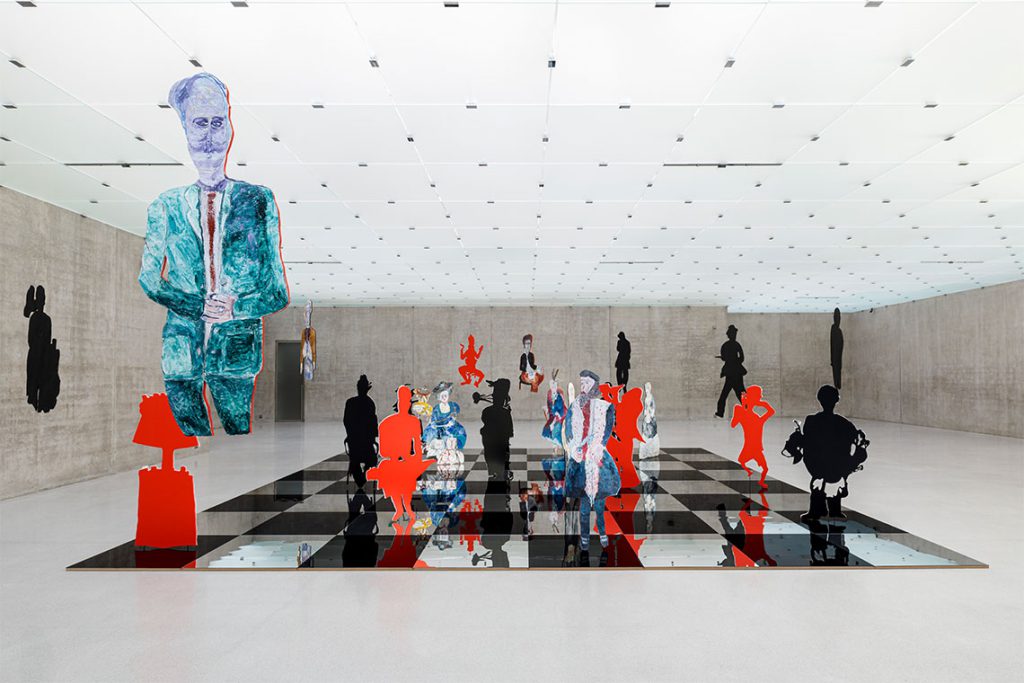
Image courtesy of the artist © Anna Boghiguian, Kunsthaus Bregenz
Travel has been a form of practice for the artist, who studied political science at the American University of Cairo before heading to Canada. A gradual loss in her hearing led Boghiguian to seek a “silent” practice, and she eventually majored in drawing, alongside music, at the Concordia University in Montreal. She subsequently showed her work for decades, largely in Cairo, but the 11th Istanbul Biennial in 2009 – where she exhibited a series of drawings about Cavafy – introduced her practice to an international audience. Then came, alongside tens of solo shows around the world, participations in documenta, Site Santa Fe and biennials in Sharjah, São Paolo and Sydney. In 2015, Boghiguian – who has Armenian heritage – showed in the Armenian Pavilion’s group exhibition, Armenity, which won the Golden Lion for best national participation at the 56th Venice Biennale.
With each invitation, the artist has found herself in a new destination, surrounded by layers of history and stories, whether written or told. In her 2018 New Museum exhibition, The Loom of History, she laid out cotton plants in the gallery space to tie her installation of marching cutout figurines from all walks of histories with America’s connection to slave labour. A year later, she was in the UK for her Tate St Ives retrospective, which washed the London institution’s seaside town outpost with sailcloths hovering over a huddle of ancient Roman characters from Nîmes, including soldiers, gods and bullfighters. In a stark example of how to conjure the folkloric with the local, Boghiguian also cast in her spellbinding orchestration anonymous fishermen and mine workers, in steel and nickel, from the heart of St Ives where tin mining was a major industry for centuries. “I look for the obvious and out of it, I try to create the obscure,” she explains, “because the most obvious things are also the most obscure.”
2024. Photography by Stathis Mamalakis. Image courtesy of the artist and Sylvia Kouvali London/Piraeus
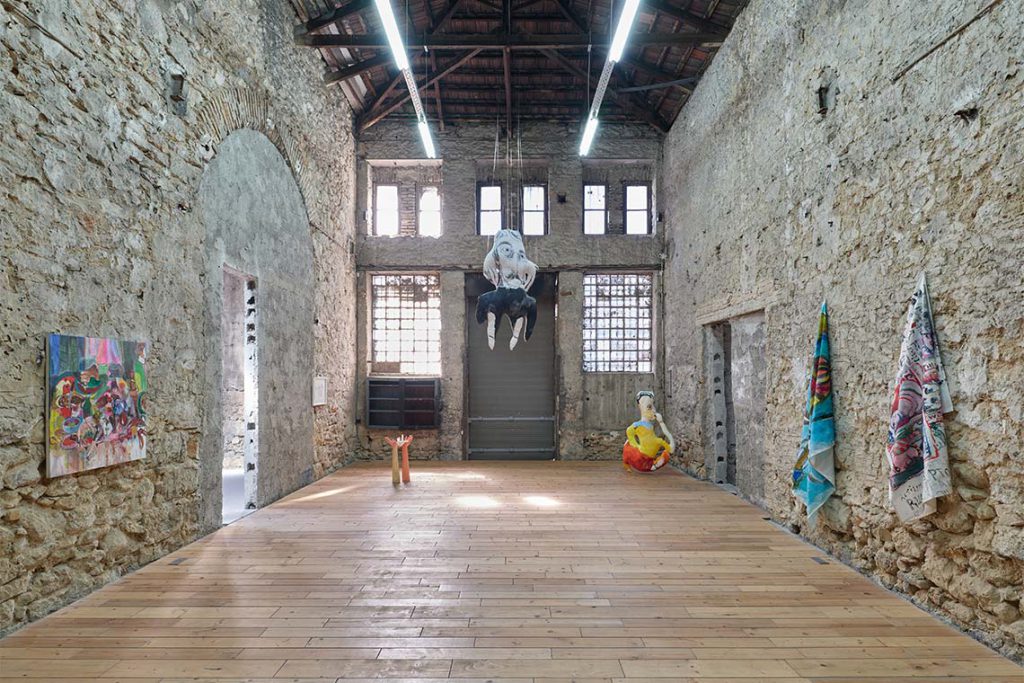
Spirited and exhilarated, the artist’s figures thrive in their plurality and procession. They embody the Greek chorus with their harmonised concert, yet the characters also inhabit the line between the protagonist and the antagonist, the hazy territory of determination and carnage. They tend to gaze at different directions and commit to singular volitions. Each part possesses an openness towards the future while vehemently holding onto past burdens of trauma and joy. Boghiguian rewrites past figures – some storied, others fallen out of grace – parallel to anonymous archetypes who have perhaps shaped history as much as the names in history books and on pedestals. The tight knot of micro and macro, as well as the global and the local, conveys human and even humorous accounts of time, experienced according to the artist herself and anyone encountering her work. The visual story of each exhibition starts in her mind, based on research before grabbing the paint. “Circumstances of the space and ‘mentality of the world’ later affect the initial plan,” she explains.
at Sylvia Kouvali, London, 2024. Photography by Lewis Ronald. Image courtesy of the artist and Sylvia Kouvali London/Piraeus
At the end of 2023, Boghiguian returned to Canada for the most ambitious outing of her career in the country, an engaging show at Toronto’s The Power Plant, which featured a larger-than-life game of chess in which the 32 cut-out pieces included none other than Josephine Baker, Egon Schiele, Leo Tolstoy, Marie Antoinette, Franz Ferdinand and Friedrich Nietzsche. The desire for witty outsmarting inherent to the chequerboard game is characterised with the slipperiness of glory and disgrace.
Whether orchestrating a surreal mind game or a procession of local labourers, Boghiguian starts the journey at her Cairo studio, the rooftop of which overlooks the Nile. Travels allow the avidly curious artist to spill her thoughts into the streets, whether she is stomping through Berlin, Athens or Brisbane. Among her most cherished trips are those to India, Cambodia and Japan, partly because of the conversations she had with locals on the long train journeys she undertook and which she spent drawing. “People were always very interested in what I was doing,” she recalls. Unsurprisingly, chance steers her life and work, with an eager receptiveness to the whispers of a place serving as her guiding light. Effortless but precise, she tunes soundbites, journals, pictures, history books, letters and songs into new possibilities to understand the past.
