

Constantly striving to see the unseen, the artist composes odes to cities haunted by ruins and memories.
Five years ago, Emre Hüner began seeing Istanbul like never before. During the height of the pandemic, the enforced immobility helped the artist explore his city through a different lens: its chaotically composed mosaic of the historical and the new, as well as the beautiful and the grimy, yielded new paths to stomp and archive. The long walks around the storied neighbourhoods of Karaköy and Dolapdere promised their mishmash familiarity – think a car repair shop sandwiched between a private vegetable garden and a high rise of luxury condos – but the city was also plunged into a foreign discord, a trait that Hüner meticulously orchestrates in his video installations and sculptures. “I have always been fascinated by walking through Istanbul, gazing at its brutal and post-industrial landscapes, the. absurdities with no architectural rules, unplanned DIY structures and the contrasts in its urban texture,” he tells Canvas. “Being familiar with the city but discovering it again all the time plays an important role in my work, as do the micro-stories that I’ve captured in these locations.” Even a trained eye can barely catch in the artist’s work a direct homage to the grand metropole.
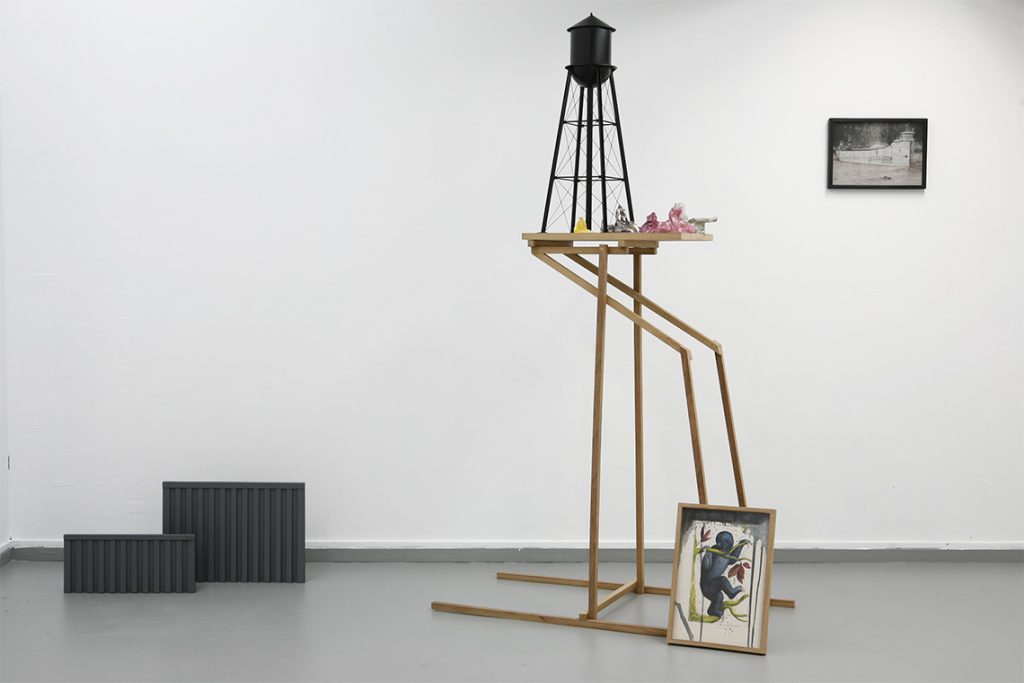
Hüner extracts odd slices from the city’s urban multitude to craft, in return, moody contemplations of detachment and drift. From the mass production of washing machines to placid canal waters glistening with city lights, the objects of Hüner’s curious eye are woven together with cut-outs of found footage and animation. The artist’s sequences of collapse and reformation linger at a hypnotic pace, often accompanied by emblematic epoxy resin, ceramic or clay sculptures that seem to have travelled out of the video. They remain as static witnesses of the moving images, excavated artefacts with alluringly intact surfaces.
Opposite: Emre Hüner. The Archive of Capillary Ruins, nr.5. 2024. 30 x 42 cm. Images courtesy of the artist
While Istanbul is a recurring subject for Hüner, who also resides in Amsterdam, the artist distills his first-hand bond to the city to conjure anonymous, almost foreign, landscapes. He translates his tight strategy of capturing and configuring a place to other cities, such as San Antonio, where the artist was a resident at Artspace in 2019. The Texan city’s synthesis of colonial Spanish architecture, generic glass-clad high-rises and endless highways provided yet another harmony of discord for an installation at the art centre, entitled A Model is not a Map a Home is not a House. Hüner’s footage of the city’s light-filled streets – where doomsday preparers’ tents blend with chain restaurants – along with fire clay sculptures and discarded found objects, chronicled a place extremely remote from his foremost city; however, the sense of a displaced search was familiar.
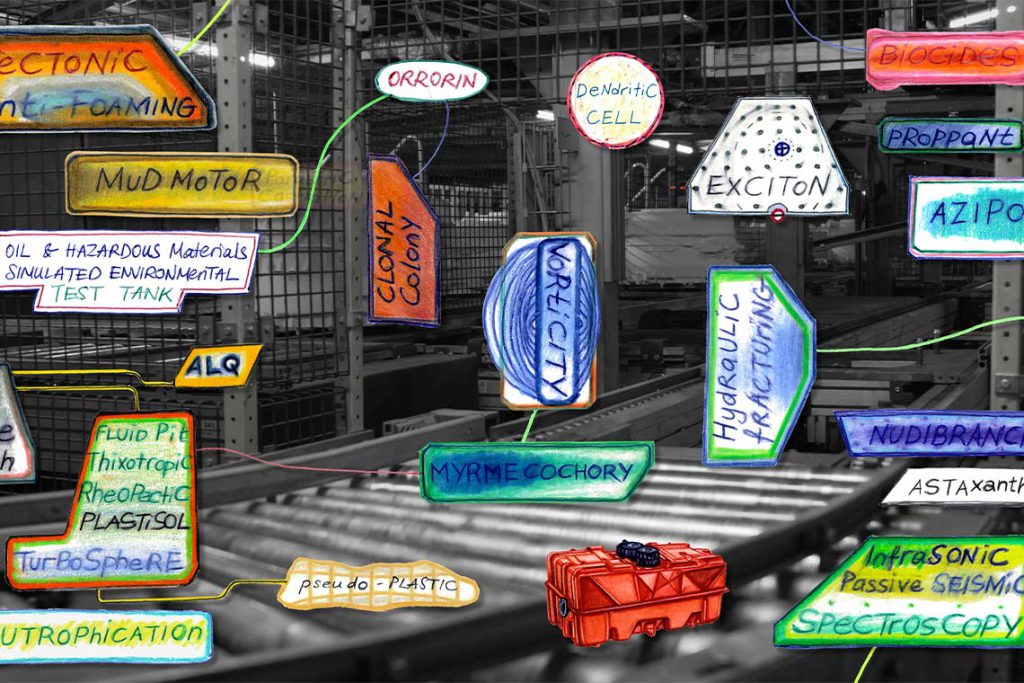
[ELEKTROİZOLASYON] (2021–24), which debuted in the artist’s solo show at Arter in 2021, features over five-hour long shots of productivity and its refusal, sonic echoes of industrial production howling into silent introspections of a few anonymous subjects. Between the haziness of black-and-white shots appear cartoonish illustrations of a human organ or scribbles of chemical products. Actors clad in sterile all-white attire commit to vague tasks, searching for an unknown or researching the absurd while they move around soaring factory facilities and outdoor piles of debris. “Whether in the industrial zones or hardware stores around my studio, the ruins among the new high-rises, with car mechanics next to hospitals or the way that the city operates,its strange dynamics are always an inspiration for collecting materials or taking notes,” adds Hüner.
Rather than focusing exclusively on Istanbul, the artist chases the speculative texture of a city, eschewing any direct references to particular characteristics of his home town. The uninhibited meandering between documentation and fiction renders Hüner’s universe devoid of the stamp of any particular time period. Yet the aloof positioning of the characters within their surroundings hints at a recognisable breezy isolation born from contemporary angst. “Today’s fast access to world events has really changed the way in which we approach physical space,” says the artist, “but on the other hand we’re still living with the constructs of the past century.” He admits to believing in the possibility of society “[even] moving backwards, except maybe in terms of the levels of surveillance or control by those who benefit from such systems”. These ambiguities keep Hüner’s practice porous and even unpredictable. “My approach remains sceptical, trying to imagine a couple of steps further,” he admits.
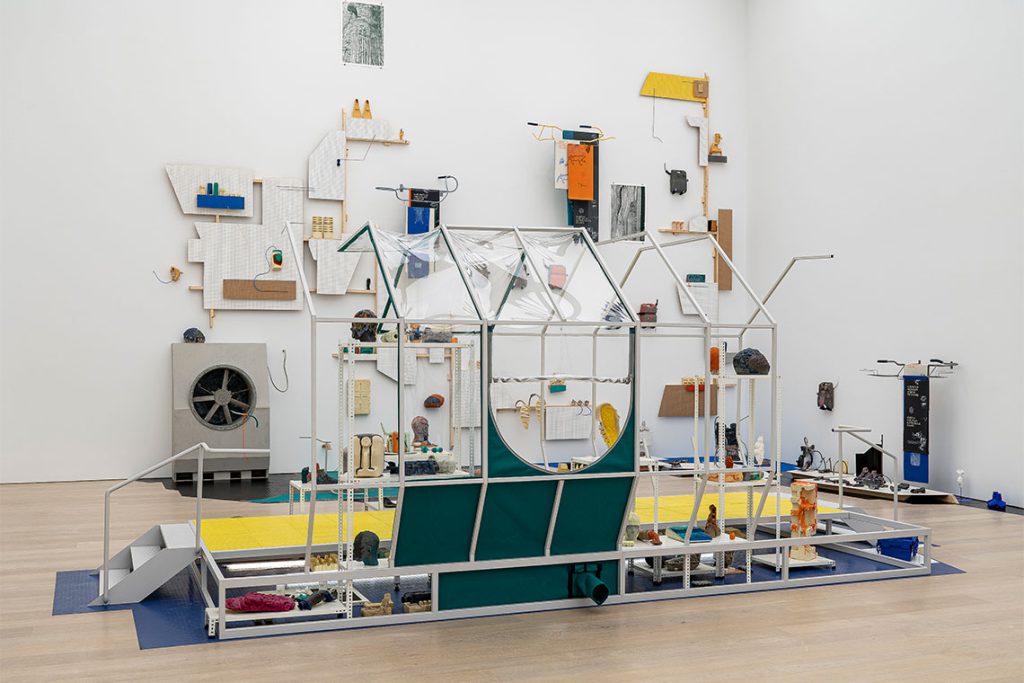
The Archive of Capillary Ruins (2024), a series of drawings currently on view in the Asian Art Biennial (see page 168) in Taichung City in Taiwan, chronicles fictional and encyclopaedic knowledges in the form of assembled diagrams. Their technical precision complicates their speculative reality. This strategy is not different from Hüner’s overall composition of objects and fleeting thoughts throughout his videos, such as a shorter version of [ELEKTROİZOLASYON] that is now on view as part of the show at the National Taiwan Museum of Fine Arts and will be in the upcoming Sharjah Biennial. The artist presents the display of film, drawings and sculptures behind a
plastic curtain in blue, not only embodying the murkiness of fiction suggested throughout but also enveloping the viewer with a clinical discomfort. The audience feels challenged by an urge to finger point to a feeling which remains too slippery to grasp.
Dystopian is perhaps an immediate attribute for Hüner’s world-making; however, he is more concerned with the failure of the utopia, the aftermath of shattered promises in progress. “I think about the present, where the dystopian element is already in the past, now just a default fact of our time,” says the artist, who builds his universes on the in-between. Neither here nor there, Hüner’s sequences traverse the realm of logic without settling on any particular feeling or conclusion. The weaving of demolished construction sites, abandoned Byzantine ruins, gargantuan oil tanks and seamlessly operating factories strips each site of their charged narratives. They appear as pantheons of insistent disbelief and lost memories, witnesses to soaring ambition and its eventual fizzling out.
When Hüner travelled to the Brazilian Amazon to visit Fordlândia in 2010, he was initially compelled to shoot the town of failed industrialist desire and environmental decay. The collapse in this case, however, was too obvious and the reality too palpable to infiltrate – he was already surrounded by his own video. He instead created the installation Quixotic (2011), without any image from the site of failed Fordism, rather composing together sculptures with vague references to rubber plantations and the prefabricated town’s unrealized collectivity. “When I travel to different locations to make new work, I find the elements that are already there as part of my universe,” says Hüner, “as if there is one big narrative in my mind. The pieces come together by themselves or unexpectedly, all connecting to the sequences of an ongoing film.”
