

Lydia Ourahmane blows new life into the invisible functions of Venice in her Nicoletta Fiorucci Foundation exhibition.
A glory of art is that it defies function. Unlike the majority of other fascinations that make crowds travel across the world and funnel to cultural destinations, art unabashedly does not necessitate a primary purpose. Instead, an intrigue to ask questions and a desire to simply absorb an aesthetic reverie are its promises. Lydia Ourahmane, however, runs against the grain. The often unpredictable output of the Algerian-born artist is commonly anchored by a direct impact to change and ideally advance the circumstances of the communities that surround her exhibitions. She previously invited more than one hundred local people to freely utilise the gallery space that Museum of Contemporary Art of Barcelona granted her for her first institutional exhibition in Spain; and, along with her musician sister, she composed a sonic piece for visually impaired singers to read through touch for her Castello di Rivoli commission.
Ourahmane’s new solo exhibition, 5 Works, at Venice’s Nicoletta Fiorucci Foundation, economically features a handful of artworks that mostly burgeon from the locals’ needs and histories. The artist has, in fact, spent over a year in the city (where she still resides) to listen to the echoes of a lagoon thickly blanketed by tourism and environmental collapse, and beyond gushes of crowds bottlenecked in narrow alleys and howls of heavily trafficked water taxis, she heard whispers lingering from the past, striving to be heard for the future.
The fruit of Ourahmane’s months of calling Venice’s relatively quieter Giudecca district home is a locally minded show. The works that she has installed to gently occupy the serene fifteenth-century palazzo’s earthy interiors stem from her collaborations with local craftspeople and organisations that maintain both the city’s liveability for its people and its sustainability for the future. Stretching to 975 centimetres in length, (45.3820696, 12.3294242) is a long platform made out of various kinds of wood and galvanised iron. Materially hefty and dominating in its command, the structure results from the artist’s joining of forces with the local organisation Poveglia per tutti, which aims to turn the titular island off Venice into a park for the locals.
Once a prison and then a mental asylum, the abandoned isle is often considered to be haunted, and – like many other untouched plots of land within the lagoon – faces the possibility of being poached by developers for development as a resort. Ourahmane’s response is a solution-based piece that eschews aesthetic concerns for the sake of function. After fulfilling its position as an artwork, the sculpture will become the permanent dock for the island’s visitors and connect its future park with the public. Reversing the common ritual of readapting a found object into a work of art, in a way the offering strips a sculptural reality into a completely conceptualist approach and suggests a reckoning on the position of art-making in a city increasingly affected by climate change.
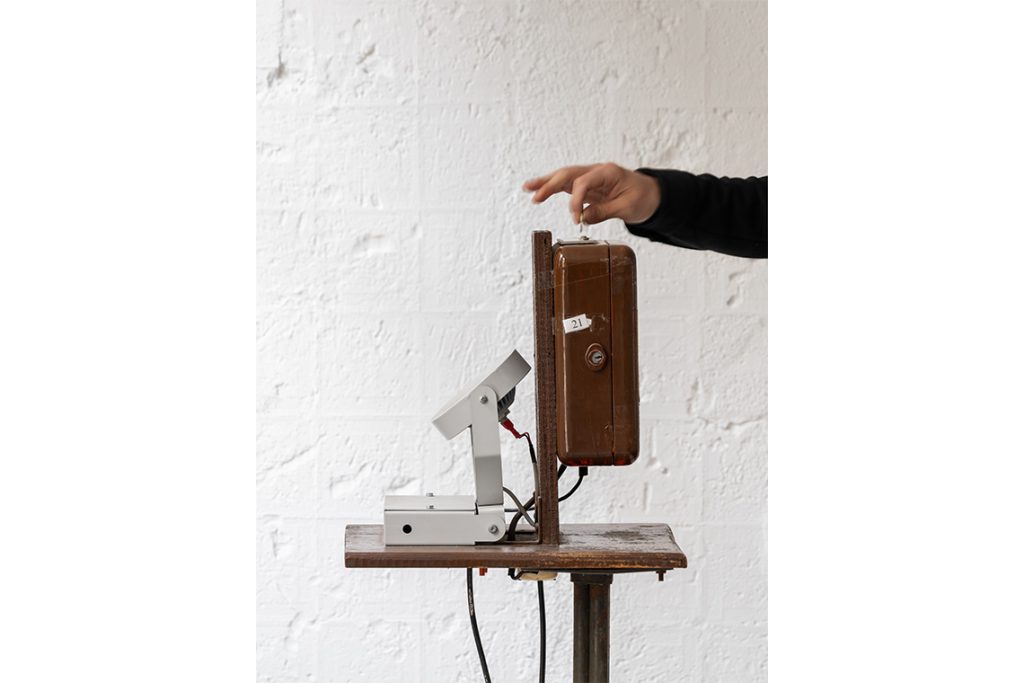
The marriage of sustainability and conceptualism is also evident in Offerta Luce €1, an old light box which asks for the insertion of a one Euro coin into its slot to turn on its LED light. Held together by tape, the crumbling machine still flickers when activated, albeit with little obvious impact in a gallery generously bathed in natural light coming from its caressing backyard. The machine comes into the show from the nearby church of San Giovanni Grisostomo, after illuminating Giovanni Bellini’s 1513 oil-on-panel painting Saints Christopher, Jerome and Louis of Toulouse for decades. Ourahmane monumentalises the fleeting awe and amusement of visitors that the machine witnessed when it made visible the divine depiction of a holy conversation between saints.
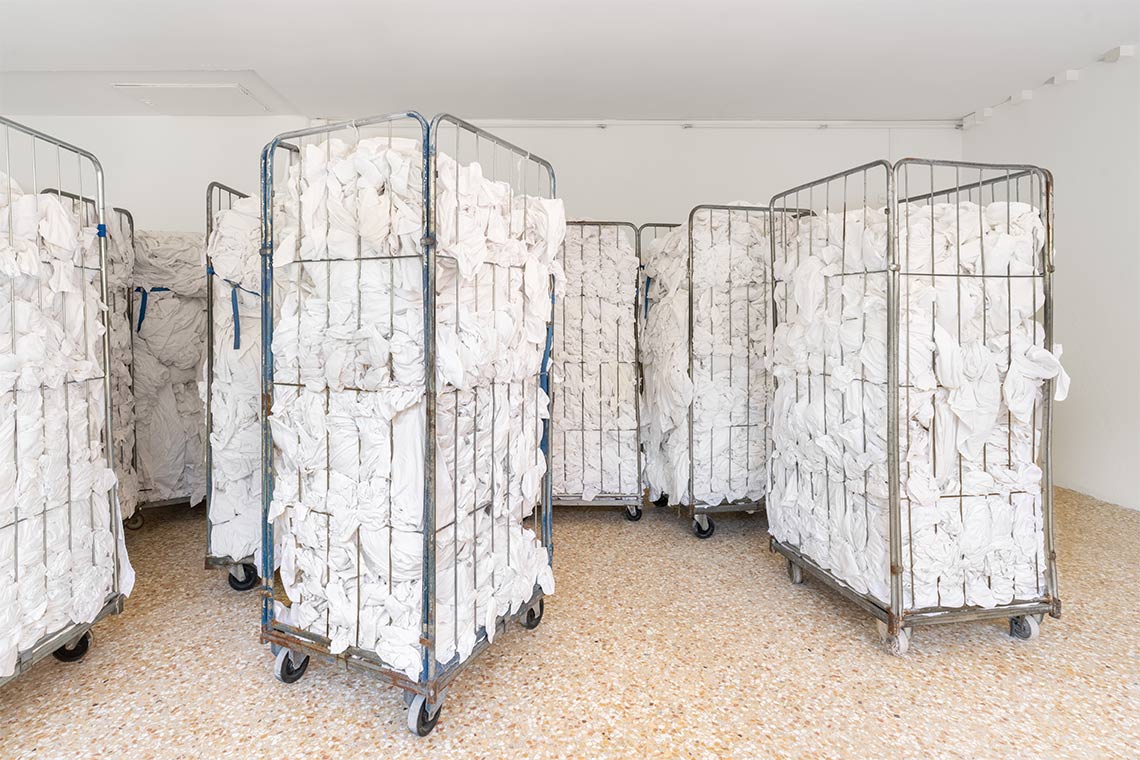
The Foundation has donated a new light fixture to the bell-towered sixteenth-century church in exchange for the retired machine’s second lease of life as a participatory sculpture. This shuffling of purposes allows the artist to question the determinators of value and viability. Take, for example, 1.3 tons of decommissioned bed linen from 200 Venetian hotels, a huddle of white bedsheets crammed into industrial-looking cage trollies on the second floor. A common sight for early morning strollers, masses of laundry are hauled to hotels every day via boats; here, Ourahmane instead disrupts their often neatly folded format into chaotic piles. The sheets collected from 200 local hotels paint the gallery corner into a crisp white, contrasted with the rigidly geometric structures of their containers. The dramatic folds of masterfully depicted Renaissance paintings come to mind, yet in lieu of euphoric saints, the agents of the textiles are rapidly recycled guests and exhausted hotel workers.
5 Works runs until 22 November
This article first appeared in Canvas 123: Venice Special Issue
