

A group exhibition at Indigo+Madder embraces the often difficult-to-grasp state between our interior world and what can be seen from the outside.
Indigo+Madder is tucked away in an alley in London’s Holborn, a hidden gem in the sense that it is easy to walk by without realising it. Its current group exhibition, Diaphanous, has taken over the space, bringing together works by eight artists “whose practices operate at the threshold between psychological interiority and the external, social world”.
The natural light filtering through the skylights in the gallery’s high ceiling makes the otherwise modestly sized space feel airy and light. In London, that trickling of natural light can itself feel ethereal as it filters through windows, the sun almost present yet not quite within one’s grasp. The first work that visitors encounter in Diaphanous is a mere 23 x 18 centimetres, a small embroidery on muslin and hand-dyed phulkari on cotton by Jagdeep Raina. One has to get very close, almost uncomfortably so, to make out the figures woven in black and colourful threads onto the upper half of the piece of fabric. Beneath a scene where a young woman appears to pour water into an older man’s mouth, Raina has stitched the words “The old man’s lips crack, His hands blistered, his mouth, dry, she pours him water”. They read like a poem, and the last one, “water”, seems to spill off the edge of the fabric.
Surprisingly, this is not the smallest piece included in the exhibition. A tiny, miniature chair by Noorain Inam is affixed to a nearby wall, suspended far above ground. It sits between a mystical moon painting by Lulua Alyahya, echoing the night scene on its other side by Gurminder Sikand, in which two nude women appear in a nighttime forest setting. One lies on the mossy floor, the bent branches of the trees in the background suggesting a cold and tempestuous night, while the other is standing, looking almost surprised at her state of undress as a red moon rises in the sky. Are they one and the same? The scene comes up like a dream, the boundary between interior and exterior embodied in the seemingly vulnerable and perplexed state of the standing woman.
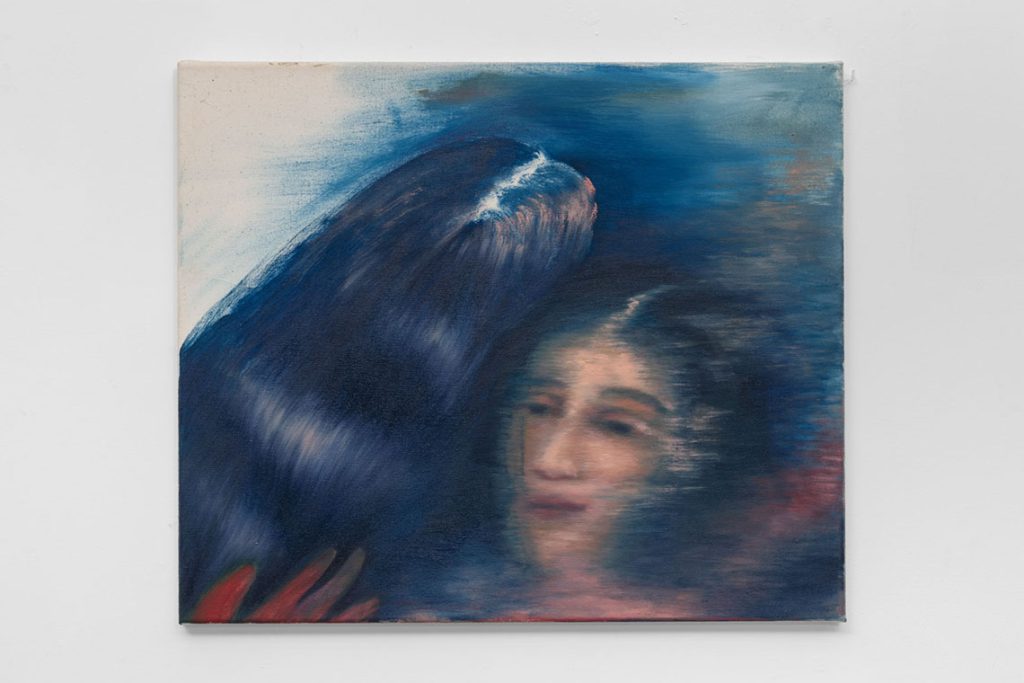
Overall, the exhibition is pleasing to the eye at first, but behind that pleasure lies something else, not necessarily sinister but discomfiting. Diaphanous is felt as something that cannot be easily grasped but is still felt. This tension pervades the various scenes dotting the gallery walls. In the watery aquarelles of Lalitha Lajmi, where orange and blue-hued figures appear, a nude woman with a clothed companion admires a bird as two ducks look on, leaving one in a state between reverie and reality. Other scenes pertain more obviously to what the exhibition text terms as “diaphanous”, meaning the link between internal psyche and external being, as in Lajmi’s Dialogue (2017), where a woman turns away from her reflection in a hand-held mirror or in Shivangi Kalra’s I melt in your embrace (2026). There, a raven-haired figure with her back turned holds a woman whose face is visible to us, the two appearing to be one and the same as the edges between them blur at the point their hair meets.
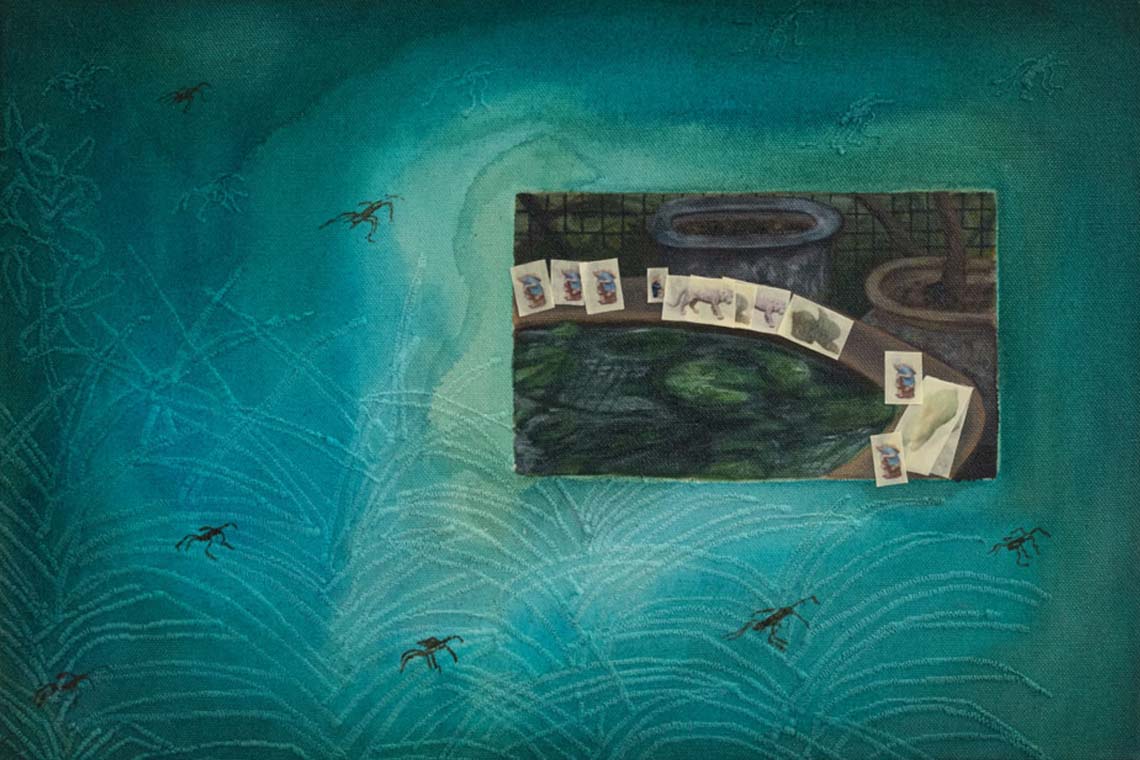
Intimacy reigns, but where it appears gentle, it also brings to mind something more instinctual and perhaps even primal in human nature – the face that is not always shown to the world. There is a recurring sense of the natural world encroaching onto the human psyche, as in A Canopy Nevertheless (2025) by Fiza Khatri, where a shadowy plant hovers over a woman gently resting with her eyes closed, maybe even slowly taking her over. The sense of the wild creeping in is pervasive, like the crawling spiders in Leily Moghtader Mojdehi’s turquoise painting, rearing its feral head in the form of a canine in That took way too long (2025) by Shivangi Kalra and taking over entirely in Fantasies of persuasion (2026) by Noorain Inam. In the long painting directly under the skylights, little fires punctuate a colourful melee of galloping horses on a dark background, the animals going every which way until they appear almost in motion on the static canvas.
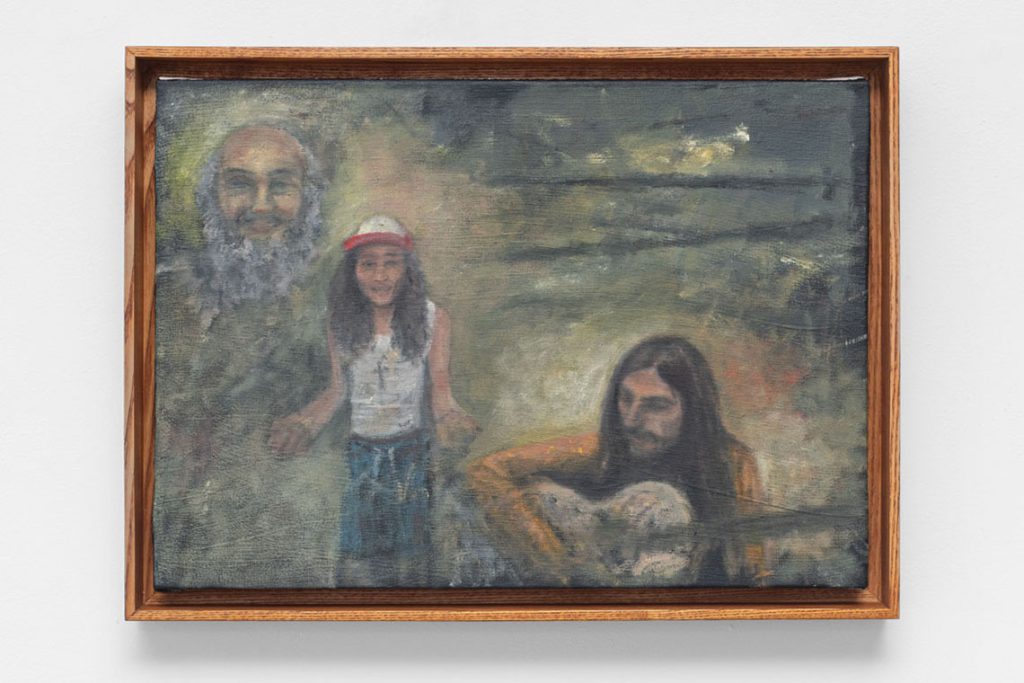
Most impactful, however, is Lulua Alyahya’s Not without compassion (2026). The small oil-on-canvas depicts three men. The first, fading into the upper left-hand corner of the canvas, has grey hair, a scraggly beard and a beatific expression. The second appears young, maybe even a teenager, in a pair of denim trousers with a white wife-beater vest, trucker hat and long necklace with a cross dangling on the end as he shrugs his shoulders while looking outward. The last man sits in the lower right corner, strumming a guitar, seemingly nonchalant and with an impressive moustache that complements the omnipresent long hair. Here, we truly feel this “diaphanous” quality, not just in the almost wispy execution of the piece but also as we understand that these three men must be one and the same, at different stages in life. The threshold between them feels tenuous, as though just behind the old man’s eyes are the midlife hippie and the rebellious boy, screened by the gossamer veil between these stages of life.
